

By
Álvaro De Benito
We spoke with Seba Calfuqueo about her first institutional exhibition in Europe, at the Museo Thyssen-Bornemisza in Madrid, a show that delves into the relationship with territory through history and identity, from a heterogeneous and contemporary perspective.
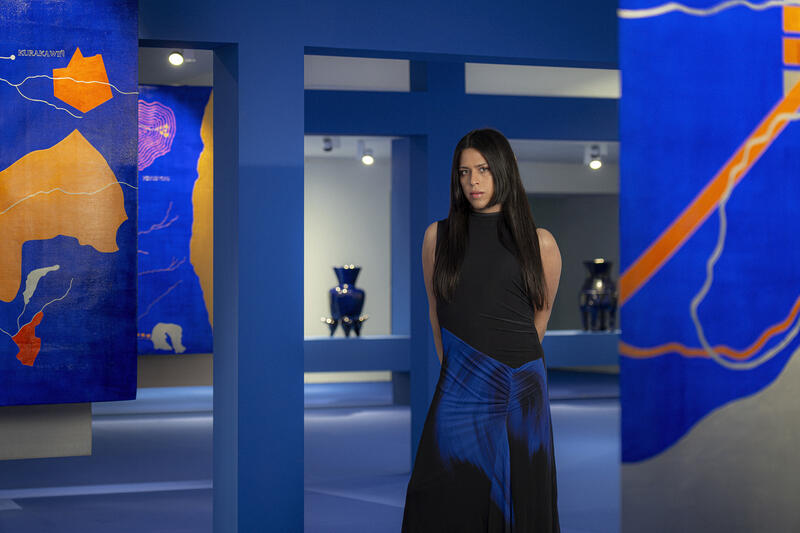
Seba Calfuqueo (Santiago, Chile, 1991) presents Cautín at the Museo Thyssen-Bornemisza, a brilliant exhibition in which history, Mapuche identity, and the Wall-Mapu (the "surrounding territory") are interwoven with a perspective shaped by urban life, hybridity, and family memory. With more than thirty new works, the artist questions Western perspectives and homogeneous representations of the Indigenous, incorporating her personal experience and recovering little-known chronicles as part of the reconstruction of a memory marked by colonial violence. We talked with her about her vision of art and about the creative process behind an exhibition in which the Cautín River becomes the central axis and which reflects the idiosyncrasy of her artistic proposal.
Álvaro de Benito [Á.B.]: The exhibition you are presenting at the Thyssen brings together, in a way, your community and your origins with the fact of having grown up in a city. You have said on occasion that you start from a position close to your roots, but a "contaminated" one. What weighs more when building your artistic language? At what point do you feel that root becomes most powerful?
Seba Calfuqueo [S.C.]: We have to understand that the Mapuche world is also a very urban world. The largest population is in Santiago, where many of us identify as Mapuche. For me, growing up in the city as an Indigenous person was very complex, because thirty years ago the racism was brutal. Having an Indigenous surname, grandparents who didn't speak Spanish well, and still being treated as a stereotype because of prejudice and racism made me grow up always as an "other." From school I felt that rejection, and there were very violent notions around how my childhood and adolescence were shaped by being an Indigenous person.
Á.B.: And how did that experience of growing up in the city carry over into your relationship with your own family and with the territory?
S.C.: I grew up in both contexts. My mother, who was Chilean, was taken in by my grandmother's family after my grandfather threw her out of the house when she got pregnant with me. I grew up with that Mapuche family, in a very matriarchal environment and very close to her, who was fundamental in passing on my identity. She was the only one in her family who lived in the city, and her house was a meeting place for relatives who came from the community. There, our language and our practices coexisted with urban life, while in the territory other ways of life and relating were maintained. So I grew up in a Mapuche, matriarchal family, as opposed to a much more patriarchal and violent Chilean family.
Á.B.: From a European perspective, when someone approaches this exhibition, it's easy for the gaze to go toward what they identify as Indigenous (the patterns, the textiles, certain visual codes) and for the urban side to recede into the background. Are you interested in reinforcing that difference?
S.C.: No, I'm interested in the opposite. I want to blow up established ideas about Indigeneity, because they are often based on racist, stereotyped, and colonial readings of what agency Indigenous people have and from what place they should speak. That's why I use video animation, technology, and synthetic hair, elements that go beyond my Indigenous self and also relate to other intersections of my identity, such as my gender, being a trans person, and my aesthetic fascinations.
Á.B.: How do all those elements that make up your identity and those aesthetic attractions relate to the place from which you build your work?
S.C.: I'm a Mapuche person, but I'm not a leader or a spokesperson for my community. I try to create an imaginary related to my origin and my place, but shaped by my own experience and by everything that makes me who I am. That's why I speak of a "contaminated" exhibition, with references and connections that don't respond to the traditional Indigenous narrative built by the Western art world. I feel that this is somewhat my place: putting an end to those structures and questioning the gaze that "exoticizes" the Indigenous. It's very easy to fall into that "exoticization" when an Indigenous person is expected to reproduce certain rites or images to explain a reality they haven't necessarily lived. My generation of artists is trying precisely to break with that.
Á.B.: In the face of a gaze that expects to find certain codes or hackneyed, homogeneous forms of representation, what are you interested in claiming or bringing to the foreground from your own experience?
S.C.: For me it's much more important to talk about all that contamination, that web that makes me who I am: a person who inhabits the city, speaks from where they come from, organizes collectively, and works in connection with other Indigenous people.
Á.B.: All of that ultimately comes back to the concept of hybridity that you often mention. That is, it's not only racial hybridity or geographic hybridity, but there are also many facets within that concept.
S.C.: In a way, the idea of hybridity is also a way of escaping a bit from the idea of mestizaje (cultural mixing). For me, mestizaje is a very violent concept that assumes the forces of connection between the Indigenous world and the colonial world were neutral and horizontal, and that is not the case at all. María Galindo has a concept that I really like, "bastardaje," which says that we are the product of a systematic violence that has made our histories what they are.
Á.B.: What does it mean for you to move away from that idea of mestizaje, and why do you consider it important to question it when you talk about your own history and that of your people?
S.C.: The most violent part of all this is that the Mapuche people resisted Spanish colonization and were recognized as an autonomous territory by the Crown in the 16th century. Later, in the late 19th century, Chile and Argentina carried out colonial campaigns, and my grandparents were among those who had to migrate. It's a history of less than a hundred years and, being so close to my family history, I can't distance myself from the suffering and violence my grandparents lived through.
Á.B.: You have frequently raised issues that correct certain colonial narratives, especially regarding the Araucanía and the Chilean campaigns of the 19th century, and you have also shown the role of women and the strength of matriarchy in Mapuche society. Have you encountered problems or barriers when explaining these issues in the face of Western discourses that present a mistaken view, almost by default?
S.C.: Yes, because they're not used to having that racial stereotype handed back to them the way they expect. The Western world expects me to behave a certain way, and I'm interested in the opposite. I'm interested in using technology because I live in a contemporary world, and I don't want a cultural appropriator coming in to make a work about the Indigenous world through technology. I'd rather use those tools myself and create those media myself. And performance has that sense too: it's embodying, in body and presence, a past of violence that is still present and still inflicts violence on many people.
Á.B.: Starting from that idea of hybridity and all the references running through your work, I wonder whether there is a risk that your work might generate rejection within certain circles of your own community, precisely for moving away from certain ways of understanding or representing the Indigenous.
S.C.: I feel that my reception in the Mapuche world is quite good, because I have also been very careful to work around history. Many of my works, especially my early ones, have to do with compiling archives that weren't very visible. So I think that, in some way, this also leads my production to be considered serious work, one that doesn't go to such violent extremes but works more directly on how history has been constructed and how the archive is evidence that trans and dissident people existed, that there were other forms of bodily expression, that women had a different role in my community.
Á.B.: How important is the archive to you in that reconstruction of memory and in recovering memories or chronicles that have been left out of official narratives?
S.C.: It's about building through memory and through oral and written archives, above all those of Jesuit and Capuchin priests, Spanish and Italian, who did not colonize the territory but did evangelize it. They introduced ideas that can be reproduced in our environment today, such as patriarchal or discriminatory attitudes, but that don't represent the community as a whole. The Mapuche world is very diverse: there are those who defend radical autonomy and also people who are right-wing, so it can't be categorized in just one way.
Á.B.: In the end, a community is made up of people with different ideologies and interests, ways and experiences that go beyond that unitary concept. How does that diversity influence the way you understand it?
S.C.: This happens to me a lot in the art world: when I meet a curator I tell them to go to Santiago, to get to know Chile. They can't work only with the ideas of the people they know or with the references they have; they have to go to Chile and learn its history. Chile is a country built through a neoliberal experiment from the United States, not only since the dictatorship but since the early 20th century and before, through other colonial projects. And it's obvious that when you go, you realize other things are happening. If you look at that, you realize that many Mapuche communities hold their ceremonies in the city and that there is a political articulation among those collectives.
Á.B.: In that sense, you are perhaps one of the first Chilean artists exhibiting in Europe and North America who still lives in Chile. Being closer to reality, in the end, gives your language and your discourse a stronger connection to what is really happening, and keeps it from being distant from what is being felt.
S.C.: It has been striking how the history and narrative of Chilean art have been built outside Chile. It's very evident that Indigenous people have not existed in those representations, much less people who don't come from an elite background. That is very violent. Their surnames are, generally, those of very powerful families, settlers too, who have built their narrative around this idea of what Chile was. I was born in a democracy under a constitution created by a dictator, but the Chile of the 1970s is not the Chile of today, where everything is privatized and the consequences of that dictatorship are still present, as with the issue of water, for example.
Á.B.: What does it mean to you that this exhibition is taking place in Europe?
S.C.: It's a huge opportunity, but not only for me, also for a new generation of artists who were not supported by established artists. No older artist introduced me to any curator, any museum, any institution. I've built everything myself with my friends, my community, and my people. And that sets a radical reference for how things are done and from where one speaks, too. For me there is no possibility of leaving Chile now.
Á.B.: In the recently created works that make up this show, you continue to use different techniques, such as ceramics, embroidery, or painting, and it seems each one relates to different elements of the territory. Do you feel that each element of the ecosystem finds a distinct form of expression in your work?
S.C.: I'm interested in thinking about what relationship the viewer will have with my work. I define all the materials I use as "travestis": materials that feign, simulate, deceive, cross-dress, or make up another element. I don't work with traditional materials. The ceramics have luster, a very toxic lead component that produces a shine related to the glint in the Mapuche world, but that is neither organic nor natural: it's like life itself, exposed to constant processes of contamination. The synthetic hair comes from wigs that I take apart and from my own history with hair, from having grown up in men's spaces where wearing extensions was always a problem. These materialities come from my experience, not from an origin in my community as such.
Á.B.: How do you decide which material to use in each work, and what relationship do you seek to establish with the viewer through that choice?
S.C.: What I do is hybridize what makes me who I am, and the different techniques allow the viewer to approach the works in different ways. If I want something more narrative, I use video; if I want something more bodily, hair, because it can produce repulsion or, on the contrary, a desire to touch and comb it. These are techniques I've developed throughout my practice and that now, for the first time, I can deploy together, also responding to my multiple interests as a person.
Á.B.: In underscoring the symbolic importance of territory, I'm interested to know whether you conceive of a single true way of encompassing or interpreting it.
S.C.: No, no, not at all. Cautín doesn't try to speak for the river. What I did in this exhibition was travel through a territory that is my family's, a river to which I have been connected throughout my life. My video performances and most important works were made in that watercourse.
Á.B.: And what does it mean for you to travel the Cautín after so many years of relationship with it?
S.C.: It's like the closing of a long process of conversation with that river. I don't know if it will really be an end, because I may keep making works with the Cautín. For me, what mattered was generating a narrative that accounted for the journey and my experience of inhabiting and traveling it, rather than saying that it is a human subject that has rights. I'm not going to speak for the river: it speaks on its own, and the species are the ones who are there accompanying me on this journey.
Seba Calfuqueo. Cautín can be seen until January 17, 2027, at the Museo Nacional Thyssen-Bornemisza, Paseo del Prado, 8, Madrid (Spain).
A conversation with the curator of the 37th Ljubljana Biennale of Graphic Arts on navigating biennial management within a turbulent global landscape, detailing his collaborative, site-responsive project exploring expanded printmaking for the 2027 edition.
Interview with Cecilia Vicuña