By
Álvaro De Benito
Interview with Cecilia Vicuña
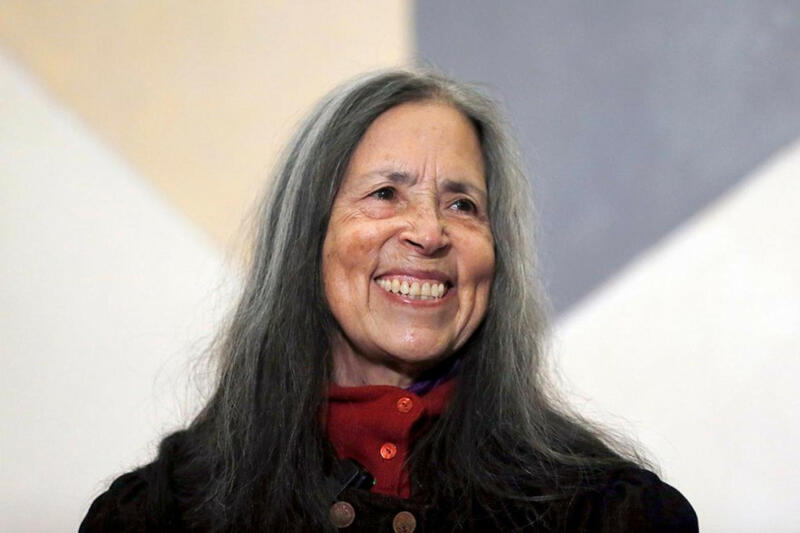
Cecilia Vicuña (Santiago, Chile, 1948), recognized as one of the most indispensable voices in contemporary Latin American art, is experiencing a moment of maximum international visibility, with an appreciation of her work that has led to a program of solo exhibitions that have enabled audiences to access a language of ritual and tradition. In Madrid, she will take part in the XIV Ídem Festival, at La Casa Encendida. There she will premiere her collective ritual Lavar nos and perform, together with Colombian musician Ricardo Gallo, Niebla y aliento, a performative concert accompanying the release of the album Tejiendo nubes contra la muerte. Her presence in Spain also anticipates the major event in October with Living Threads, her first major retrospective in the United Kingdom, organized by the Whitechapel Gallery. We spoke with the artist about the poetics that inhabit the visual arts, the different languages of her work, and the continuing relevance of ancestral thought in a world marked by contradictions.
Álvaro de Benito: There is something about working across disciplines that allows one to encompass different languages and forms of production, and perhaps also to feel protected within them. It may also allow that opposing discomfort to be channeled as a creative impulse. Of the techniques you work with, in which do you feel most comfortable?
Cecilia Vicuña: Comfort and art are not connected. If you embark on an expedition to Antarctica, the word comfort does not figure. That is what art is like. Art and poetry are something into which you venture into the unknown and, for that reason, what is beautiful about them is that there is no comfort.
When you speak of this adventure into the unknown, you also begin from a prior body of knowledge, in many cases ancestral, and connected to your own identity. How is this body of knowledge transferred into that uncertainty?
The uncertain and the unknown do not imply a lack of knowledge. I have opened up the word to know, which in Spanish means “to be with.” So, between not knowing and knowing there is a porous and transformative territory. It is not one or the other. All ancestral knowledge is within all of us. But the question is to attune oneself to it. That is, to stop and listen, to feel.
When making that connection, there may perhaps be territories and environments more conducive to it than others. How can this question be understood, for example, in relation to distance, to being far from that physical root or space, while continuing to generate that knowledge?
There is no physical space that is truly and completely physical. That kind of connection with that way of feeling exists at all times and in all places. And you can also lose it at any time and in any place. That is why I emphasize the word attunement, although it is a term more commonly used for radio. Perhaps our being is a form of reception. You receive according to your heart; your attention, your deepest desire, is what guides you.
Lavar Nos, the ritual that is going to take place in Lavapiés, could it be valid in another place? Or is that imprinting precisely part of thinking about something specific?
Of course, all places have something that is specific. When one performs a ritual, one does it precisely for that place and from that moment.
I understand that the same answer could also apply to a much more institutional environment such as a museum. In October you will inaugurate an exhibition at the Whitechapel Gallery in London, where another type of concept and language emerges. Does the open space or enclosed space condition that dialogue?
Undoubtedly. It is very different to be somewhere where it rains. For example, I have just performed two major rituals in Valdivia, one of them with everyone putting their feet in the water and mud, and another in the rain, inside a rain forest. So that, of course, completely changes the nature of the encounter, the nature of what is experienced. And the same thing happens in places.
Each place has its own charge, its own energy, which comes from everything that has been lived in that place. And that is fantastic because even this very table where we are sitting has that as well.
t may be that the transmission of knowledge, of the expression present in your work, is a journey completed through the understanding of the spectator, but it may also not be understood. Can the work be completed without that perception taking place?
There are many ways of completing a work. For example, one of my works of precarious art can be completed when it dissolves, when it disappears, when the sea swallows it, when the wind undoes it. That is also a way of completing it. As for whether it is understood or not, I do not know whether understanding is completion. Understanding may perhaps be the beginning.
The poetic dimension within the artistic language of the visual arts, to use a general term, is transformed into something that goes beyond the letter. But, in your conception, it may have a different process or begin with poetry. When you conceive a more visual work, what permeates what?
It always begins with poetry. Poetry is the foundation. There is no separation between this being poetry and that being art. It is a way of categorizing experience here according to Western premises. In the ancestral cultures of the entire planet there is a fluidity, an interpenetration of all these forms, but the foundation is always poetry.
Does every object have a soul?
Every object has a soul, why not?
You live in New York, an environment that at first sight seems quite far removed from what might perhaps represent that root, that ritual and spiritual dimension. How do you feel in such a commercial environment as the world of the art industry, in a city like New York, with everything that it represents and what might impact your philosophy?
Well, all of that is real and all of that is evident, but that is not the only New York. New York is also Indigenous territory; it is also ancestral Lenape territory. The name Manhattan is Lenape, meaning “land of hills”, and when I walk around the island, I feel those hills. Between my home and my studio there are two small hills, so I go up and down them. I connect not only with what is above, that is, with the cement upwards, but I also connect with what is beneath the cement, with the light, with the sun, the wind, the river that is there. In other words, there is still an intense presence of the living in industrialized and commercialized spaces.
What did an exhibition as radical as receiving the recognition of the Venice Biennale represent for you, a Biennale that has practically become a reflection of the geopolitical? I do not know whether it can come to be experienced as a burden…
I imagine that for some it could be a burden, but for me it is not. I find it quite the opposite; it seems to me like a mystery or a miracle that a Golden Lion could be given to a person like me. Do you see? I remember the moment when that happened and for me it was an explosion of happiness, as if I had jumped like a rocket to the moon, because it was the feeling that it was an Amerindian recognition. I am a little person, but in reality, what carries me like a wave is that millennia-old culture. That is what I felt, that it was for that culture, not for me.
In the evolution of this century, the quipu may come to represent a medium, an end, or an essence in itself. What does the quipu represent today and what place does it occupy within your artistic language?
It represents a way of feeling and knowing suppressed through violence, suppressed through colonization. So, despite the fact that the quipu was prohibited and that all the wise men and women who worked with the quipu were killed, the quipu did not die. For me, the fact that the quipu continues to manifest itself is like saying that life continues. It is like the threat of extinction that humanity is now facing. I attune my life, my being, my dreaming, my breathing. Life has to continue.
In recent years, there has been a historiographical resurgence of the quipu and a recognition—and that of textiles in general—by Western art institutions. Do you think this fact could come to be considered a whitewashing or a concealed form of redemption in light of the persecution you mentioned?
They can be both things. One does not exclude the other. On the one hand, they may see that textiles are fundamental to human culture and that, without textiles, for example, there would be no architecture. Look, the words “text,” “textile,” and “architecture” share the same roots. So, valuing that is fundamental. Is it a use and an abuse of commodification? Of course, but what is not commodified in this universe in which we now live?
In the 1980s, you went out into the street and asked people, “What is poetry?” What will be your answer now?
Well, I would like to involve Ricardo Gallo in this answer, as he is here with us. I went out into the streets in Bogotá, a city that I loved and continue to love. Ricardo, who is my partner in the musical creation that we are going to present in Madrid, was two years old at the time. For me, it is something absolutely extraordinary that a child existed at that moment, while I was going out into the streets asking policemen and prostitutes from all over the world what poetry was. Ricardo and his music embody poetry.
Taking advantage of his presence, Ricardo, I would like to know from your point of view what the imprint of Cecilia Vicuña’s work entails in that musical translation. Is it a process that you undertake in order to translate, or is it simply collaborative work?
Ricardo Gallo: It is always collaborative work and it begins with poetry. What struck me from the beginning is that the dimension of the sound of poetry is very important, and it is that materiality that, suddenly, you can see. With Cecilia, the sonic dimension of poetry is also very evident; it is part of everything that is being said. And that is where we connect and where this conjunction of dimensions emerges at a specific moment, the meanings, the messages. Also, as Cecilia said earlier, everything is for a specific moment and place.
The XIV Ídem Festival runs until 25 September 2026 at La Casa Encendida, Ronda de Valencia, 2, Madrid (Spain). For its part, Cecilia Vicuña: Living Threads opens on 7 October at the Whitechapel Gallery, 77–82 Whitechapel High St, London (United Kingdom).

An Interview with La Chola Poblete