
By
Álvaro De Benito
We spoke with Daniel Vega, director of Faro Santander, to address the cultural strategy of the center, its commitment to territorial engagement, and the controversy surrounding the Gelman Collection, which anchors one of its inaugural exhibitions.
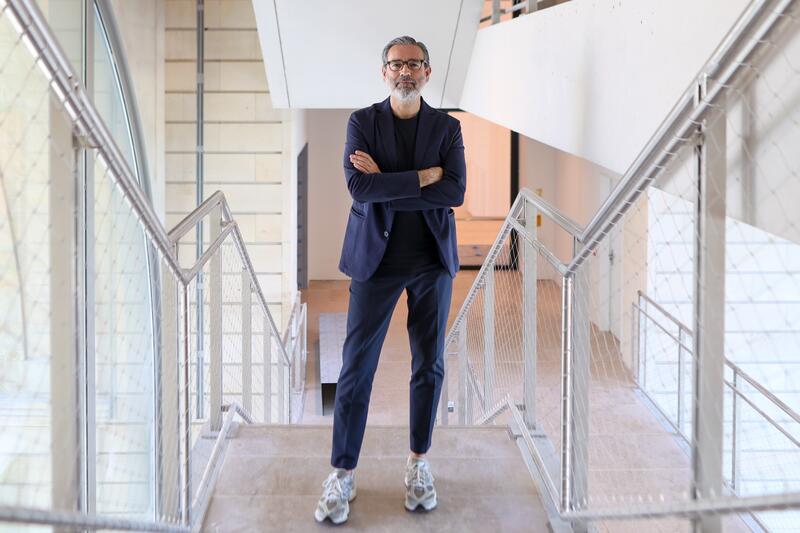
Daniel Vega (Bilbao, Spain, 1971) directs Faro Santander, the cultural institution of Fundación Banco Santander opened to the public in the Cantabrian capital in late summer with the aim of positioning itself as a benchmark in the city. To achieve this, its strategic lines rely on a strong territorial vocation, prioritizing Cantabria, alongside programming open to interaction and of ambitious scope. The opening of the center has also been marked by controversy surrounding the Gelman Collection, featured in Modern Mexico in the Gelman Santander Collection, which, together with Symptomatic Surrealism: Leonora Carrington and Masterpieces from the Banco Santander Collection, constitutes the initial exhibition program. The director receives us in Santander to discuss his management lines, the objectives of the center, and the controversy regarding the exhibition of part of one of the most relevant collections of modern Mexican art.
Álvaro de Benito [Á.B.]: Faro Santander is the latest proposal integrated into the cultural fabric of Santander, a medium-sized city marked by the presence of consolidated institutions and the arrival of new museum projects. What singularity does it aspire to contribute to the cultural landscape of Santander?
Daniel Vega [D.V.]: Since our arrival, we have wanted to remain conscious of what already exists in Santander and of the projects yet to arrive, such as the Reina Sofía and the Lafuente archive. We understand that our proposal must be complementary to the activity of institutions such as the Centro Botín, the Port Authority, or the MAS, which carry out significant cultural work in the city. Our differential character resides in several elements. We possess the Santander collection, a fine arts collection that allows us to offer the scale of a major museum, a space dedicated to art and technology, and an entire floor designed for visitor participation, something that is uncommon in many museum projects. Added to this is the ambition to organize major exhibitions with a chronological and thematic breadth made possible by our collection.
Á.B.: You mention the relevance of the Santander collection as one of Faro’s main assets. What exhibition and research trajectory is planned for the coming years, and how can such an extensive holding be transformed into a proposal capable of connecting with diverse audiences and generating new readings?
D.V.: The collection will always be present at Faro Santander, especially on the fourth floor, which due to its dimensions allows for ambitious proposals. The inaugural exhibition brings together 70 works selected by Lola Jiménez Blanco, a great connoisseur of the collection, based on four axes: landscape, portrait, still life, and sacred narratives and spirituality. It is a subjective selection, conceived to bring the collection closer to the public, spanning from the Renaissance to contemporary art. We are speaking of a set of more than 1,200 paintings and sculptures, not counting prints and graphic works. Our intention is to present it dynamically over the coming years through chronological itineraries, dialogues with other works and collections, and exhibitions centered on artists who have a sufficiently relevant representation to feature in dedicated proposals.
Á.B.: Faro Santander originates from Fundación Banco Santander and works with a collection belonging to the bank itself. How is that relationship between ownership and funding articulated? To what extent does the connection with Banco Santander condition the cultural strategy of Faro and the presentation of its collection?
D.V.: Not at all. Faro Santander is the flagship cultural project of Fundación Banco Santander, linked to the bank. The collection we present belongs to Banco Santander, whose stewardship and management are entrusted to the Foundation, but the strategy, vision, and content design are our responsibility. That connection should not generate dependence in how the collection is presented. We can, of course, incorporate elements related to the history of the bank and its environment, as we do in the Cubo, where we work with contemporary artists to address the shared memory of the bank and the city. Furthermore, the collection is actually an aggregation of corporate collections, incorporated in many cases through the acquisition or absorption of other banking entities. Our current challenge is to give meaning to that ensemble and develop a future strategy.
Á.B.: Logically, the name Santander as a financial entity and as a foundation evokes a very strong localism, rooted in and with the city, and I would like to know to what extent that affects the strategy of Faro Santander.
D.V.: We have a clear vocation to root ourselves in the territory and to become a place where the people of Santander and Cantabria want to come. We also aspire to attract visitors from elsewhere, as well as tourists and international audiences, but our priority is to be relevant to the territory. If there is a perspective that defines our project, it is Cantabria. The programming is articulated across five axes: the collection, temporary exhibitions, the Cubo, the Marisma—linked to the Cantabrian cultural fabric and with free access—and Llamita, a space for creative exploration in childhood. Several of these spaces are designed to encourage local participation through programs that activate the regional audience. The Cubo also responds to this perspective: its inaugural proposal addresses the history of the building, the bank, and Santander since the creation of the entity, as does the current exhibition Symptomatic Surrealism, which incorporates the history of Leonora Carrington when she spent four months in the city in 1940.
Á.B.: It is curious, because it seems to run counter to the policies of many cultural agents who focus more on international expansion. Does this commitment to the territory represent an alternative to the growing internationalization of cultural institutions?
D.V.: We do not intend to renounce the international dimension, but rather to develop our proposal by leveraging the diversity of spaces and the breadth of programming. We will organize ambitious temporary exhibitions and work with international artists to activate some of our spaces. In fact, we are already holding conversations and preparing programs for the coming years. However, we will never lose sight of the territory. We want everything that has relevance, that allows for collaborations, or that possesses a special meaning for Cantabria to find a place at Faro Santander. The international dimension and local grounding are not incompatible objectives, but rather aspects that we want to integrate into the same project.
Á.B.: The fact of having launched the project with two collections, the Santander and the Gelman Santander, which constitute the two main inaugural exhibitions, raises a question. What parallel can be drawn from a curatorial perspective, or at least from a management perspective?
D.V.: We wanted to grant importance to both collections at this inaugural moment, presenting the Gelman Collection as a temporary exhibition with its own entity. The Santander collection will continue to occupy the fourth floor, and in the future, both collections could be shown jointly, integrating works from both. For now, we have chosen to keep them separate to give each its due importance and to maintain the continuity of the exhibition approach with which the Gelman Collection was presented at the Museo de Arte Moderno in Mexico under the curatorship of Marisol Argüelles.
Á.B.: Was it not a risky move to open with the Gelman Collection, given the controversy that its arrival at Faro Santander could generate?
D.V.: Risky? Well, the world belongs a bit to the brave. What cannot happen is that others dictate your program. As you can imagine, the decision to reach an agreement with the owners of the Gelman Collection, from the Foundation and from the bank, is closely linked to this project and to the ambition of this project. At no point have we wanted to look back. The great moment for us has arrived: to finally have the collection here, to let it speak for itself, to share its narratives, its stories, its marvelous works, and for the public to enjoy them. We are delighted that the collection is finally at Faro Santander.
Á.B.: And do you understand the controversy that has arisen around the collection and the criticisms regarding its management and ownership?
D.V.: I understand the commotion and, above all, the perspective that a certain sector may hold, although we do not know to what extent it is due to people reading very quickly, reading between the lines, or because the writer is not interested in objectively recounting everything there is. We have been very transparent from minute one regarding the fact that we reached an agreement with the owners and another agreement with INBAL, because, evidently, this collection has a significant number of works that are artistic monuments, and this requires their oversight. It is a matter that involves, on one hand, the monuments aspect, and on the other, customs legislation.
Á.B.: Opacity in everything related to its transfer has also been pointed out from various fronts.
D.V.: From minute one we have shared with clarity what we came to do, what our purpose is, and the interest we have in managing, exhibiting, conserving, and researching this collection. There is a great deal to do. I believe a confusion has been generated, intentionally or not, between the feeling that this is a collection of such high quality that it is perceived as if it were national heritage and the fact that it is private property, not public property. Therein lies a massive misunderstanding. It is private property of incredible relevance, to the point that it is perceived as heritage belonging to all Mexicans—which it is in terms of cultural heritage—and some works enjoy a special degree of protection. But it is private property, and from our perspective, the aim is for it to be conserved, researched, and presented with the highest possible quality. Above all, we want to prevent it from being fragmented, as we all know it has been at risk of being, or remaining hidden from the public for years.
Á.B.: However, the temporary export permits and the 2028 horizon revealed by some parties raise questions about the available timeframes. What real margin exists to conduct rigorous research before the planned management period concludes?
D.V.: I do not see why it would not be possible. What the law states is not that it must return in 2028, but that the maximum temporary export period that can be requested is one year. That is what the law says. That maximum temporary export period can be extended, and the maximum additional temporary export period is another year. Exceptionally, an additional permit can be requested. This is what the law says. The law does not say that the work must return in 2028. We said that ourselves, but it is subject, obviously, to the relevant permits and authorizations from INBAL. We consider that there is time to research and publish on the collection. We have already presented our first publication and organized several public conversations within our programs, and there will be more initiatives. During the management period agreed upon with the owners, always respecting current regulations, we will have many opportunities to develop relevant work for the collection.
Á.B.: There is a question surrounding the designation "Gelman Santander Collection" in that it evokes commercial and sponsorship activities in its nomenclature, which may give further arguments to those who view it as an exclusively commercial and financial maneuver.
D.V.: The reason is that the Gelman Collection is a collection of 92 works assembled by Jacques and Natasha Gelman. The collection that continues to be called Gelman, until a few years ago, contained nearly 400 works. Those are the works that Robert Littman, executor for over twenty years, incorporated with great criteria. All the drawings currently in the Gelman Santander Collection are not drawings from the original Gelman Collection, but drawings acquired subsequently by Robert Littman. To give an example, all the drawings by Frida Kahlo. Of that entire collection created by Littman, the current owners sold a portion, and we have incorporated only a specific portion into our management. That portion, which consists of 161 works, is what we call the Gelman Santander Collection. It is a matter of precision, clarity, and avoiding confusion.
Á.B.: But it opens the door to that interpretation—that of a brand strategy linked to Banco Santander...
D.V.: To give you an idea, among the 161 works under our management, the majority were not in the original Gelman Collection. It is not a minority, but a majority of the works. Does that lessen or add value to them? We selected the works under our management purely based on artistic criteria. They appeared to us to be the best possible works. Why are some from the Semilla Collection not present, for example? Because some works from the Semilla collection remain the property of Robert Littman, to give an example, while others were sold.
Á.B.: In the end, I believe there is a media focus, justified or not, regarding the perspective of when a banking institution enters the equation. Dynamics emerge there about which one might question what will happen in the future, as the collection could be considered a financial asset.
D.V.: I do not even need to say it, because it is already published, but that collection is functioning as collateral for a loan. But we did not invent this. That is how the art market works. In fact, what the bank has done is guarantee an operation that was encountering difficulties. Behind this was Sotheby's, and what the bank is making possible, thanks to the management agreement reached and the financing provided by the bank, is for the collection to remain together.
Á.B.: What comes into play here, then, are two opposing views. To what extent has contemporary art ceased to be a cultural and personal expression to become a tool of economic and geopolitical power?
D.V.: Well, what I can tell you is that I disagree that this is a defining mark of contemporary art. I believe art has always belonged to elites, art has always been a tool of power, and major artists have always been close to money. Kings had it, popes had it... This is not a novelty of contemporary art: art has always been this way.
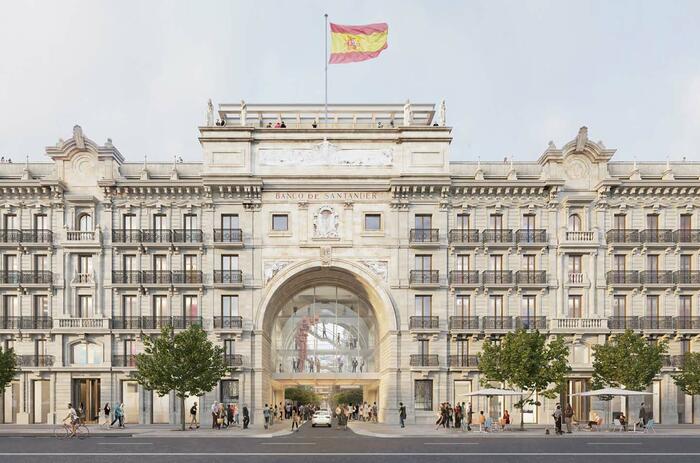
The citizens' movement challenges the legality of an agreement authorizing the works to remain abroad until at least September 2030, in contradiction with existing legislation on the protection of artistic heritage.
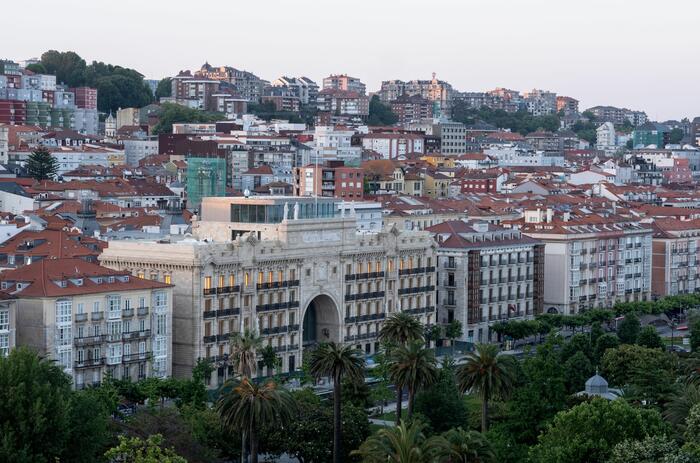
The new center opens its doors with exhibitions devoted to the Gelman Collection and Mexican art, another exploring Leonora Carrington’s connection with Santander, and a third featuring a selection of masterpieces from the Banco Santander Collection.
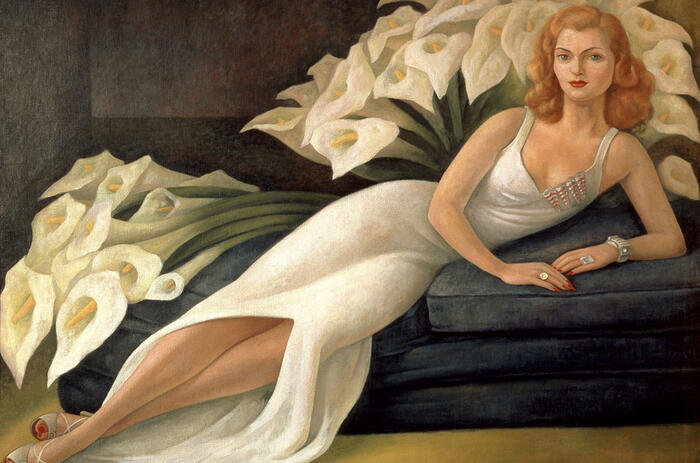
The current controversy highlights the difficult coexistence between the collection’s private ownership and the heritage protection that covers part of its works.