
THE MEANING OF THE WAVE IN DIANGO HERNÁNDEZ
Casado Santapau programs El fin, el mar (The End, The Sea), which is Diango Hernández’s (Sancti Spíritus, Cuba, 1970) fourth exhibition at the gallery, presents a new body of work that expands and evolves his artistic practice. The exhibition features several works using different techniques, all of which echo the sobriety of undulating lines. Within this theme, which forms the backbone of the exhibition, two acrylics on canvas are displayed alongside a group of pieces that emphasize the minimalism of the wave’s gesture.
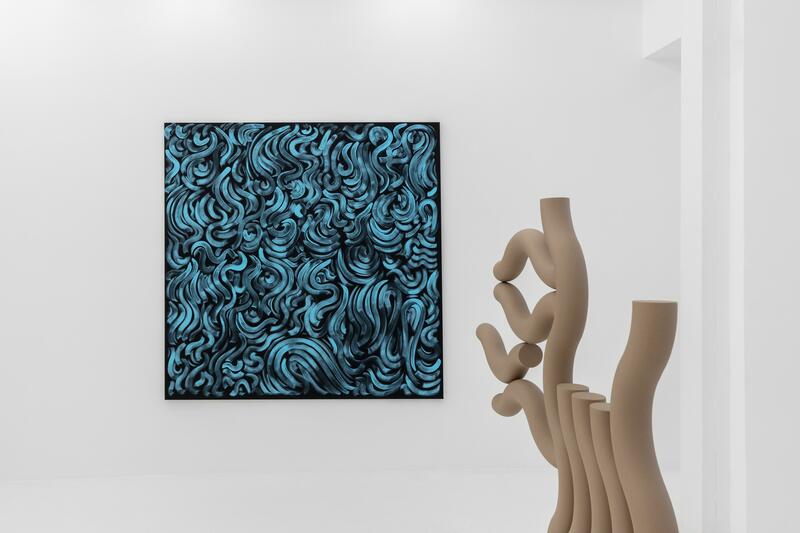
Close to a certain abstract geometry, but avoiding the rigidity of straight lines, the works move between surface tension and the precision of their coexistence with space. Hernández thus progresses in what he himself has come to call olaísmo—a way of inhabiting painting in which rhythm and cadence take precedence over concepts such as method or narrative construction.
These waves therefore move away from maritime imagery to become, in themselves, objects of beautiful simplicity that, almost unintentionally, manage temporality and tranquility. In short, El fin, el mar is a fairly explicit title. It does not refer to a place or a natural form, but rather to the forms and fragile memory that the works presented seem to convey. The curves are far from static and assert themselves with slowed-down dynamism, turning the exhibition into a proposal that immerses the viewer in the importance of the essential.
El fin, el mar can be seen until July 25 at Casado Santapau, Piamonte 10, Madrid (Spain).
May interest you
RITE AND SYNCRETISM IN THE DIALOGUE OF CALDERIUS AT THE CAAC
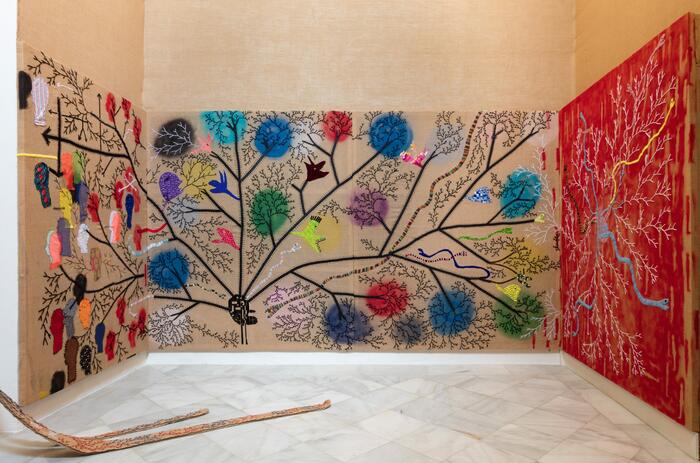
The Andalusian Center of Contemporary Art (CAAC) presents Sensemayá. Cánticos para matar a la Culebra (Sensemaya. Chants to kill the snake), the first solo institutional exhibition in Spain by Claribel Calderius (Havana, Cuba, 1986). Conceived specifically for the San Bruno Chapel, the project is a site-specific intervention that draws on the space’s historical and spiritual resonance—qualities that align seamlessly with the symbolic universe of the Cuban artist.
A GAZE INTO SALVADORAN AUDIOVISUAL ART AT THE REINA SOFÍA
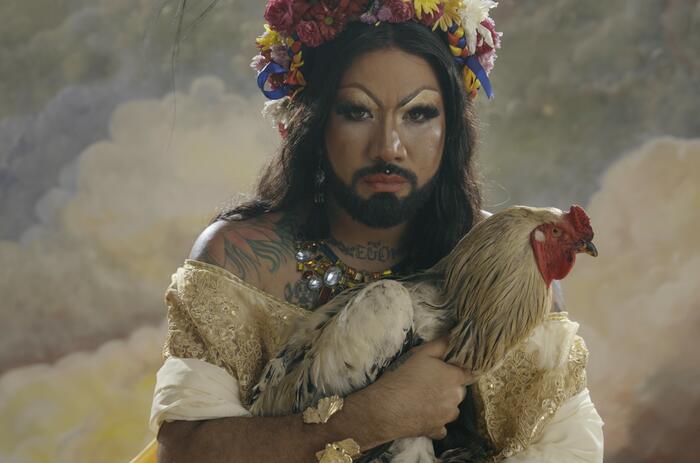
From June 19 to 28, Madrid’s Reina Sofía Museum will host Los reyes de la página roja (The Kings of the Red Page), a program dedicated to contemporary audiovisual productions from El Salvador. Part of the series Other Visions of Central America, this selection has been curated by Salvadoran artist Patricio Majano, this year’s resident at the Instituto Cáder de Arte Centroamericano—an initiative promoted by the Reina Sofía Museum Foundation and the museum itself to support research and dissemination of Central American art.
ART, COMMUNITY, AND ECOLOGY IN THE MYSTICISM OF THE JAGUAR, AT THE MUSEUM OF AMERICA
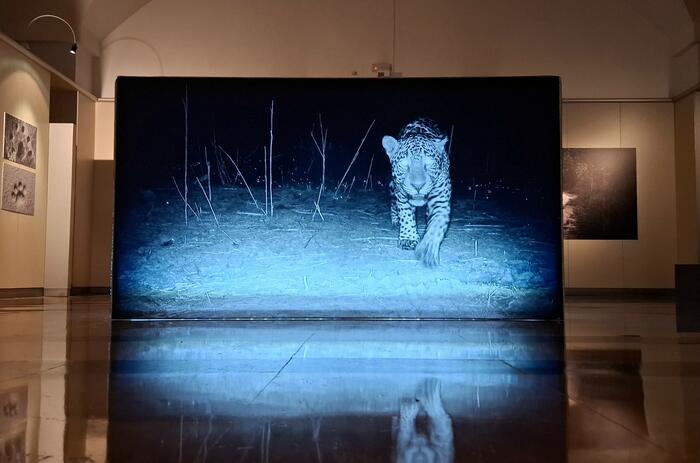
The Museum of America in Madrid is hosting El sueño del jaguar (The Dream of the Jaguar), an exhibition curated by visual artist Fredi Casco (Asunción, Paraguay, 1967) and photographer Fernando Allen (Asunción, Paraguay, 1957), which brings together artistic, ethnographic, and scientific perspectives on the jaguar and its symbolic and ecological significance.