
By
Violeta Méndez
Malba presents the most comprehensive survey of the Argentine artist’s work, featuring nearly 200 paintings, drawings, collages, embroideries, sculptures, installations, and videos; an exhibition that invites making without fear.
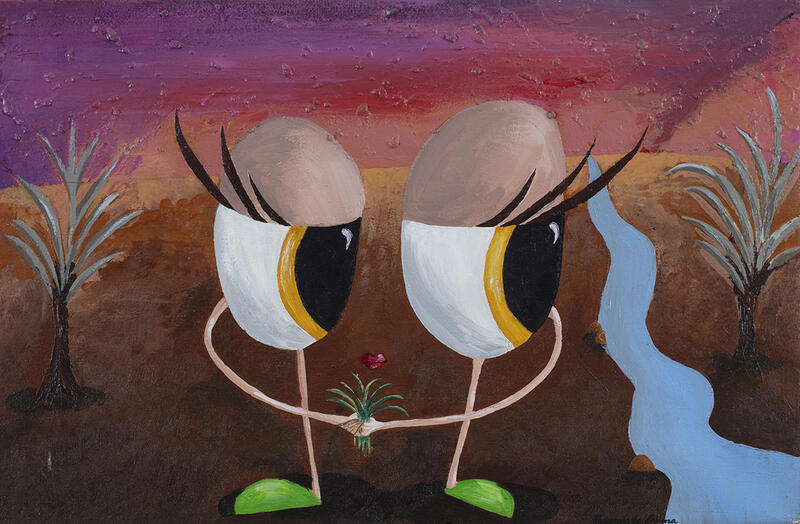
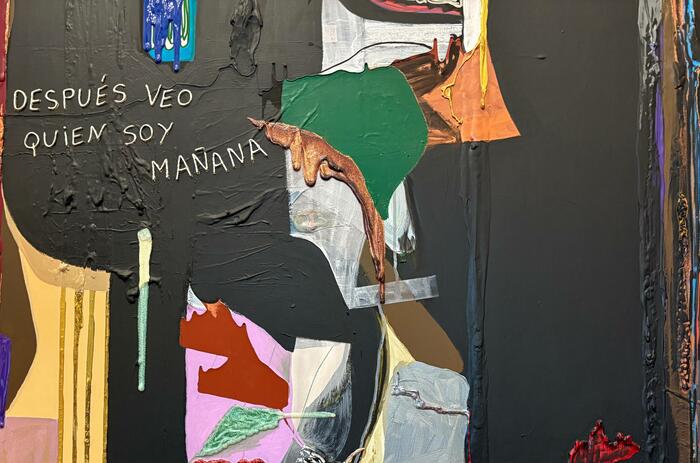
Written, scribbled, filled in, cried over, highlighted, crossed out, smudged—done in marker, pen, pencil, collage, paint, embroidery. The phrases are so intimate they become universal. Anyone could identify with statements like “I do what I do so as not to do something worse,” or “one more day without love,” “I don’t need anything from the first world,” “today I’m going to cry,” “I wish to achieve everything I desire,” “I only see what’s beautiful,” “I am lost,” “what do I do? Wait.” Malba opens its doors and reveals the heart of Fernanda Laguna, which is a magnet.
The viewer moves lightly through Mi corazón es un imán (My Heart is a Magnet), strolling at a steady pace along the many pieces on the walls, arranged chronologically from 1992 to the present. But after a few steps, it becomes clear that this seemingly innocent production carries a rebellious force. The drawn cardstock images of kittens, tears, and hearts challenge the ontology of art. Discipline and the everyday dance so closely together that the dialogue between them makes it impossible to distinguish one from the other. What is art? Can it be traced, copied? Can it be a cry from a diary? An entire bedroom? A bedroom window? Gift souvenirs? Her works, stripped of any obsession with belonging to a circuit that judges them, pride themselves on the gesture of sincerity. “Taste is a prison,” Laguna said during the walkthrough, and the echo of her words will linger until the exhibition ends. There is freedom in every piece; there is no obsessive pursuit of entering a predefined circuit. In fact, the exhibition includes a section where works are categorized as OFM (objeto fuera de mercado / out-of-market object). The intention guiding her practice is to create from genuine desire. There is an “anything goes” that belongs to her characteristic unbreakable spirit. The gaze can finally rest. Seeing is enough for analysis; making is enough for the work.
Fernanda Laguna dedicates the exhibition to independent spaces and publishing initiatives. Throughout her career, she has worked in literature, visual arts, activism, and in managing such spaces—like Belleza y Felicidad—where desires, generations, and communities converge. At Malba, the drums of feminism can be heard; photographs, ponchos, and posters recall the beginnings of the Ni Una Menos movement. It is a celebration of a struggle built on friendship, courage, and collaboration.
“Art surpasses what one wants to do, often because it turns out worse, and that is what makes it surpassing,” Laguna said. The artist speaks while placing a heart-shaped sticker over old conceptions that still persist within the discipline. She is not interested in being a solitary, misunderstood genius. She creates works thinking they might decay, like the human body itself. She believes one should not create a spotless world. Mi corazón es un imán (My Heart Is a Magnet) arrives at the right moment: to celebrate the everyday, to make art from intimacies without fear, to enjoy the small, to archive and to exhibit. Because independent spaces must also be seen. Because “behind art there is something much more beautiful,” which is transforming realities and creating beauty and happiness.
In the words of curator Miguel López: “Fernanda’s heart is a magnet, and it is calling out to other hearts.”
Fernanda Laguna (Buenos Aires, 1972) is a visual artist, writer, curator, and teacher. In 1999 she co-founded, with Cecilia Pavón, the art space and publishing house Belleza y Felicidad, active until 2007, and in 2003 she opened a branch in Villa Fiorito that remains active. She is part of the Ni Una Menos collective and, together with Cecilia Palmeiro, develops the living archive Mareadas en la marea. As a curator, she has participated in around two hundred exhibitions in independent spaces and museums in Argentina and abroad, including Malba, the Museu de Arte Contemporânea de Niterói, and the Argentine Consulate in New York. She has received the Kuitca Fellowship and the Foundation for Arts Initiatives grant, and in 2008 she promoted a project for a secondary school specialized in visual arts in Fiorito, supported by the Fondo Nacional de las Artes. Her work is held in the collections of museums and foundations such as MALBA, the Museo de Arte Moderno de Buenos Aires, Fundación Cisneros, the Museum of Contemporary Art Los Angeles, the Pérez Art Museum Miami, and the Guggenheim collection. She has published poetry, essays, and fiction; among her books are Control o no control, Los grandes proyectos, Espectacular and Muy espectacular (2025), as well as novels signed under the pseudonym Dalia Rosetti.
At Arte al Día, we are looking to commission the design of our new newsletter from emerging creatives across Latin America. A piece to explore, communicate, and challenge the ways we narrate the art of our region. Application deadline: April 10, 2026.
The Argentine curator, artist, and gallerist will lead a platform committed to positioning Latin American art within international conversations “without diluting its specificity.”
The Kunsthaus Wiesbaden presents an exhibition surveying the work of the Argentine artist, where photography, archive, and activism intertwine to reflect on the traces of violence and human rights.
The first 2026 edition of Gallery arrives in Recoleta, Retiro, and Microcentro. Organized across different circuits, this major free event has been showcasing the best of local art scenes for over two decades.
Guillermo Iuso and FlorenciaBöhtlingk next to Sebastián Gordin present two exhibitions at the Buenos Aires gallery where text and painting coexist without translating each other.
Thirty works join the exhibition starting Saturday, September 19, including pieces from the Colección Daros Latinoamérica.