By
Dayneris Brito
THE TERMS OF INDEPENDENCE
Curated by Gabriela Román González at London’s Brixton House, with the participation of artists Débora Delmar and Ilê Sartuzi, INDEPENDENCE turns its own making into an experiment in what it means to act independently within the legal structures and working relationships that shape cultural production today.
October 30, 2026
6 min.
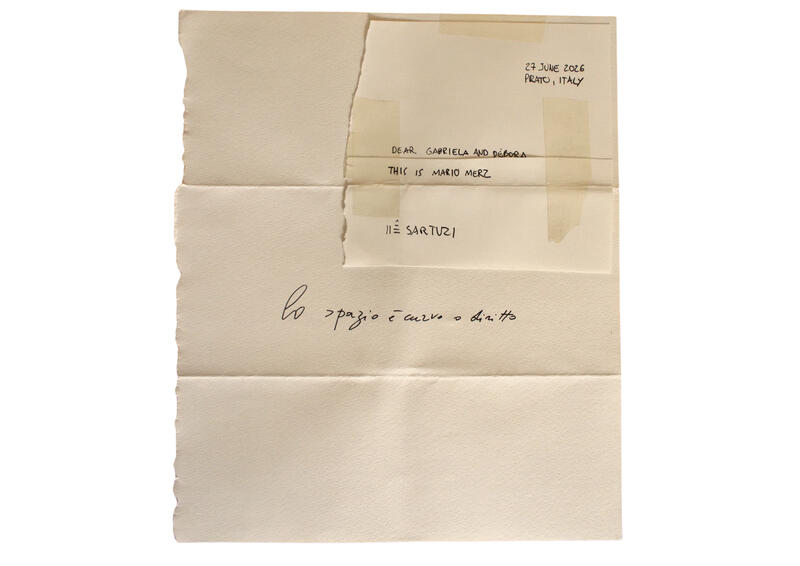
Ilê Sartuzi. Letter sent on the first day of the exhibition from the artist's current location in Prato, Italy. It was established in the agreements that, if the letter reached Brixton House before the end of the exhibition, it would be displayed. The letter did not arrive in time and was delivered to Gabriela Román González's home two weeks after the exhibition closed.
On 27 June, as INDEPENDENCE opened at Brixton House, artist Ilê Sartuzi sent a letter from Prato, Italy, to London. It was addressed to Gabriela Román González, the exhibition’s curator, and artist Débora Delmar. In the gallery, one of the contracts written for the project stated that if the letter arrived before the exhibition’s closing date of 4 July, it had to be displayed. The correspondence did not arrive in time.
What it contained, the words ‘This is Mario Merz’ and a sheet bearing the question Lo spazio è curvo o diritto - ‘Is space curved or straight?’[1], could only be seen later, in photographs published in the exhibition summary. It was a reference to a glass-and-steel igloo Merz built in 1973. Merz and Emilio Prini sat inside it to read, write and talk, turning the structure into a space for living and relating to others[2]. And INDEPENDENCE, in turn, proposed whether an exhibition could work in a similar relational way.
Enlarge image
-
Photo by Leoni Blue. Independently Authored Contractual Artworks, 2026. Displayed on a metal ring installed at the centre of the exhibition. The actions set out in the contracts were conceived as part of the artistic gesture, whether or not they resulted in a physical work or intervention within the exhibition
Presented as part of Systems in Question, a chapter of CASA’s Lines of Flight programme, Sartuzi, Delmar, and Román González made their own working relationships a field of experimentation, in which to test what it means to act independently and what makes independence possible. These questions are asked at a moment when working in the arts is particularly challenging in terms of negotiating income, time and working rights protection; a reality that becomes exponentially more fragile for cultural workers who cross borders and must exercise their practice within foreign legal and institutional infrastructures.[3]
At the centre of the gallery, three contracts were presented on a metal ring. Each was an Independently Authored Contractual Artwork, written from the position of Delmar, Sartuzi and Román González. At first glance, the three documents might be read as an image of equal participation. But reading the contracts revealed how differently the curator and artists entered the agreement, laying bare negotiations around their own artistic visions and requirements for the installation, and each person’s responsibilities and fees. It’s these typically hidden details that became the core structure of the exhibition itself, inviting us to dissect what each participant agrees to and ultimately compromises on to make it happen.
Enlarge image
-
Photo by Leoni Blue. Débora Delmar - Brief III, 2026 - A timeline presenting key developments in British immigration legislation since 1948, corresponding with the arrival of the Empire Windrush and the beginning of significant post-war migration to Britain, shall be installed across wall panels 2, 3, 5, and 6 as a continuous line of text. Produced in light grey vinyl and set in Helvetica Neue, a typeface commonly employed within British governmental and administrative communications, the legislative instruments referenced therein shall be retained within the Exhibition archive
This self-reflexive gesture is one of INDEPENDENCE’s strengths. Román González’s curatorial approach was not limited to bringing together works that illustrated forms of independence and personal agency, rather, it created a space in which to test how independence might be exercised. From this emerged obligations and outcomes that no one could fully control. At the same time, through many of the artistic gestures the exhibition proposed, it opened up a broader reflection on the conditions in which art production takes place.
From each author’s personal contract presented on the central metal ring installation, the eye could move towards the walls. Across them ran a chronology of British immigration legislation dating from 1948, the year the Empire Windrush arrived carrying hundreds of migrants from the Caribbean, to the most recent one today. Set in pale grey, the entries encircled the room with the discretion of an administrative document. Their spatial proximity to the metal ring holding the contracts also prompted me to ask how the curator and artists’ agreements, whether intimate or professional, take shape within legislative structures that exceed them and, in many cases, determine an unequal distribution of power. Presented as a continuous line - moving away from the dramatic iconography usually associated with borders - the timeline seemed to emphasise how immigration policy is not a series of isolated past events, but an accumulating structure that grants or limits working conditions and mobility rights.
Enlarge image
-
Photos by the artists and curator. Débora Delmar, Brief IV & V, 2026. As set out in the contract: From 27 June 2026 until 4 July 2026, each Party shall wear a wristwatch set to the local time of another Party's nation. Artist 1 shall use Cuba time. Artist 2 shall use Mexico time. The Curator shall use Brazil time. From 27 June 2026 until 4 July 2026, each Party shall transmit a daily message stating "CLOCK IN" to the other Parties. All messages shall be retained within the Exhibition archive
This subtle tension became explicit in Delmar’s contract, which required each participant’s specific immigration circumstances to be declared. As the wall text noted, none of them were born in the United Kingdom, yet all three live and work within the legal conditions shaped by this history, making the legislation a framework through which the exhibition itself can be read.
Delmar’s contract pushed this inquiry into autonomy even further by translating abstract independence into daily, relational habits. As agreed in her Brief IV and Brief V, each participant needed to wear a wristwatch set to another’s home time zone (Cuba for Delmar, Mexico for Sartuzi, Brazil for Román González). Checking the time became a constant reminder of their mutual obligation. They were also required to send one another a daily ‘CLOCK IN’ text message.
Enlarge image
-
Photo by Leoni Blue. Artwork description: Débora Delmar, Brief VII, 2026. As set out in the contract: Débora Delmar and Gabriela Román González agreed to acquire one imported good from Brixton Market on their way to the opening of the Exhibition. These were placed within the Exhibition space and subsequently consumed by the Parties
While ‘CLOCK IN’ borrows from factory workers clocking ‘in’ and eventually ‘out’ once their shift ends, here it marked the labour that continued long after gallery hours. Combined with other contractual directives, such as Delmar and Román González purchasing imported fruit from the nearby Brixton Village Market to consume in the space, the exhibition pointed to the idea of invisible labour that is constantly overlooked and taken for granted.
Román González’s contract brought the curatorial role into the same inquiry from a different angle. It named her as the person shaping the exhibition’s conceptual framework, mediating between the artists and the institution, and making decisions that affected the project. However, it also acknowledged that those decisions were made within relationships she could not determine alone. Her contract gave this interdependence a place within the exhibition, making the negotiation of its conditions part of the work itself.
Enlarge image
-
Negotiation Log, 2026. A record of the conversations and negotiations between Débora Delmar, Ilê Sartuzi and Gabriela Román González throughout the development of Independence.
What each agreement required could also be discovered through a QR code in the Certificate of Independence[4], another work on display, which was interactive. It led visitors, in real time, to a Negotiation Log: an exhibition archive where they could follow some of the interactions taking place behind the scenes whilst the show was open to the public.
INDEPENDENCE demanded time from its visitors. One had to read the contracts, access the archive and look again at what seemed incidental. That demand for attention was part of the exhibition’s appeal and also one of its risks as some of its most important statements could go unnoticed by someone simply walking through the gallery.
Enlarge image
-
Photo by Leoni Blue - Exhibition opening
It is difficult to hear the word ‘independence’ without hearing the promise it carries; to govern oneself, to be subject to no one, to be able to decide one’s own future. The exhibition brought that promise into contact with much smaller acts like wearing a watch, sending two words, buying fruit, and waiting for a letter. Yet these acts made the fantasy of complete self-sufficiency difficult to sustain. Depending on others is part of living and working with them; what changes is who can negotiate the terms of that dependence and who bears the consequences when those terms change.
The letter from Prato finally arrived at Román González’s home, outside the time and place the participants had established. It crossed the distance on the map, but did not arrive within the interval that would have allowed it to enter the exhibition. This is an important gesture because it shows that intention alone does not determine the outcome, and ultimately every independent action remains bound to the interdependent conditions where it takes place.
References
[1] INDEPENDENCE: Exhibition Summary, London, 2026, exhibition documentation. https://nottheowners.co.uk/projects/independence-curation?itemId=37scx57z7814tjut2hs6a5ppoii6uu
[2] Pirelli HangarBicocca, Mario Merz: Igloos, exhibition guide (2018), entry for Is space bent or straight? (1973), https://pirellihangarbicocca.org/en/exhibition/mario-merz-igloos/.
[3] UNESCO, Global Report on Cultural Policies: Culture: The Missing SDG, “Key facts and figures”, https://www.unesco.org/en/culture/global-report. According to a 2025 UNESCO report only 9% of the artists and cultural professionals they surveyed felt that their economic and social rights were adequately or strongly protected.
[4] INDEPENDENCE: Exhibition Summary, London, 2026, exhibition documentation. https://nottheowners.co.uk/projects/independence-curation?itemId=kuvydfkdhlxg47uqd2hqparmbnaqxe
Related Topics
May interest you
News
DAGOBERTO RODRÍGUEZ: TERRACOTTA SATELLITES AND A GYMNASIUM OF THOUGHT IN LUXEMBOURG
The co-founder of Los Carpinteros presents his first solo exhibition in the country at Château de Bourglinster and a former church in Roodt-sur-Syre.
Interviews
THYAGO NOGUEIRA: “INSTITUTIONS EXIST FOR ARTISTS”
Brazilian curator Thyago Nogueira, who heads Contemporary Art and Photography at Instituto Moreira Salles (IMS), reflects on the role of institutions, photography’s multiple dimensions, and the need to build new connections between the art scenes of Brazil and Argentina, ahead of his upcoming visit to Pinta BAphoto.
Reviews
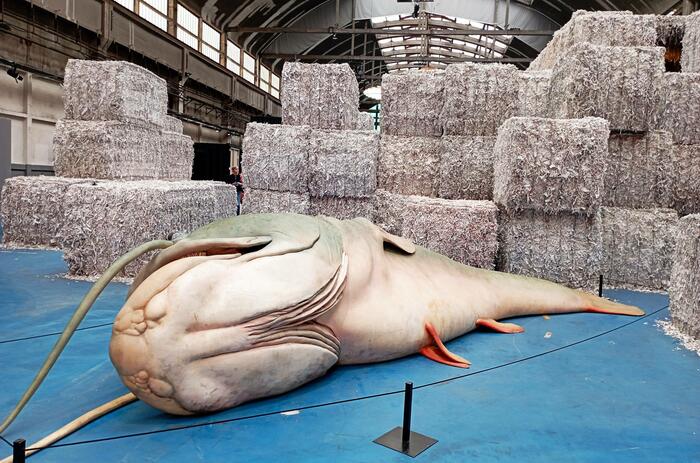
FROM ONE DREAM TO ANOTHER: THE 18TH LYON BIENNALE
In a world marked by dizzying change and a constant flow of images and information, the 18th Lyon Biennale encourages us to take the time to observe, disconnect and listen to what the works of the invited artists seek to express. In dialogue with the social, political and economic realities of our time, they question and challenge our certainties, enriching democratic debate, our collective imagination and our ways of living together.
October 19, 2026
Interviews
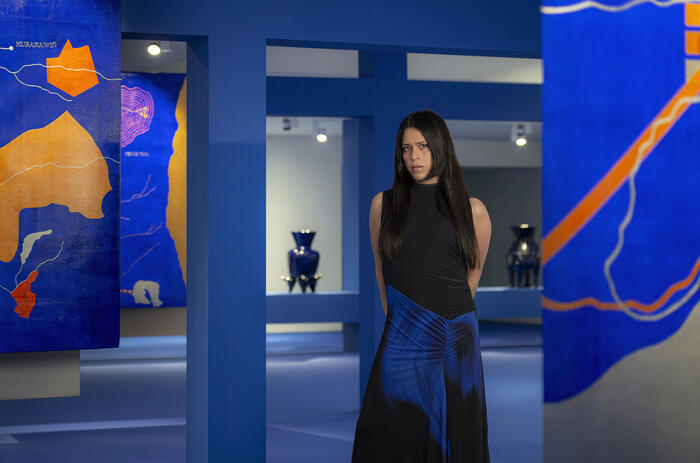
SEBA CALFUQUEO: "I AM INTERESTED IN BLOWING UP PRE-ESTABLISHED IDEAS ABOUT THE INDIGENOUS"
We spoke with Seba Calfuqueo on the occasion of her first institutional exhibition in Europe, at the Museo Thyssen-Bornemisza in Madrid, an exhibition that delves into the relationship with territory through history and identity from a heterogeneous, contemporary perspective.