
By
Patricia Avena Navarro
In a world marked by dizzying change and a constant flow of images and information, the 18th Lyon Biennale encourages us to take the time to observe, disconnect and listen to what the works of the invited artists seek to express. In dialogue with the social, political and economic realities of our time, they question and challenge our certainties, enriching democratic debate, our collective imagination and our ways of living together.
Under the aegis of guest curator Catherine Nichols, the 18th Lyon Contemporary Art Biennale welcomes a nebula of artists who echo the instability of our age, and it promises to be as poetic as it is in direct contact with its time. Originally from Australia and based in Berlin, Nichols brings both her sensitive perspective on Oceania and her broad experience of the European art scene and its many international connections, presenting a wide range of local and international artists. The Biennale brings together more than 400 works by 120 artists from 42 countries, giving pride of place to women, who make up the majority of the invited artists.
Echoing Lyon’s architecture and geography, Catherine Nichols titled her proposal Passer d’un rêve à l’autre (To Pass from One Dream to Another), taken from a text by the German philosopher Walter Benjamin. She drew particular inspiration from the traboules—Lyon’s distinctive passageways that cut through buildings and courtyards to lead from one street to another—to explore how we move from one perception to another, from one collective dream to the next. Using this idea of passage, the Biennale questions our relationship to the economy, exchange and work, but also to care, human relationships and the imagination.
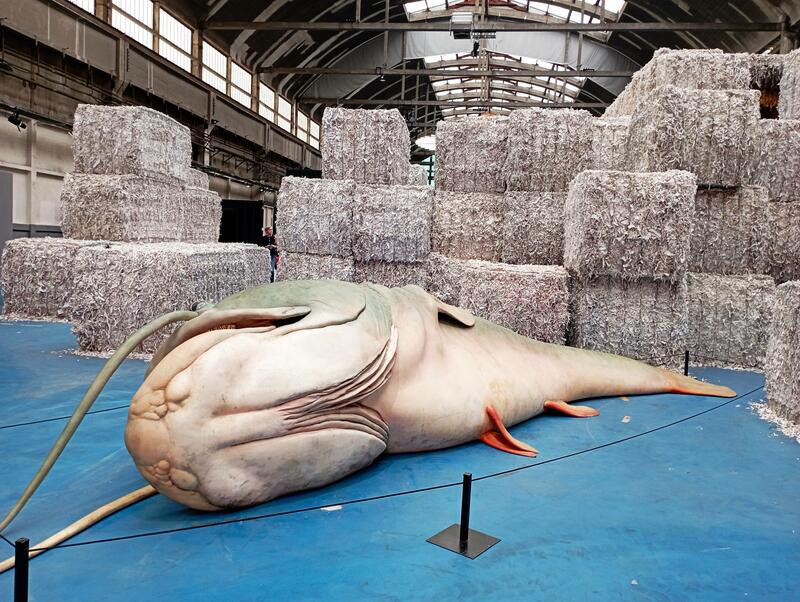
To begin this artistic marathon, Les Grandes Locos looms large. In this former railway workshop, the result is grandiloquent. It brings together monumental works in which spectacle is the dominant note; skillfully staged, they evoke landscapes transformed by industry, with underlying stories that are at times intimate, at times historical. The artists here have bet on grandeur. One example is Hovering Caress Amère by Laure Prouvost, a textile monster that swallows visitors whole. One steps into the belly of a whale, inside which lie handfuls of earth, crushed plants and a sea of empty cans, like the remains of a great global party that now seems to be over. Or there is the Dutch artist Mette Sterre, with her unlikely race of office chairs. What could be sadder than anonymous, bulky office furniture? For her humorous installation with the interminable title Hummelmania Paradise Extreme Dreams Depend on Teams, she gathers a community of workers with rubber-band heads among metal cabinets and plastic plants, inviting fantasy to venture into the heart of a harsh, productivity-driven environment. Other monumental creations await us…
As we make our way through this labyrinth marked by dizzying change and a flow of images and information, we are called out to by a river floating above the ground. The installation Río de la Plata by Argentine artist Miguel Rothschild offers, at first glance, a feeling of well-being and stillness, encouraging us to rediscover the beauty of the world through a new gaze upon the chaos of a landscape of works that in themselves embody the violence of economic change. Yet when he reveals his artistic approach, Miguel Rothschild shakes us and brings us back to a less optimistic reality.
Suspended by 4,200 nylon threads and weighed down with 4,200 lead pellets, a piece of the far edge of the world falls like a plane that oscillates between blood red, silver and leaden gray. Beneath the hanging structure, a series of small plumb bobs break loose and vanish into the shadow cast on the floor. That dark, empty silhouette faithfully reproduces the morphology of the aerial piece, representing a second river: one without shine, which guards what has sunk. In that half-light, two tragedies converge, regardless of the era: the extermination of Indigenous peoples during the colonial period and the victims who disappeared in the death flights of Argentina’s last dictatorship, the artist explains. A work of startling and unsettling beauty, it tries to contain, in fragile balance, the horror that lies beneath its surface, and invites reflection on the inseparable movement of the flow of wealth, goods, information and people that characterizes the landscape of our time. The result is disturbing, sublime and tragic.
Taking over other spaces, the Biennale extends to the Musée des Tissus et des Arts décoratifs, which hosts in its halls some twenty artists who present works exploring textiles and human relationships. From the Togolese artist Kokou Ferdinand Makouvia—who combines burnt cardboard, ceramic and rope to create a landscape of fascinating correspondences—to Rossella Biscotti, the works are extraordinarily diverse. Two installations stand out in particular. CaccHho CucchhA by Argentine artist Mercedes Azpilicueta examines public space and play through jacquard tapestries and children’s costumes, revisiting historical and contemporary narratives from a decolonial and feminist perspective and bringing forth dissident voices, bodies and stories. Working especially with tapestry and costume, she develops works with a strong dramaturgical dimension that unfold in space, nourished by Latin American speculative literature and contemporary popular cultures. The other is by Armenian artist Lucia Kagramanyan: Women’s song for the future (A cradle, a sanctuary). What can be done in the face of the Armenian genocide, the attempt to erase an entire people? What can be done in the face of oblivion, the dispersal of communities, the disappearance of cultural wealth? By presenting lullabies in Western Armenian sung by her mother, Lucia Kagramanyan gently preserves the history of her origins. Five plush hammocks, hand-sewn by members of Lyon’s Armenian community, invite the passerby to sink in and be lulled by these songs of childhood. In the depths of these cloth refuges, one is captivated by a deeply moving work.
A stop at the Institut d’art contemporain (IAC), Villeurbanne, is essential. The proposals by the ten artists under 35 are all solid and convincing. Particularly noteworthy is the installation by Chinese artist Haonan He, Mandala-Cartographie and Opium-Arium. Between research and creation, the artist’s practice revolves around psychoactive plants and the systems that regulate their use, circulation and perception. Through immersive installations, the work links extractive and postcolonial economies, mechanisms of control and cross-border infrastructures, following the journey of these plants from the Golden Triangle region to Europe.
Scattered across the Biennale’s various sites, Luz Broto’s in situ interventions are as austere in form as they are subversive in message. Printed in black and white on imposing panels, the Put Oneself in the Place of the Other pieces are impossible to ignore. By occupying public space, Luz Broto proposes situations that invite individuals to swap roles, routines or positions, thereby revealing the underlying systems of organization and control. “In the middle of a conversation: empty your bags, pockets and purses, letting everything you are carrying fall to the floor, one on top of the other. Continue the conversation,” reads one of them at the Musée des Beaux-Arts de Lyon. Or: “Upon arrival, leave your coat and bag in the cloakroom. Take another person’s coat and bag and go out into the street. Come back two hours later,” at the Musée des Tissus et des Arts décoratifs. Her practice is built on minimal gestures of perceptual displacement that question notions of access, responsibility and collective behavior, while making visible the implicit rules that govern everyday interactions. The artist explains that with these invitations she hopes to provoke “a new situation, a new thought or a new sensation.” To shake up the everyday and make us stray from our well-worn paths.
Throughout the Biennale, it is easy to detect the artists’ process of judging, building and destroying codes. Taking over the different spaces, they show us a landscape built from an overload of images, weakened by an ecosystem that imposes itself naturally on visitors as they make their way through Passer d’un rêve à l’autre; turned into actors, all that remains for them is to wander through this uncertain labyrinth of different aesthetics and surprising plastic utopias. Within an archipelago of works that are, in turn, scenes or stops that lead the wanderer to slow down, the Biennale offers a landscape in transition, a wide range of positions that help build a nuanced mosaic of narratives, to which the artists—particularly sensitive to social, political, economic and environmental impacts—are eager to respond.
Together they set out to build this Biennale as a physical, visual or spiritual journey, to which the viewer, utterly lost in those vast expanses, is invited to take part, move, discover, observe, listen, interact, feel and live, generating by turns admiration, awareness, contemplation or reflection.
The British event highlights the growing presence of Latin American contemporary art, although its visibility remains conditioned by the commercial dynamics of a global fair and by local cultural policies that pragmatically contribute to shaping a contemporary art landscape closer to its audience.
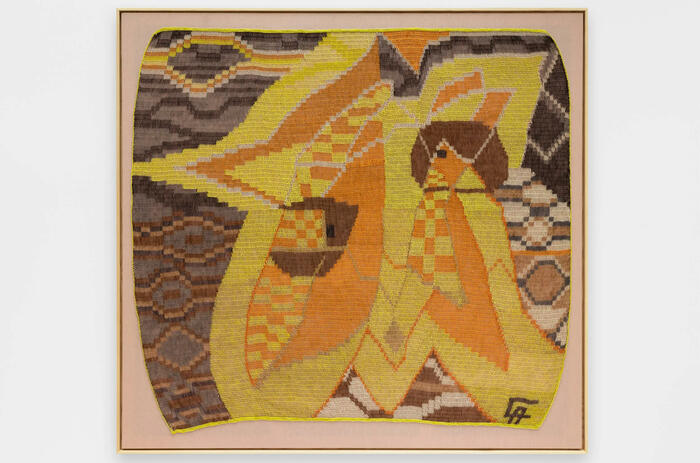
Yanantin and Cecilia Brunson Projects present it in London during Frieze week.
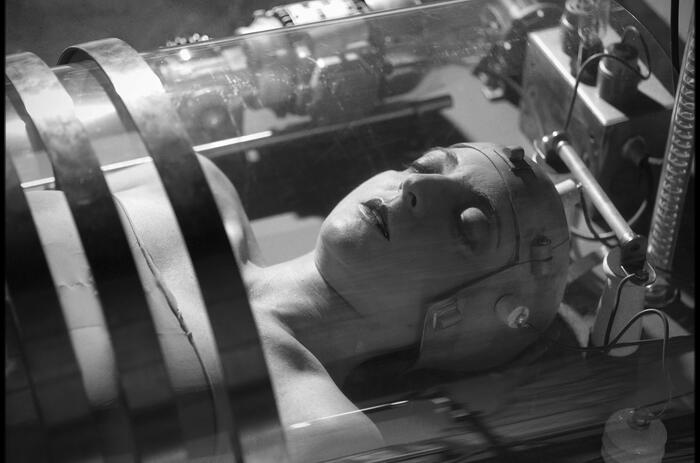
From October 22 to 25, La Rural hosts the 22nd edition of the only photography fair in Latin America: it celebrates two centuries of images with unique works, in-house curatorial projects, and an international presence.
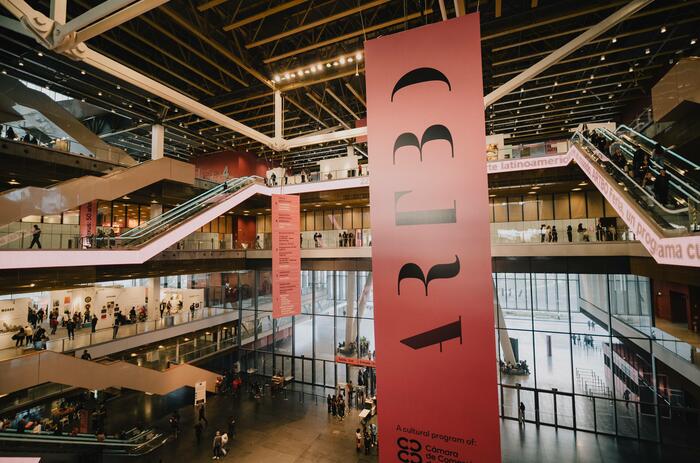
Some art fairs are defined primarily by their galleries, while others also seek to explain the cultural context in which they take place. ARTBO clearly belongs to the second category. Created in 2004 by the Bogotá Chamber of Commerce, it was conceived with an ambition that goes beyond organizing an art fair: to support the development of the art market, contribute to the city’s cultural ecosystem, and connect the Colombian and Latin American art scene with the international art world.
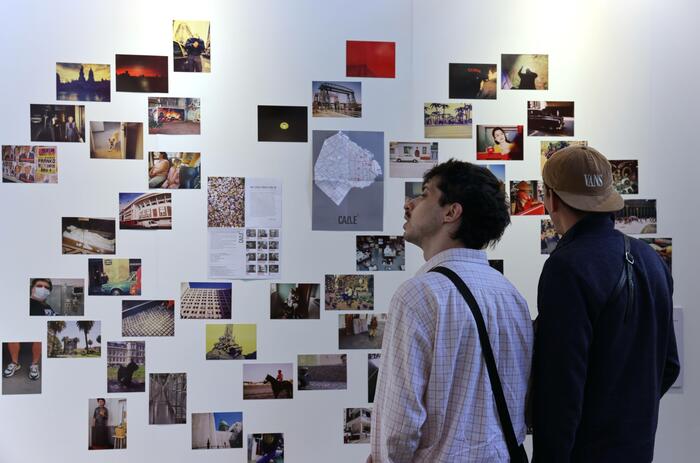
In late October and early November, the city of Buenos Aires will host three fairs with three distinct identities in a single period of intense artistic activity.