
THE NEW SPACE OF THE CARTIER FOUNDATION AND 40 YEARS OF ITS COLLECTION
The Cartier Foundation settles into Place du Palais-Royal in Paris to write a new chapter in its history at the heart of the capital, inaugurating its new space by exhibiting the “must-haves” of forty years of collecting.
By moving to the heart of Paris, the Cartier Foundation for Contemporary Art expands considerably and enters a hyper-creative architectural setting designed by architect Jean Nouvel. A modular, open stage for 600 works by more than 100 artists that recount the story of an artistic adventure that began in 1984 and continues to this day. The design of the new building is structured around three main concepts developed by Nouvel: transparency—achieved through imposing 7-meter-high glass windows; void—designed to “accommodate all forms of contemporary art” (of the Foundation’s 8,500 m², 6,500 m² are intended for future exhibitions); and modularity—ensured by five removable platforms conceived to transform the space with each new exhibition.
-
Freddy Mamani. Salón de Eventos. © Marc Domage
For the opening of this new headquarters, the Cartier Foundation presents Exposition Générale, a carefully curated selection of emblematic works and fragments of exhibitions that now constitute the core of its collection. Singular for the unique principles that guide its development and enrichment year after year, it traces more than 40 years of international contemporary creation to date. Composed essentially of works created and presented throughout its rich programming, it ranges from established artists to those still relatively unknown on the art scene. It is an opportunity to rediscover figures previously shown at the former venue, such as Claudia Andujar, Guillermo Kuitca, and Graciela Iturbide.
Upon entering the current foundation for contemporary art, visitors experience an unprecedented sensation. The gaze extends across three levels, where high ceilings alternate with more intimate rooms, adaptable thanks to the modular platforms. This clear, multidirectional, immersive vision often amazes and disorients the viewer.
-
Santidio Pereira, Junya Ishigami, Luiz Zerbini © Marc Domage
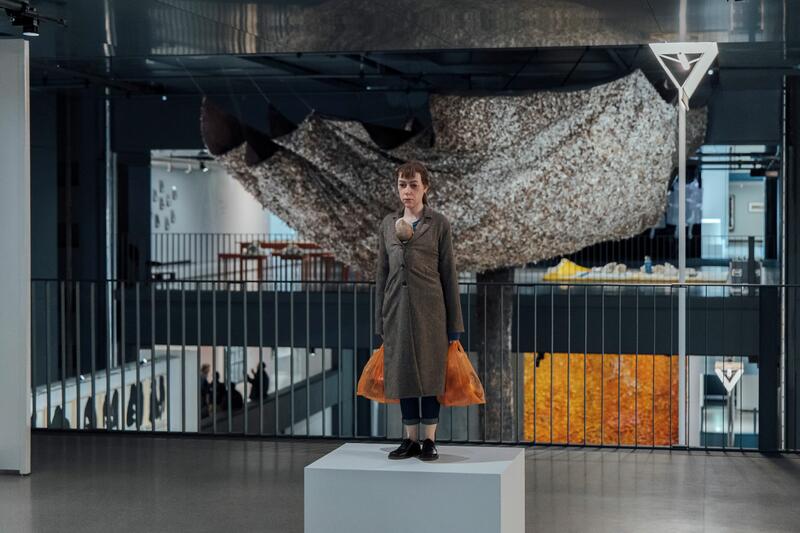
Among the many pieces in the collection are genuine gems, such as Paysage amoureux by Jean-Michel Othoniel in Murano glass; Woman with Shopping by Ron Mueck, a hyperrealistic reduction of a mother with a disillusioned gaze; Olga de Amaral’s golden tapestry; and Luiz Zerbini’s painted wood installation, which evokes a giant herbarium. In the basement, Panamarenko’s utopian submarine transports us to the imagination of exploration that has marked modern times. The graphic arts section is unmissable, featuring drawings by Marc Couturier, by Ehuana Yaira of the Yanomami community, and by David Lynch, displayed along a long corridor. As for photography, three significant series stand out: Francesca Woodman’s bodies in motion, William Eggleston’s urban landscapes, and Patti Smith’s snapshots.
-
View from platform 2. Ron Mueck, Solange Pessoa, Olga de Amaral. © Cyril Marcilhacy
Ceramics have a notable presence with Gustavo Pérez’s glazed stoneware, which explores the subtle interaction between structure and surface; the clay animals of Virgil Ortiz; and the figures by Izabel Mendes da Cunha—ceramic sculptures inspired by everyday life that reveal an artistic practice deeply rooted in their environment and stand as true homages to the history, spirituality, and folk art of Brazil’s Northeast, from where they originate.
-
Virgil Ortiz, Olga de Amaral. © Marc Domage
Suspended above, Miracéus, a monumental installation by Solange Pessoa composed of thousands of bird feathers, invites viewers to delve into the wild, animal essence of humanity, imbued with spirituality and shamanism. Claudia Andujar’s photographic series and drawings by members of the Yanomami community address challenges related to the disappearance of rainforest peoples in the northern Amazon and their struggle for cultural and territorial preservation.
In contemporary painting, one can admire works such as a 1984 diptych by the American artist Joan Mitchell, who followed in Monet’s footsteps in expressing sensations of nature, located near a more anecdotal painting by Damien Hirst that recounts—through a revisited impressionist style—the British provocateur’s return to painting.
-
View from platform 4. Huang Yong Ping, Solange Pessoa © Marc Domage
The journey through the Foundation’s memory takes us from lighthearted evocations—such as a life-size bronze sculpture of Nini, the cat of filmmaker Agnès Varda—to grave themes, like a video by philosopher Paul Virilio recounting the Chernobyl disaster. Malick Sidibé’s studio photographs portraying young people in Bamako during the 1960s and 1970s enter into dialogue with Patti Smith’s Polaroids, which capture a Paris of poets and nostalgia.
As one moves through the gleaming spaces of this new Foundation, it is difficult not to perceive a clear affinity for Latin American artists, who appear to be widely represented. The question arises: why not highlight and explain to the public the origins of this affinity? In its attempt to show all aspects of such a vast collection, Exposition Générale takes on a fair-like atmosphere, where visitors can wander without a clear direction, resulting in an exhibition that at times feels disordered, without an evident guiding principle, and whose path becomes labyrinthine.
Despite these initial challenges in presenting the collection, this new space expands the Foundation’s ambition: to support contemporary creation in all its forms (art, design, photography, architecture, science, and the performing arts). Through temporary exhibitions, performances, and debates, the Cartier Foundation promises a program that will address the major challenges of our time, fostering dialogue among artists, audiences, and disciplines.
-
Malik Sidibe. © Marc Domage
Related Topics
May interest you
IN UNCERTAIN TIMES, COLLECTORS TURN BACK TO THE CLASSICS
Signs of caution in a market seeking stability.
PARIS, CAPITAL OF ART AND FASHION: MIU MIU AND HELEN MARTEN’S 30 BLIZZARDS AT ART BASEL
In a city where art and fashion have long shared the same stage, one of the most talked-about encounters during Art Basel Paris week was 30 Blizzards, a performative project by British artist Helen Marten, presented by Miu Miu at the Palais d’Iéna. The preview gathered an international mix of collectors, curators, and fashion figures, confirming how naturally these worlds now intersect.