

By
Álvaro De Benito
The Argentine-Peruvian artist takes over the National Museum of Norway to question, through sculptures born from technical and digital speculation, the limits of artistic creation in a dehumanized future.
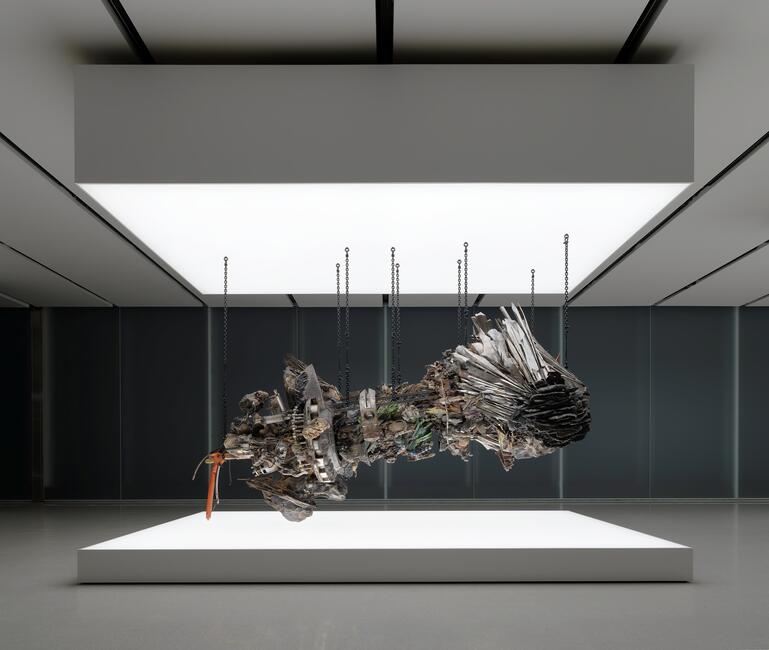
The National Museum (Nasjonalmuseet), in Oslo, hosts The End of Imagination, an exhibition bringing together a set of sculptures from the homonymous series developed by Adrián Villar Rojas (Rosario, Argentina, 1980). This exhibition constitutes the artist's first presentation in Norway and the first major display of this body of work in Europe. Through unsettling forms that appear extracted from an unknown future, the author questions the possibility of art surviving the disappearance of humanity and considers the limits of artistic creation traditionally bound to human existence and intelligence.
Since the beginning of the decade, a multidisciplinary team led by Villar Rojas has developed Time Engine, a software system that generates speculative worlds through simulations based on the analysis of environmental processes, economies, societies, and conflicts. Accounting for diverse durations and periods, these produced synthetic ecosystems evolve and yield organisms, architectures, machines, and geological formations that serve to extract the final sculptural forms.
With the generative capacity of nature transferred to digital environments, the Argentine-Peruvian explores a concept of creation in which no single intelligence determines the outcome on its own, given that the materialization of these imaginary objects always requires a process of collective research and fabrication. Within it, synthetic elements and organic matter are worked with to produce pieces that evoke geological formations or industrial waste within a dystopic discourse.
In Oslo, the sculptures occupy two light halls of the building, questioning, in a sense, the role of the museum and its museological essence as guardian and interpreter of the past. His proposal thus raises fundamental questions regarding who imagines, constructs, and dictates the conditions of creation, especially in a hypothetical world where humanity has ceased to have the final word.
Adrián Villar Rojas. The End of Imagination can be seen through March 7, 2027, at the National Museum (Nasjonalmuseet), Brynjulf Bulls plass 3, Oslo, Norway.
Astrup Fearnley Museet presents 150 works by the Colombian artist, who passed away in January 2026. An exhibition she helped plan herself, spanning six decades of everyday images, political violence, and a palette all her own.