
By
Álvaro De Benito
An extensive exhibition in Bonn featuring more than 400 works and objects presents Amazonia through the perspectives of its Indigenous peoples, exploring their cosmologies through a dialogue between contemporary artistic practices and historical artefacts.
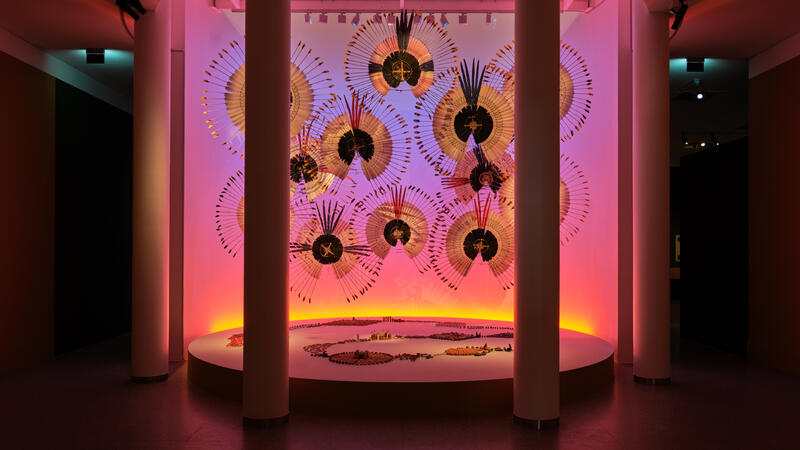
Amazônia. Indigenous Worlds brings together nearly 400 artworks, craft objects and artefacts at the Bundeskunsthalle in Bonn, offering an approach to the Amazon region through the perspectives of its Indigenous peoples. Curated by anthropologist Leandro Varison and artist Denilson Baniwa, the exhibition seeks to move beyond visions that reduce Amazonia to a merely natural or exotic space, presenting it instead as a complex cultural and social territory—dynamic, diverse and in a constant state of transformation.
The exhibition establishes a dialogue between past and present, anthropology and art, through the juxtaposition of contemporary works with archaeological and historical objects drawn from the collections of the Musée du quai Branly – Jacques Chirac. Structured around five thematic sections, the project examines the multiple forms of knowledge, cultural practices and modes of expression that shape the region.
The first section, Creating the Forest, Inhabiting Worlds, explores Amazonian narratives concerning the origins of existence. Rooted in Indigenous cosmologies, these accounts emphasize the idea that creation emerges through continuous processes of transformation in which humans, animals, plants and spirits remain fundamentally interconnected. The theme is addressed not only from an anthropological perspective but also through contemporary artistic reinterpretations, such as Denilson Baniwa’s Waferinaipe, or The Ancient Heroes of the Universe Open the Navel of the World (2018), which revisits foundational myths through a contemporary lens.
A second curatorial axis, Making Humans, examines how humanity is understood as a condition continuously constructed through social and cultural processes. Exemplified by the Ritxòkò dolls used by the Inỹ Karajá people to transmit knowledge across generations, as well as by Iano Mac Yawalapiti’s photographic documentation of the Kwarup festival, this section highlights the body as a site of identity formation shaped through ceremonies, body painting, adornment and communal relationships.
In Engaging with Others, the exhibition moves to the core of Amazonian cosmology, examining artistic expressions that reflect a worldview in which animals, plants, spirits and ancestors inhabit a shared universe. The section ranges from traditional ritual objects—such as an atujuwa mask employed by the Wauja people in ceremonies involving supernatural beings—to more contemporary and critical reflections, including Hunters of Colonial Fiction (2021), which interrogates the figure of the “Other” within colonial history.
Understanding and Exploring Worlds investigates the ways in which Indigenous peoples generate and transmit knowledge. Observation of the natural world coexists with dreams and visions, while shamanic practices function as means of accessing alternative dimensions of reality. The fifth and final section, Multiplying Futures, addresses how Amazonian peoples negotiate their future in the face of dominant Western models of development, advocating instead for multiple and diverse ways of imagining and constructing the future.
Amazônia. Indigenous Worlds remains on view until 9 August 2026 at the Bundeskunsthalle, Helmut-Kohl-Allee 4, Bonn, Germany.

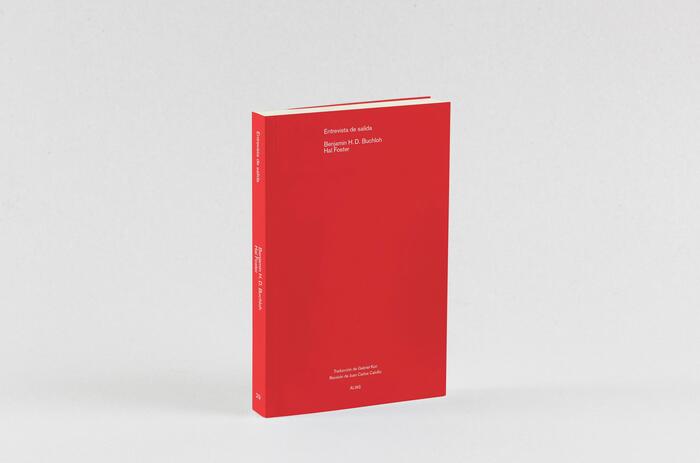
Alias editorial publishes the Spanish translation of the conversation between Benjamin H. D. Buchloh and Hal Foster, conceived as the farewell of one of postwar art criticism's central figures.

"When the flame drinks from the stars and the spider weaves cycles of life, where the sky touches the earth and time expands like salt...", this is how Tomás Saraceno describes the exhibition Ancestral Futures at Haus der Kunst.