STORIES BEYOND THE HUMAN AT THE NATIONAL MUSEUM THYSSEN-BORNEMISZA
Terraphilia—a term combining terra (earth) with philia (love and friendship)—evokes a deep-rooted connection of affect, care, and responsibility toward the earth and its multitudes of inhabitants. In a time of planetary unmaking and gaping inequalities, the exhibition turns to art to orient us toward transformative ways of being—mobilizing interspecies kinship, new forms of collectivity, and practices of planetary love.

Organized by the Museo Nacional Thyssen-Bornemisza and TBA21 Thyssen-Bornemisza Art Contemporary, Terraphilia brings together around 100 works spanning five centuries from the Thyssen-Bornemisza collections. These works present an evocative spectrum of artistic and intellectual explorations, revealing the depth and reach of more-than-human stories and multispecies intimacies. Resisting the impoverishing dualisms of modern cosmology, the exhibition invites viewers to rediscover the world as a pluriverse: a world of many worlds.
Terraphilia moves through a constellation of thematic currents and undercurrents, focusing on cosmograms, animate worlds, the art of dreams, land relations, mythical time, oceanic cosmogonies, and the contested legacy of objectivity. This layered approach is mirrored in an architectural intervention by Marina Otero Verzier with Andrea Muniáin: a serpent-like, translucent structure that wraps around the exhibition space, guiding visitors through its shifting planes of transparency and interwoven scenarios.
-
Jan Brueghel the Elder. Christ in the Storm on the Sea of Galilee, 1596. Museo Nacional Thyssen-Bornemisza, Madrid
Landscape paintings by Roelant Savery, Joachim Patinir, and Jan Bruegel the Elder illustrate the most accomplished early attempts to map and moralize nature, casting it as orderly, legible, and divinely structured. In the paintings of Jan Jansz. van der Heyden and Melchior de Hondecoeter, the desire to understand the world turns into a mandate to master and normalize it. Curiosity is folded into conquest and expansion becomes destiny, as exemplified in the landscapes by Frans Jansz. Post and Albert Bierstadt. In the wake of this shift, the earth is no longer a home to care for in a shared cosmology—it becomes resource, territory, and possession.
Terraphilia resists and complicates this entrenched logic. Mythology, mysticism, and dream spaces emerge as sites of resistance and renewal, where the boundaries between the human and more-than-human blur. In Domenico Fetti’s The Parable of the Sower, the act of sowing becomes both a spiritual allegory and an earthly gesture of care. Paintings by Yves Tanguy, Natalia Goncharova, Wassily Kandinsky, and Rubem Valentim explore abstraction and dream logic to access the deeper structures of reality that exceed visibility and reason. Metamorphosis and hybridity recur as motifs of transformation. Salvador Dalí’s dream creatures and Elyla’s fluid avatars blur the lines between spirit, animal, and gender. Inês Zenha’s biomorphic ceramics pulse with queerness and excess, insisting that the earth, too, resists classification.
-
Franz Marc. The Dream, 1912. Museo Nacional Thyssen-Bornemisza, Madrid
Artists such as Arthur Boyd, Regina de Miguel, Asunción Molinos Gordo, and Janaina Tschäpe turn to fungal, microbial, and vegetal agencies to suggest forms of intelligence that defy anthropocentric logic. Their works challenge the notion of the human as exceptional, proposing instead a mode of subjectivity that is porous, entangled, and reshaped through exchanges with the living world.
Meanwhile, the earth is reanimated not as property but as witness and relation in the works of Dineo Seshee Bopape, Rashid Johnson, and Vivian Suter. Through clay, soil, and the elemental, they speak of continuity, rupture, and return, crossing the threshold of matter and myth. In Daniel Otero Torres’s totemic tributes to land defenders, figures emerge that hold together the living and the lost—not monuments to the past but embracing an enduring presence.
-
Dineo Seshee Bopape. More/Moreana, 2021. TBA21Thyssen-Bornemisza Art Contemporary Collection
The ocean is a sentient presence, a space of memory, fluidity, and fugitivity. Works by The Otolith Group, Josèfa Ntjam, and SusanneWinterling conjure the ocean as a multispecies archive of migration, mourning, and planetary renewal. Ntjam’s Siphonophore 1/2, inspired by marine biology and African cosmology, imagines collective being as mutualist figuration: many-in-one, becoming-with.
Sissel Tolaas’s commissioned installation whereareWEarewhere animates the exhibition space and interweaves its distinct parts. Harnessing smell molecules sourced from varied landscapes and ecologies, she infuses a series of glass olfactory vessels with the elemental forces of Terraphilia: Ocean, Animal, Human, Stratosphere, Earth, and Nature. Smell becomes a medium of communication, shaping molecular cosmograms that invite sensory engagement beyond the visual.
-
Susanne Winterling. Planetary opera in three acts, divided by the currents, 2018. Installation view, Gravitational currents & the life magic, Empty Gallery, Hong Kong. Courtesy of the artist and Empty Gallery. Photo: Michael Yu
Through the voices of artists like Ayrson Heráclito, Brad Kahlhamer, Ana Mendieta, and Hervé Yamguen, the exhibition affirms the importance of listening to silenced histories, of learning from plural cosmologies, and imagining life otherwise.
The exhibition is accompanied by a monographic catalog edited by Daniela Zyman and Álex Martín Rod, that brings together leading voices across the explored themes, including Amerindian perspectivism, trans*feminism, decolonial ecologies, the history of science, critical fiction, and political theory.
May interest you
RITE AND SYNCRETISM IN THE DIALOGUE OF CALDERIUS AT THE CAAC
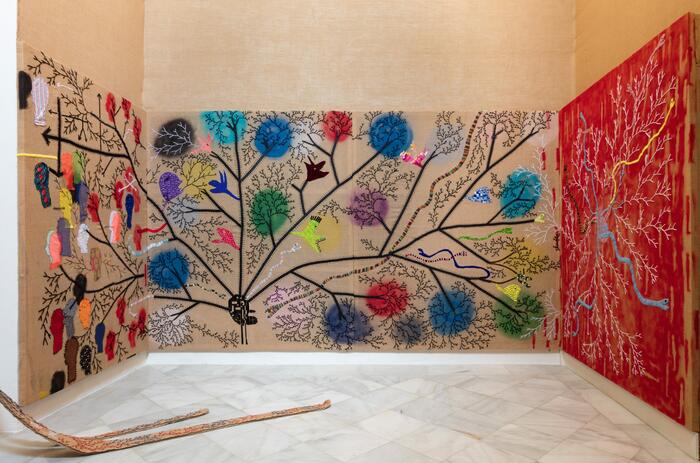
The Andalusian Center of Contemporary Art (CAAC) presents Sensemayá. Cánticos para matar a la Culebra (Sensemaya. Chants to kill the snake), the first solo institutional exhibition in Spain by Claribel Calderius (Havana, Cuba, 1986). Conceived specifically for the San Bruno Chapel, the project is a site-specific intervention that draws on the space’s historical and spiritual resonance—qualities that align seamlessly with the symbolic universe of the Cuban artist.
SEARCHING FOR A REPUBLIC: PERU'S PAST AND PRESENT ON A CHESS BOARD
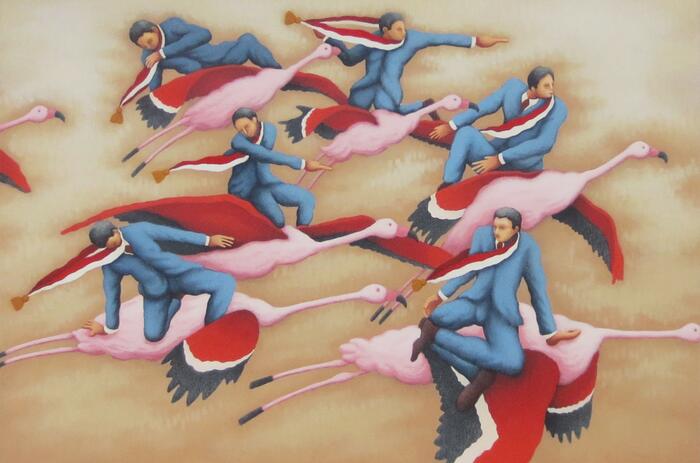
Gonzalo García Callegari presents his twentieth solo exhibition at the Inca Garcilaso Cultural Center in Lima. In the wake of Peru’s bicentennial of independence, he invites us—with his signature dark humor—to question the unfinished ideals of national emancipation.

LOURDES GROBET AND THE LTCI, AT CASA DE MÉXICO
The Fundación Casa de México in Spain presents the exhibition Lourdes Grobet y el Laboratorio de Teatro Campesino e Indígena, a selection of nearly seventy photographs from the project developed by Lourdes Grobet (Mexico City, Mexico, 1940–2022) around the Laboratorio de Teatro Campesino e Indígena (LTCI) (Peasant and Indigenous Theatre Laboratory).

A NEW REVIEW ON CLAUDIA ANDUJAR’S A SÔNIA
The Elba Benítez Gallery in Madrid is currently hosting an exhibition of photographs from A Sônia, a project by Claudia Andujar (Neuchâtel, Switzerland, 1931), created in 1971. This body of work stands as one of the most significant early explorations into the creative manipulation of the photographic snapshot. For this occasion, the exhibition focuses on a carefully curated selection of images that establish a dialogue of balance, intensity, and chromatic richness with the surrounding space.