OSWALDO VIGAS IN GUANGZHOU, CROSSINGS BETWEEN ANCIENT CIVILIZATIONS OF CHINA AND THE AMERICAS
The Guangdong Museum of Art presents the first major museum retrospective of the Venezuelan artist in Asia, spanning seven decades of work.
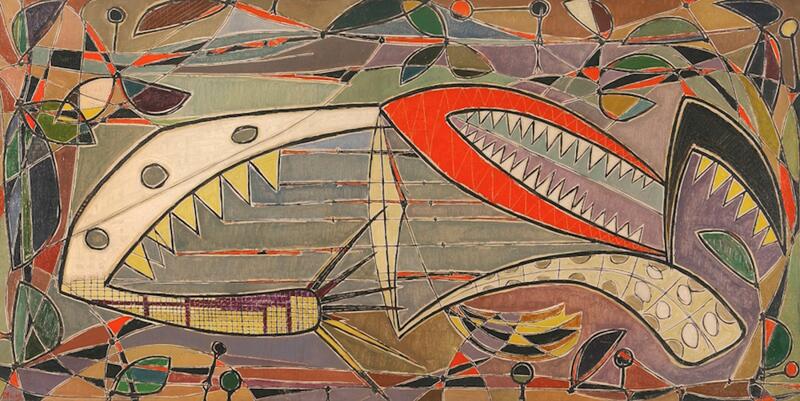
The Guangdong Museum of Art presents Oswaldo Vigas: Reality Is What I Imagine, the first major museum retrospective of the Venezuelan artist in Asia. The exhibition brings together a focused selection of paintings alongside rarely seen archival materials, spanning seven decades of his practice.
The show is co-organized with Kwai Fung Hin Art Gallery and supported by the Oswaldo Vigas Foundation. It is co-curated by Venezuelan curator Gabriela Rangel and Chinese curator Jiang Jun, whose collaboration places Vigas within a broader reconsideration of modernism beyond a predominantly Eurocentric framework, bringing a Latin American artistic experience into dialogue with a Chinese perspective on the multiple and multidirectional histories of modern art.
-
Installation Shot, Oswaldo Vigas: Reality is What I Imagine, Guangdong Museum of Art, 2026
Rather than positioning Oswaldo Vigas (Valencia, Venezuela, 1923) as a peripheral figure within an established history of Western modernism, the exhibition examines how he developed an autonomous visual language from the intersection of multiple cultural histories. His career moved between Venezuela and Paris and across abstraction, figuration, Informalism, and neo-figuration, while remaining connected to the ancestral imagery, myths, and material culture of Latin America.
Rangel describes this refusal to settle into a single artistic or cultural category as Vigas’s “amphibian modernity”: a practice capable of moving between different cultural and aesthetic ecosystems without belonging exclusively to any one of them. According to the curator, Vigas did not simply adopt European modernism; he transformed it through a sustained engagement with the histories, symbols, and cultural memory of Latin America.
-
Oswaldo Vigas, Gesticulante, 1977. Image courtesy of Oswaldo Vigas Foundation Archives. Photo: Eduardo Chacón
Vigas studied medicine before dedicating himself fully to painting. From the 1940s onward, he developed a body of work rooted in both international modernism and the cultural heritage of Latin America. His early Brujas (Witches) emerged from his exploration of pre-Columbian imagery, including the Venus of Tacarigua and Venezuela’s ancient petroglyphs, transforming ancestral forms into hybrid figures that occupy the space between the human, animal, and mineral worlds. His visual language also drew on African art and the ancestral traditions of the Americas.
During his years in Paris, from 1952 to 1964, Vigas encountered the international exchanges surrounding postwar modernism. Rather than adopting a single European model, he developed an increasingly independent language that moved between organic geometric abstraction, Informalism, and neo-figuration, while retaining a connection to the symbolic forms of his earlier work. Of his own practice, the artist said: “I have never been rigorously abstract, nor rigorously figurative. What I have always tried to be, is rigorously Oswaldo Vigas.”
-
Installation Shot, Oswaldo Vigas: Reality is What I Imagine, Guangdong Museum of Art, 2026
For his part, Jiang Jun approaches Vigas’s work from a perspective that questions the traditional, Western-centered account of modernism. He places the artist within a polycentric and multidirectional history of modern art, in which different cultural traditions are understood as active sites of modernity rather than secondary responses to European models. “Vigas’s art transformed cultural friction, identity crises, and cultural consciousness into a powerful creative force, achieving a localized reconstruction of modernism,” the curator states.
Jun places Vigas’s work in dialogue with ancient Chinese and Indigenous American civilizations. Through this comparative approach, the exhibition considers how modernism might be understood when viewed through multiple cultural and geographic centers rather than as a single universal model.
The exhibition unfolds across four periods of Vigas’s career: his early engagement with ancestral figuration and the Brujas series; his transformative years in Paris; his return to Venezuela and development of a syncretic neo-figuration; and the increasingly liberated biomorphic language of his later decades. Together, the works reveal a practice characterized by continual movement, reinvention, and return rather than stylistic consistency.
Oswaldo Vigas: Reality Is What I Imagine is on view at the Guangdong Museum of Art in Guangzhou, China, through November 22, 2026.
Related Topics
May interest you
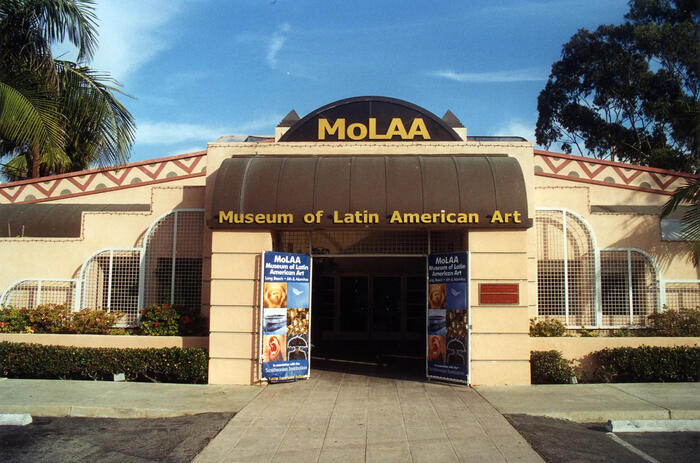
TANYA CAPRILES DE BRILLEMBOURG RECEIVES THE LEGADO AWARD FOT PHILANTROPY IN THE ARTS
MOLAA honored her at its gala marking the museum’s 30th anniversary, citing her work at the intersection of cultural patronage and humanitarian action.