

By
María Sancho-Arroyo
How new U.S. trade policies are reshaping the movement of art and design, blurring the line between cultural object and commercial good.
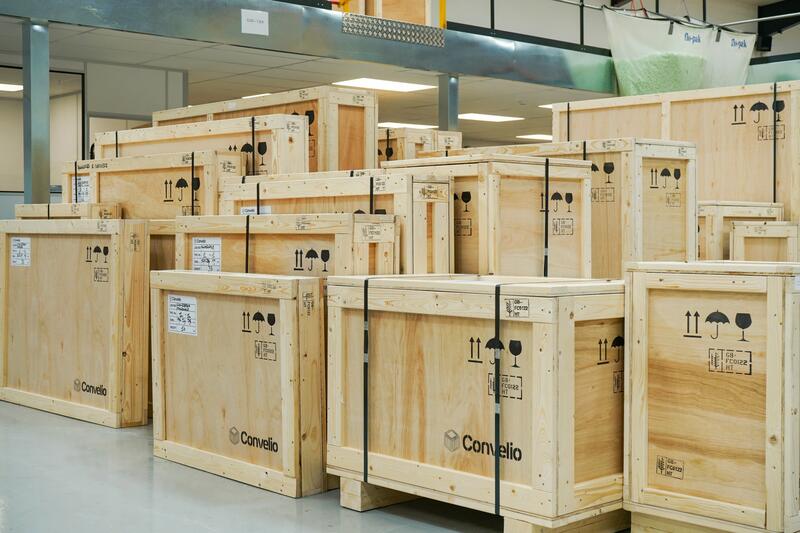
It has now been seven months since the Trump administration launched a new wave of tariffs across global trade. Although the art market was never an explicit target—its volume is negligible compared with automotive, steel, or consumer goods—these measures have nonetheless changed the conditions under which artworks and design objects enter the United States.
A detailed new report titled U.S. Tariffs and the Art Market, published by the international art logistics firm Convelio, examines how recent trade measures are transforming the import of artworks and design objects into the United States. Edouard Gouin, the company’s founder, was among the first to analyse the 2025 tariff framework when it was introduced, and this updated edition (October 2025) offers a thorough, practitioner-focused overview of the current tariff landscape and its impact on the market—a resource designed to help galleries, collectors, and institutions navigate these uncertain times.
Legal exemptions and their limits
In principle, original artworks—paintings, drawings, sculptures, and prints—are exempt from tariffs under Chapter 97 of the Harmonized Tariff Schedule. This exemption is grounded in the International Emergency Economic Powers Act (IEEPA), which explicitly protects cultural and informational materials from import restrictions or penalties. The rationale stems from the First Amendment to the U.S. Constitution: artistic expression is considered a form of free speech, and the government may not impose duties or barriers that could indirectly restrict that expression.
In theory, this framework should shield the fine-art trade from economic sanctions or tariff retaliation. Yet, as the Convelio report shows, the reality of customs enforcement has diverged sharply from the letter of the law. Shipments that clearly qualify under Chapter 97 are now routinely detained, reclassified, or delayed. Overstretched customs officers, inconsistent documentation, and a lack of familiarity with contemporary art practices have blurred the distinction between what is exempt and what is not. Even the simple use of the word antique on an invoice has caused works to be reclassified under Chapter 9706 (the customs category for antiques such as furniture or decorative objects)which are treated as commercial goods rather than fine art and therefore subject to import duties. For example, a 19th-century painting described as an “antique painting” can lose its fine-art exemption and be taxed simply because of that wording.
This example shows how narrow the line can be between what qualifies as fine art, protected under Chapter 97 and the IEEPA cultural exemption, and what does not. The distinction depends largely on how an object is defined. If it is valued for its age, function, or materials rather than its expressive or creative intent, customs officials no longer regard it as fine art. In those cases, the object is classified as a commercial good rather than a cultural work.
As a result, categories such as decorative arts, furniture, and design pieces fall outside Chapter 97. They are treated as utilitarian objects, not as forms of artistic expression, and therefore receive no constitutional or statutory protection. The financial consequences can be significant
Additionally, objects that incorporate steel or aluminum elements face not only the general import duty (typically 10–15%, depending on origin) but also additional Section 232 surcharges of up to 50 percent on the value of the metal component. In practice, this means two tariffs are applied to the same item,one based on its origin and another on its material composition. Although this rule was never designed for the art market, it has created complications for contemporary artworks that use industrial materials. Legally, an original sculpture—whether made of bronze, steel, or resin—should remain exempt under Chapter 97, since it is classified as an expressive artwork and protected under the International Emergency Economic Powers Act. However, in practice, customs officers retain broad discretion when deciding how to classify each shipment. If the documentation focuses on materials or fabrication methods rather than artistic intent, or if the artist’s professional status is not clearly established, the work can be misinterpreted as a commercial product.
The report cites a recent case involving a mixed-media sculpture with a steel armature that was mistakenly classified as a “steel product” under Section 232 rather than as a sculpture under Chapter 97. This misclassification triggered a 25 percent surcharge on the steel component, forcing the importer to appeal and provide additional proof of artistic authorship, exhibition history, and conceptual intent before the work was correctly recognized as fine art and released duty-free.
This example highlights how the issue is not the material itself but the documentation that accompanies it. When the customs paperwork emphasizes materials or manufacturing rather than artistic creation, the work risks being treated as a commodity rather than a cultural object. Under the current conditions, precision in description stating that a piece is an “original sculpture by a certain artist executed in steel” rather than “steel sculpture or design object”, can determine whether it enters duty-free or faces costly surcharges.
By contrast, when the object is genuinely functional or decorative rather than artistic, the tariffs apply fully. The report offers a clear example: a mid-century steel-framed side table valued at $12,000, imported from France, now incurs a 15 percent EU tariff ($1,800) plus a 50 percent Section 232 surcharge applied to the 20 percent of its value attributable to the steel frame ($1,200). The total duty reaches $3,000, an effective rate of 25 percent.
Case example – Mid-century steel-framed side table (France, $12,000 value)
Effective rate: 25% of the item’s total value
For galleries that once relied on European sourcing, these combined costs reduce profit margins by roughly a third and make certain design categories commercially unviable.
Even materials not explicitly covered, such as bronze or brass, can trigger requests for detailed alloy data if customs officials cannot verify smelting origins. Works made of wood are affected by the expansion of the Lacey Act, which now requires importers to declare the species and harvest origin of any wood used in a work or frame, a measure designed for environmental control but administratively burdensome for art shipments.
The administrative burden
So, while tariff percentages make headlines, the most visible impact for the art world lies in documentation, delays and the additional costs that these processes entail. Until recently, small-value shipments benefited from what was known as the de minimis exemption: parcels worth less than 800 U.S. dollars could enter the country without paying duties or undergoing full customs processing. That rule made it easy for galleries, artists, and collectors to send prints, catalogs, or small works directly to clients.
Since the exemption was eliminated in August 2025, every shipment entering the United States—regardless of its declared value—must now go through formal customs procedures. A 200-dollar print requires the same documentation and clearance as a 200,000-dollar painting. For dealers, advisors, and auction houses, this means longer lead times and higher costs. Many now conduct “pre-clearance reviews” with customs brokers before export, adding several days to every shipment. Specialist broker fees have risen by 30–50%, and storage costs for detained works can reach several hundred dollars per day. The administrative time once absorbed in transit now must be completed in advance, effectively doubling preparation workloads for registrars and gallery operations teams.
Indirect effects on the market
The consequences extend well beyond shipping departments. Customs uncertainty has reshaped collector behavior and market geography. US buyers are increasingly reluctant to acquire works abroad unless the import cost is fully known in advance. Some request “Delivered Duty Paid” terms, forcing galleries to absorb unpredictable duties into their prices. Others focus on works already stored in the U.S., giving domestic inventory a clear premium. At the same time, the new tariff environment has made participation in U.S. fairs more complicated for foreign galleries. Higher shipping costs, tighter customs timelines, and the need for more documentation have added layers of uncertainty. Some international exhibitors now ship fewer works, rely on local storage for previously imported inventory, or simply choose to participate in fewer American fairs.
Institutions also face a subtler constraint. Museums working with fixed annual budgets find that unplanned tariff exposure can derail acquisitions or loans. Even when exemptions ultimately apply, the need for detailed classification files and pre-approval can extend timelines well beyond exhibition schedules.
For artists and fabricators, the ripple effect is equally tangible. Those who produce work abroad now face higher costs for raw materials and shipping, leading some to postpone fabrication or relocate production to the U.S. at greater expense. The report notes that these shifts are already influencing edition sizes, delivery schedules, and pricing structures.
Imports, Exports, and the Question of origin
It is important to clarify that the current tariffs apply only to imports into the United States. Works exported from the U.S. to other countries are not subject to U.S. export duties. The asymmetry, however, reinforces an inward shift: importing has become riskier and more expensive, while domestic circulation remains comparatively stable. When artworks, design pieces, or antiques are shipped out of the United States, exporters face no U.S. tariffs, but the destination country may apply its own import duties, value-added tax (VAT), or cultural property regulations upon arrival. As a result, exporters must still verify the import conditions in the receiving country before shipping.
While tariff rates are applied at the point of import, they depend not only on where the work is shipped from but also on where it was originally created. Under U.S. customs rules, the “country of origin” is determined by where the object was made, not by its current location. A porcelain vase created in China but exported from France, for example, may still be considered Chinese in origin and therefore subject to higher duties under Section 301 or 232 designations. Works by artists holding certain nationalities can also attract closer scrutiny when linked to specific trade or sanctions regimes. For importers and galleries, confirming and documenting this chain of origin has become another crucial step in avoiding unexpected tariff exposure.
Reading the new landscape
Taken together, the tariffs, surcharges, and procedural changes amount to more than a temporary disruption. They mark a structural change in how art and design objects cross the US borders. Legal exemptions remain on paper, but the practical reality is that every transaction now demands an additional layer of administrative precision. The report offers a clear message for art professionals: success under the current regime depends less on legal knowledge than on operational readiness, accurate documentation, specialist brokers, and early planning.
The U.S. market remains active, yet its rhythm has shifted from fluid exchange to careful calculation. In an era when every crate, frame, and invoice can carry unintended fiscal weight, navigating this system has become as complex as the market it serves.
Signs of caution in a market seeking stability.

In a city where art and fashion have long shared the same stage, one of the most talked-about encounters during Art Basel Paris week was 30 Blizzards, a performative project by British artist Helen Marten, presented by Miu Miu at the Palais d’Iéna. The preview gathered an international mix of collectors, curators, and fashion figures, confirming how naturally these worlds now intersect.

By Violeta Lozada
As the global art market recalibrates, a quiet but powerful shift is rising. Collectors are increasingly moving away from multimillion-dollar blue-chip purchases and towards living artists whose work offers emotional resonance, personal connection, and affordability. Cuban painter Eric Alfaro is a standout in this new wave, an artist whose work combines painterly sophistication with accessible pricing and deeply human themes.

Organized by Pinta in collaboration with Meridian International Center, CAF – Development Bank of Latin America and the Caribbean – and CC LATAM, the exhibition brings together works by artists from seven countries addressing themes of identity, territory, and memory, reaffirming the value of art as a tool for regional integration.

Frida Kahlo has entered a new chapter of global recognition. The sale of El sueño (La cama) for $54.66 million at Sotheby’s marks the highest price ever achieved by a woman artist at auction and the strongest result for any modern Latin American artist.