By
Manuel Vásquez Ortega
This past April 2025, Venezuelan artist Samuel Sarmiento (Maracaibo, 1987) opened his solo exhibition, Primordial Marshes: Of Waters and Goddesses, at the Claustro de San Agustín of the National University of Colombia. Curated by María Belén Sáez de Ibarra, the show features over 100 works—ceramics, watercolors, and paintings—created by Sarmiento from 2013 to the present. The exhibition presents water as a fertile ground for human stories and myths, focusing particularly on narratives from the Caribbean islands, where the artist resides.
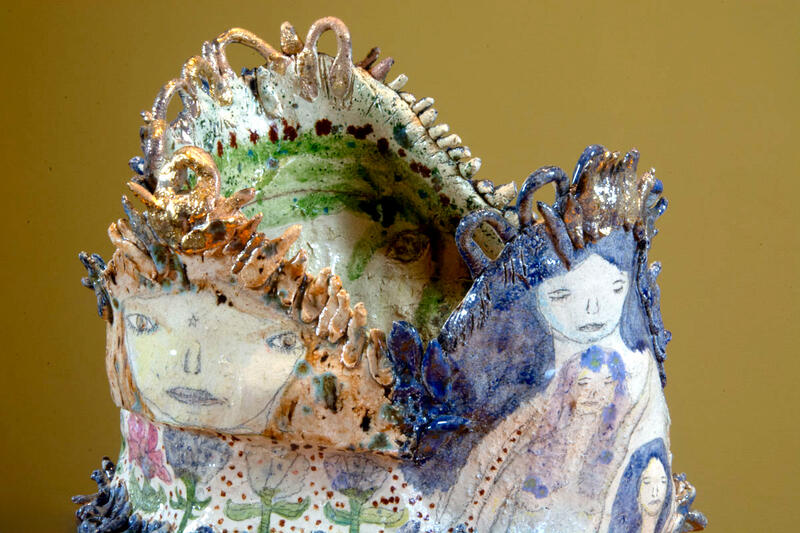
In this conversation with curator Manuel Vásquez Ortega, Sarmiento delves into his interest in mythology and ancient cultures, as well as his deep connection to orality—a means of communicating and preserving stories and knowledge from ancient times to today. In an era saturated with digital images, contemporary ceramics emerge as a way to endure and safeguard knowledge in a world where everything seems fleeting.
Manuel Vásquez Ortega: Samuel, your recent exhibition in Bogotá has an anthological character, exploring recurring themes in your work: water, myths, and figuration. These elements coexist in your pieces, creating an ecosystem of symbols that invite detailed observation and narrative imagination. Could you tell us more about this exhibition and the curatorial approach that shaped it?
Samuel Sarmiento: The curatorial process of Primordial Marshes: Of Waters and Goddesses was very intuitive from the beginning with María Belén Sáez de Ibarra. She undertook the task of deciphering and making sense of the symbols I create and use in my work. She was the one who initially spoke about this conceptual territory of marshes and their relationship with femininity and origin. In our previous conversations, we discussed the symbolism related to the sea in my work, and she shared a story that Bogotá was once filled with water—a kind of lake from which a series of living beings and mythical entities emerged.
However, long before that, I had an affinity for a book by Gaston Bachelard called Water and Dreams, where he discusses the relationship between water, the maternal, and the origin of life. It's curious because that's precisely the image of the marsh: a watery territory that might seem like a swamp at first glance but gives rise to the existence of many beings. It's a space where semantic and ecological dynamics and interrelations are generated. I like to think that this image of the marsh and the elements that live in it have a certain connection with the characters and symbols I've worked with for many years. They exist in an aquatic space, which can be both a maternal womb and a swamp. From these similarities, we began to talk about myths, divinities, and the presence of the feminine figure in all of this, which ultimately shaped the exhibition.
This brings to mind the approach of feminist philosopher Teresa Mira de Echeverría regarding myth and women, asserting that "perhaps the most meaningful female myth for our times is metamorphosis." Does metamorphosis have a place in your work and in this exhibition?
That's an interesting point about metamorphosis. It's even a lesson that nature constantly demonstrates: achieving changes, transformations, and branching from a point of origin. If we think of the idea of a rhizome, we'll see that the plant kingdom moves in that direction, constantly trying to survive, transforming from what exists, branching into possibilities; and that includes history. I believe we are changing the way we digest history, the way we write it, and therefore, the way we understand it. Perhaps one of the most interesting ways to reinterpret history is to understand the origins and speculate about them. Primordial Marshes speaks about origin, starting from the theme of the feminine, the maternal, from that which connects us to our most germinal self, to our matrix.
On the other hand—also speaking of transformation but opening a gap—I think literature itself is like a window that allows us to create fields of metamorphosis or create possibilities for change that perhaps reality doesn't allow us to change entirely. I firmly believe that literature is a way to speculate about history and its possibilities, and that we must not lose faith in possibilities.
It's fascinating, this desire to approach history through speculation; it's precisely one of the possibilities that ancient history and the unwritten offer: fiction. However, among many layers of fiction, we can have one certainty: ceramics have been present in humanity since its beginnings. Pottery, painting on stone, storytelling around the fire... These are all "resources" that have accompanied humans since their earliest days and, in a twist (one of those that history—and the market—takes), are now of interest in contemporary art. What is your relationship with the ancestry of ceramics?
When we talk about transformation, we can see how both the individual and matter are capable of changing form. From a planetary perspective, this is because all living individuals are made of matter, being part of a whole. I believe that the act of shaping or transforming mineral or vegetal matter into objects capable of narrating stories is a way to sublimate human action into an act of communication. The very act of kneading, the act of transforming this organic matter, is an action of preserving technical, bodily, intellectual knowledge, or perhaps the profound need to continue communicating over time.
I'm particularly struck by the fact that, when we look at the origins of ceramics—whether from Egypt, Greece, Rome, China, or pre-Hispanic ceramics—we always see the need to narrate important historical events or to share stories that could be relevant in shaping certain contexts that humanity experiences. I think that in many cases, ceramics have served as a tool to make inventories, to store valuable information, to preserve, exalt, point out, and I believe we continue to do so at this moment. The thing is, before, there were no art markets; now there are. And what happens with this? We're in a very peculiar moment where production is based on the final need—or even more so, overproduction.
That is, in the past, having original, 'customized' objects or objects that told amazing stories was a luxury few could afford; whereas now we live in an era of image and object saturation, we experience the democratization of image and history. In response, the return to ceramics could be a need driven by recovering the value of rudimentary, manual, analog crafts, of enduring.
I'd like to return to the idea of painting on stone to talk about your connection with painting and drawing. How does your ceramics 'drink' from painting (and vice versa)? How has this process of relationship between techniques been?
I came to paper perhaps because I didn't have enough technical skills as a painter; but mostly because I felt it was a much more direct medium. By this, I mean that a wash could be a mountain, some simple strokes could become a forest, much more immediately. Then I did some tests with ceramics and decided to draw on this new surface. I felt comfortable and fascinated exploring, enjoying myself among so many steps where there was a high probability of errors.
Over time, I noticed that in this new material, two-dimensionality was offering me more possibilities. My language began to take organic shapes, referencing objects I saw, images I took from my readings; everything happened very intuitively, and little by little, I've managed to reach three-dimensionality by creating symbolically utilitarian objects, so to speak. But the utility of these objects is to tell a story.
I feel that I haven't yet reached the point where the sculptural gesture has the capacity to narrate a complex story, but rather I use this surface to contain these fables. And many times, we see that what truly moves from the pieces is not their form itself, but the theme or some very precise detail contained in that object. I don't see myself as a ceramist; for me, ceramics and the craft it entails are just a support to develop constructions that come from painting.
And one thing I find very interesting—it's not something new, many people have done it—is trying to reproduce through painting characteristics of which there isn't much reference, but that generated turns in history. An example: imagine I decided to make a series of birds, and these birds were the ones García Márquez describes in one of his stories; it's a pictorial and imaginary exercise of trying to reproduce something that doesn't exist. In literature, it's a strategy of Borges, who had the ability to use literary references he himself invented, and those literary references he connected with historical events, places, countries, and writers that were also invented, and then the boundaries between reality and fiction become indistinguishable. And that interstice is where I'm interested in narrating through images.
It's well known that geographic location and environment influence the ways of seeing and understanding oneself, both as a person and as an artist. Do you think that living in a place like Aruba has affected or touched your artistic production?
In my work, I tend to accumulate many stories from the oral tradition, both Caribbean and Latin American. What strikes me about these is that many times, major events—from the origin of knowledge to the reasons for significant social changes—always come hand in hand with external factors. It makes me think of a theory I like: panspermia, which says that life came from outside Earth. When we look at Caribbean or South American stories—for example, the origin of pottery or the discovery of certain foods—we always see an external phenomenon that occurs (apparently out of nowhere) and generates a change. Living on an island sometimes feels like that, as if everything that happens comes from the outside. In my work, I reflect on this circumstance, as I think it's interesting to open ourselves to possibilities and positive confrontations; to let two seemingly unrelated ideas converge and feed off each other to see what happens.
Samuel, to conclude: in this exhibition, you bring together over 10 years of work and pieces. Do you consider yourself a prolific artist? What does it feel like to have an anthological exhibition as a young artist?
I feel grateful to the Claustro de San Agustín of the National University of Colombia and curator María Belén Sáez de Ibarra for allowing me to exhibit and trusting in my work. I don't consider myself particularly prolific; I just try to be consistent. Often, you have to work more to make it evident that you need to show your work. I believe that the museum and gallery system can be quite thorny and contradictory, although there are curators and artists doing things well. I think the key lies in understanding that the center is everywhere, and that a masterpiece or an unprecedented project can be created from any corner of the world.
MAC Panamá's Chief Curator Juan Canela, reflects on the challenges of curating in Central America, the value of collaborative practices, and the context of Panamanian art. He is participating in the inaugural Pinta Panamá Art Week, running May 21–25 with activities centered on the local art scene.