
UNSTABLE GROUND: ELENA DAMIANI IN STOCKHOLM
The sculptures of the Peruvian artist reveal the movement of the natural world, from the monumental to the fragmentary.
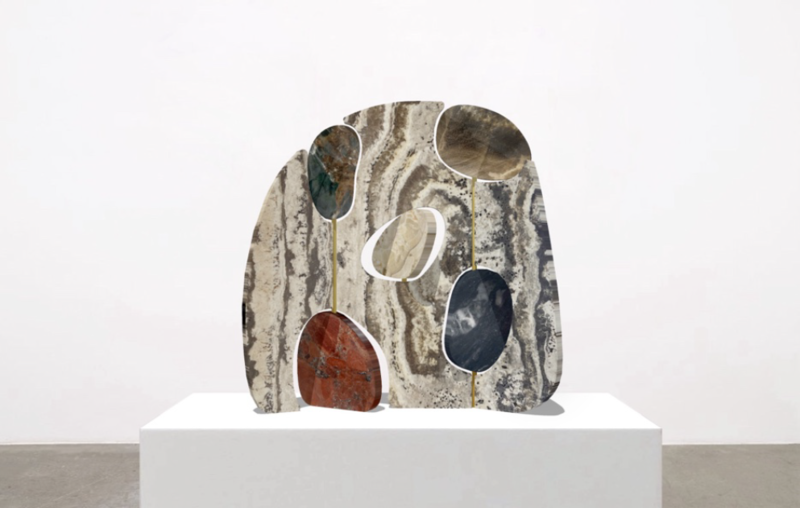
In Rising Grounds, Elena Damiani presents a series of sculptural works that articulate a vision of the natural world as perpetually unsettled, formed by accumulation and disruption, always in motion even when appearing still. Across new and recent works, the exhibition reflects a central concern in Damiani’s practice: how geological forms, often perceived as stable and inert, are in fact sites of continuous transformation shaped by deep time, tectonic pressure, and environmental flux.
Damiani’s sculptural language is grounded in material research and geological symbolism. Her use of stone goes beyond its traditional sculptural weight to propose a different kind of monumentality: one that is modular, fragmentary, and receptive to change. In Rising Grounds, stone becomes a record of time’s passage and a proposal for structural impermanence, Where the built and the eroded coexist.
-
Elena Damiani. Strata belt. Crater Fantasia travertine, stainless steel. Variable dimensions. 180 x 200 x 56 cm approximately. Courtesy Galerie Nordenhake
At the center of the exhibition is Strata Belt, a large, flexible spine composed of 105 paired travertine modules. Though assembled from heavy, solid material, the work is conceived as a mobile and reconfigurable form; capable of bending, expanding, or contracting in space. Its structure evokes the slow folding of orogenic belts and stratified sedimentary layers, suggesting a landscape that rises through compression and displacement. This logic of adaptation, where even the densest materials carry the possibility of shift, is echoed across the other works in the show.
Earth Drill introduces a new verticality in Damiani’s practice. Here, diagonally cut travertine cylinders form a helical stack, recalling both industrial tools and biological spirals. The piece suggests a force that moves inward and upward, drilling into geological memory while gesturing toward transformation. The geometry of the drill, precise yet elemental, becomes a symbol of excavation, inscription, and encoded motion.
-
Elena Damiani. Earth drill. Crater Fantasia travertine, copper, steel, 250.5 x 40 x 40 cm. Courtesy Galerie Nordenhake
-
Elena Damiani. Models after Noguchi’s Shrine of Aphrodite N.1, N.2 and N.3. Courtesy Galerie Nordenhake
-
Elena Damiani. Model after Noguchi’s Shrine of Aphrodite N.1, 2025. Travertine, marble, granite, onyx, bronze, 50 x 53 x 2 cm. Unique. Courtesy Galerie Nordenhake
In the Models after Noguchi’s Shrine of Aphrodite, Damiani reinterprets the notion of the architectural model as both a vessel and a fragment. These compact stone structures open like triptychs to reveal smaller, polished stone elements that can be rotated in place. Drawing from the morphology of breccia formations, where disparate stone fragments are embedded in a finer matrix, the works embody both cohesion and fracture, movement and stillness.
This tension between natural force and structural language also shapes the two new pieces from the Unfoldings series. Drawing inspiration from Donald Judd’s serial geometries, these wallbased sculptures stage a quiet interplay between mass and reflection. Carved travertine boxes hold slanted copper planes that reflect fractured rock surfaces within. These internal reliefs, handsplit and raw, bring instability into the logic of the cube, allowing light and stone to perform an ongoing, mirrored transformation.
-
Elena Damiani. (referential image) Unfoldings I - II. Hand-carved Rumi travertine, copper, duralumin, 27 x 66 x 27 cm. Courtesy Galerie Nordenhake
By making geological time visible through sculptural form, Damiani’s work challenges the viewer to consider matter not as permanent, but as perpetually reorganizing: a body that holds tension, carries history, and remains susceptible to change. These works hold a quiet urgency. They suggest that even the most seemingly immovable parts of the world—mountains, strata, stone—are not static, but in slow motion: rising, folding, fragmenting, and re-forming.
Rising Grounds will be on view from August 21 until September 27, 2025, at Galerie Nordenhake Stockholm,Lützengatan 1, SE-115 20 Stockholm (Sweden).
May interest you


BEAUTY, MEMORY, AND ENVIRONMENTAL COLLAPSE AT BALTIMORE MUSEUM
Black Earth Rising brings together artists from the African diaspora, Latin America, and Indigenous communities to explore the links between environmental devastation, colonial legacy, and the possibility of imagining alternative futures.

CHAOS AND TECHNOLOGY BY SANTOSCOY, AT THE MUSEUM OF AMERICA
The Museum of America is hosting an exhibition of paintings by Juan Carlos Santoscoy (Guadalajara, Mexico, 1973) in its La Tapada gallery, open until the end of the month. Titled Algoritmos del caos (Algorithms of Chaos), the show features a selection of the artist’s most recent large-scale works, which engage with pressing themes in contemporary art such as global warming and the overexploitation of natural resources.