

By
Álvaro De Benito
The two Colombian artists approach the exploration of painting’s zero point through separate solo exhibitions at La Cometa, responding from positions shaped by contemporary visual saturation and the suspended pictorial gesture.
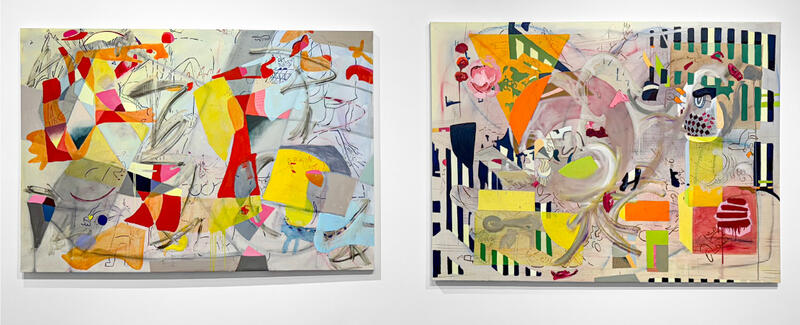
La Cometa presents at its Madrid venue a dual pictorial proposal that revolves around two distinct ways of understanding the origin of pictorial action. Although independent, Parar el mundo, by Adam Goldstein (Bogotá, Colombia, 1989), and Pensamiento mágico / El año entrante, by Alejandro Ospina (Bogotá, Colombia, 1970), enter into dialogue through a shared concern: the search for painting’s zero point in a time marked by saturation and the acceleration of experiential life.
Both artists address this question from apparently opposing positions, yet ones that prove highly complementary in their outcomes. While Ospina works through appropriation, digital layering, and the excess of media images in order to recover a primary condition of seeing, Goldstein follows an inverse movement from within, privileging suspension, interiority, and expressive reduction.
Ospina’s pictorial research unfolds alongside the radical transformation imposed by the digital era on the consumption of images. Within this proliferation of visual material, which generates perceptual saturation, the artist proposes strategies aimed at re-establishing a mediated relationship between painting and image, restoring a form of direct experience and clarity within contemporary noise.
He also incorporates drawings made by his children during the pandemic period, introducing a key additional layer within this process. These children’s images, still unmarked by social, media, cultural, or advertising codes, return the viewer to the innocence of a primordial gesture, allowing a direct confrontation between spontaneous imagination and the historical and digital references employed. In this way, Ospina turns painting into a space of memory in constant transformation, where the innocence of the mark points towards a zero point of becoming.
Adam Goldstein, by contrast, departs from a more expressive and introspective premise. For him, painting can be equated with an initiatory impulse linked to the possibility of halting the processes that disturb contemporary perception. His practice, rooted in gesture, seeks a form of spirituality that unites action and expression within pictorial creation.
His work materializes through physical processes in which color and form are allowed to take control of the act of making. In the absence of primary mediation, his painting recovers a contemplative abundance in which chromaticity operates as a primary language. Goldstein’s pictorial surfaces reveal landscapes and atmospheres that suggest an experiential instruction of perception, introducing a pause and pointing, perhaps, to another valid understanding of the origin and purpose of pictorial practice.
Adam Goldstein: Parar el mundo and Alejandro Ospina: Pensamiento mágico / El año entrante can be viewed until 5 July 2026 at La Cometa, San Lorenzo 11, Madrid, Spain.
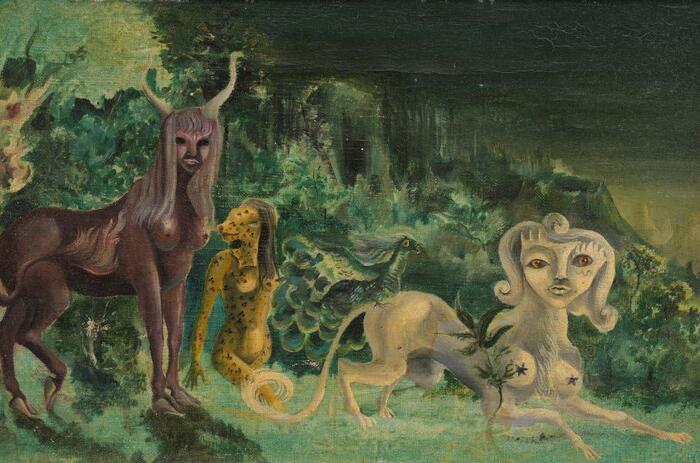
The exhibition Leonora Carrington: el surrealismo sintomático will include a painting the artist made in 1940 during her stay in Santander, a work that has remained hidden for decades.
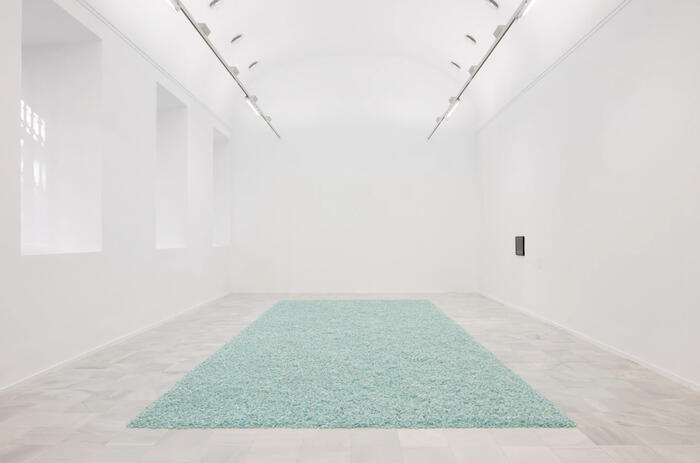
The Museo Reina Sofía presents a selection of more than fifty participatory, reconfigurable and conceptually driven works by Felix Gonzalez-Torres, activating a contemporary reading of his practice that exceeds both curatorial boundaries and established discursive frameworks.
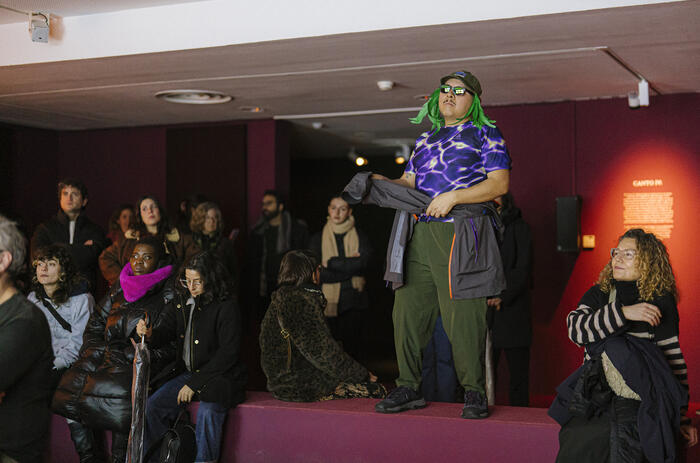
The call for submissions, open until May 31, is aimed at creators residing in Spain and invites them to design performative tours and workshops in dialogue with “Cautín,” the exhibition by the Mapuche trans artist.
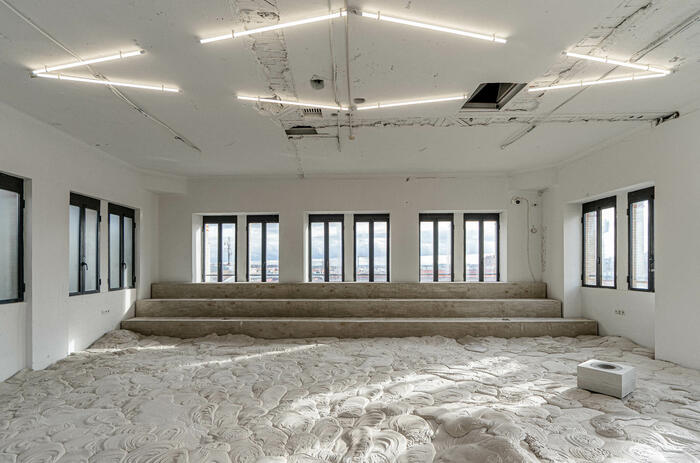
Fundación, by Marlon de Azambuja, transforms one of La Casa Encendida’s towers into a walk-through sculptural installation. Aiming to reflect on the act of founding and the search for what underpins knowledge, the work questions the divisions between reason and sensation and proposes the exhibition space as an experiential environment.
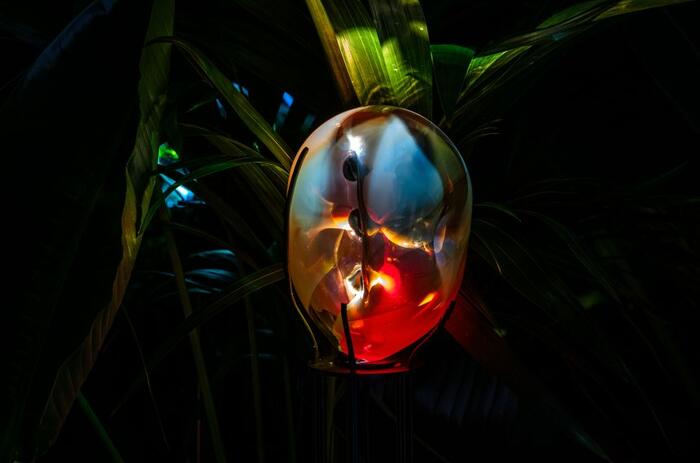
Tania Candiani arrives in Valencia with an immersive installation that reimagines the subsoil as a living, speculative organism, where nature, technology, and memory converge to configure a hybrid ecosystem.