NFT, BLOCKCHAIN AND CRYPTOART: CHAIN REACTION
Collectors, investors and artists are fascinated by the promising profitability of NFTs. The phenomenon exploded with the succulent sale of a digital work by Beeple (Mike Winkelmann) in 2021 and since then it has generated a chain reaction whose consequences are still not entirely clear.
The least attended aspect is that of the artistry or aesthetic value of works of art in the blockchain ecosystem. It is not clear if the work is the sensitive concretion of the creative process or the code that enables it for an electronic transaction. It is also not well understood whether what is being offered is the codification of an idea, a new model of finance, or a simple property registry. Supply and demand seem to be the only visible rule. But not much is said about the aesthetic qualities.
-
Beeple. Everydays: The First 5000 Days. Editions: 1. Collector: Metakovan. Date Sold: 11 Mar 2021. Price: $69,346,250.00 (24,346.626 ETH). Gallery: Christie's. Source: https://cryptoart.io/
In this environment of expectations, there is enthusiastic talk of a new artistic modality: crypto art, which in simple terms means something like digital art + NFT, and includes illustrations, videos, GIFs, memes, podcasts, songs, avatars and tweets. Its distinctive qualities are immateriality, free (virtual) accessibility and the support of authenticity. As an additional attribute is the decentralized nature of the process of circulation of the work that eliminates the system of intermediaries and the hierarchy of the traditional art market. However, some auction houses and online art spaces (including virtual museums) are entering the crypto art scene as licensed mediators. In aesthetic terms, most crypto art develops from the imagery of cyber culture or is inserted into the premises of pop culture.
The technological and market factor still prevails over aesthetic issues. The important thing for many of interested parties in what is happening with crypto art is the story behind the work or the author's narrative. At the moment, there is nothing substantial from a sensible point of view except the incentive to break into a platform that offers new benefits, although many of them remain to be seen or will never have a measurable manifestation.
Apparently, crypto art has managed to turn the Benjaminian thesis on reproducibility and aura into an oxymoron. Crypto art is reproducible and original at the same time, so the aura of its exclusivity remains even when its accessibility is unlimited. The authorship remains intact and the work cannot be plagiarized. But this sounds more like filing a patent than generating a culturally exceptional product (at least so far). The way things are going, perhaps we should no longer talk about the loss of "aura" due to reproducibility, but about its belated replacement by a new type of collective "fascination" where the aesthetic is irrelevant.
Boris Groys speaks of "objectless aura", which is close to the current phenomenon. But that post-fact aura is very different from the one that used to surround conventional works of art. It does not bring with it that hypnotic commotion of the spectator in front of the work, but the expectant euphoria of the bettor before the roulette wheel while the ball spins weightlessly. It is the aura of probability, riding on an algorithmic chain. Here is another unprecedented form of the aesthetic where beauty does not reside in the thing.
What is extraordinary is the connection between the idea of art and the evolution of money. In crypto art, both things seem oriented to the same purpose or at least they are "chained" in the same technical substratum. The old belief that money and art are antagonistic seems to dissipate.
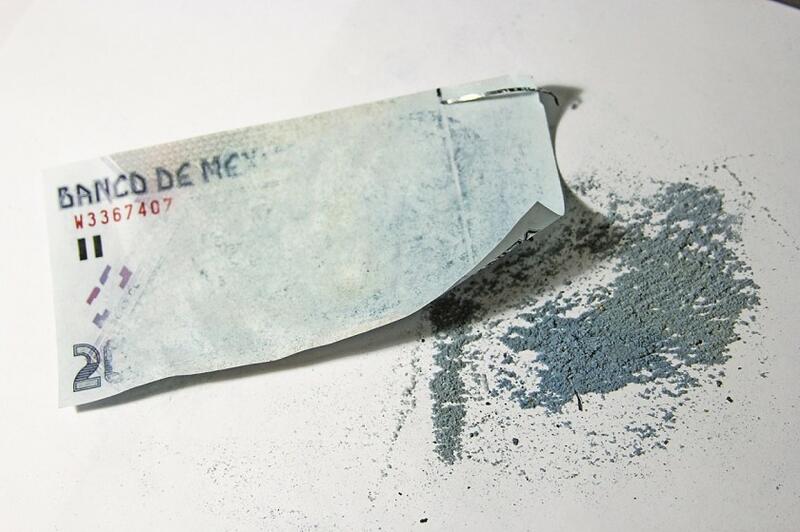
In truth, money is not the problem, but its relation to the goods and desires it can buy. Long before the appearance of cryptocurrencies, various artists had confronted the issue. In Brazil, Cildo Meireles used coins and bills of dollars and cruzeiros with zero denomination. In Mexico, Miguel Rodríguez Sepúlveda inscribed the phrase "I do deserve abundance" on old nickel coins and Fritzia Irizar made works by sanding the pigment from 20, 50, 100, 200 and 500 peso bills. The Japanese Yuken Teruya recreated trees, landscapes and cities by cutting out won, yuan, yen and dollar bills, while the Venezuelan Milton Becerra made tapestries with Bolívar coins. Before, as now, money is an abstraction that establishes equivalences between the material world and the financial universe, an issue addressed by fellow Venezuelan Alberto Cavalieri in his Cryptoblocks. What is different is that both crypto art and its monetary support are now fully virtual and what is exchanged is nowhere and everywhere at the same time.
-
Miguel Rodríguez Sepúlveda. Elegía y (re)Percusión (Sí merezco abundancia), 2019, Punched nickel coin.
-
Miguel Rodríguez Sepúlveda. Elegía y (re)Percusión (Sí merezco abundancia), 2019, Punched nickel coin.
-
Cildo Meireles. Zero Cruzeiro, 1974-1978. Double-sided offset lithograph. MoMA Collection, New York.
On the other hand, the vertiginous expansion of crypto art is generating an avalanche of new names and pseudonyms of artists whose resumes and statements do not resemble those that support the activity of the best known "analog" artists. They do not detail studies carried out, residences, awards, collections or exhibitions, except for impressive appearances or viral flows of their proposals on electronic platforms. This singularity is redefining the traditional reference indicators to evaluate the trajectory of an author. Its relevance is not argued by concepts but based on stories and personal motivations, the most seductive being those that crystallize with millionaire sales.
-
Fritzia Irízar, Sin título (Polvo), 2005.
-
Dmitricherniak. Self Portrait # 1. Editions: 1. Collector: Edgar_eth. Date Sold: 26 Oct 2021. Price: $2,682,000.00 (941.618 ETH). Gallery: SuperRare. Source: https://cryptoart.io/
-
Milton Becerra. Tapiz de monedas, 1997. Bs.2 coins, linen fibers. Beatriz Gil Gallery, Caracas.
Either way, it's too early to establish the aesthetic relevance of crypto art. The prudent thing, however, is to contextualize this modality in the vast territory of the metaverse, a virtual galaxy in gestation, where the rules will be different and what we understand by art will be different. For the moment, we must greet those who are already preparing to colonize this new world where art will retain its aura even if it has no object. If the prediction comes true, there will also be critics, curators and analysts who will discern between the significant and the banal. Then the value "chain" (including the artistic question) will be complete.
Related Topics
May interest you
FROM PARTICIPATION TO IMMERSION
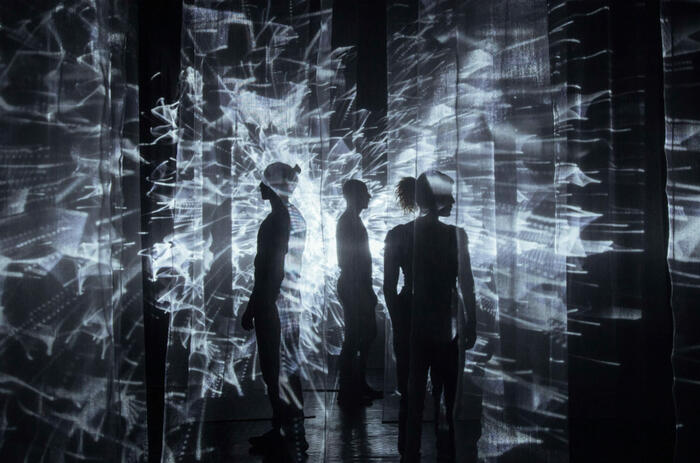
A few decades ago, the art utopia consisted of incorporating the viewer into the work, either physically or sensorially. Frank Popper called these practices with the term "participation art".
RICHARD GARET: FRAME COMPOSITIONS
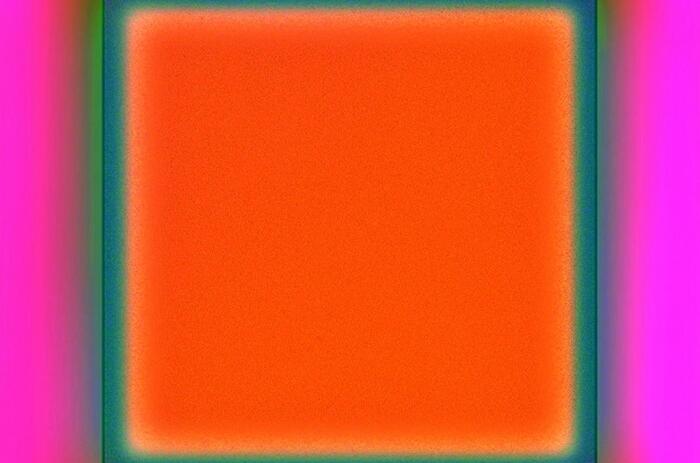
Recently, Richard Garet, a multimedia artist based primarily in New York City, opened a solo exhibition titled “Frame Compositions” with 1stDibs NFT marketplace. The eponymous show exhibits 29 vibrant NFT works and explores the relationship between color, light, surface and form. Garet’s practice encompasses sound installations, performance, computer applications and other mediums. Adhering to strict parameters, he creates compositions by carefully selecting high-definition 1080x1080-pixel square frames one-by-one and then collating 60 per second using computer applications. Because each work contains 1800 frames squeezed into a 30 second time period, the eye can no longer identify individual frames, thus, creating moving images.
ART, A HARD BONE TO CHEW
Regarding Artist in Residence, an exhibition by Fernando “Coco” Bedoya (Borja, 1952), at the Instituto Cultural Peruano Norteamericano (ICPNA) in Miraflores, Lima, Peru. Curated by Max Hernández Calvo, the exhibition is open until June 4, 2022.
ART AND ALGORITHMS. BEFORE (AND AFTER) MACHINES TOOK OVER
Before machines took over, many issues were resolved following an algorithmic principle with some logic and a little math. The originator of the idea was a Persian mathematician in the eleventh century. Later, the procedure became essential for science, everyday life and art. Basically, the algorithmic methods are in the patterns of Islamic art (see tessellation notation), in the Andean chakana and quipus of the Inca period, in the Renaissance perspective and in other representational devices of the pre-digital era.
NFTS AND METAVERSE: A CUBIST VIEW ON THE NEW DIGITAL ECOSYSTEM (PART 1)
As a conceptual artist working in the crossroads of art, science, and technology, with a corporate past and a social communications baseline, I am deeply interested in the new digital ecosystem raised by blockchain technology, NFTs and the Metaverse, from a perspective that addresses this realm as a sociological phenomenon, as a new business field, and as another one of the many mediums I utilize to express my ideas.
NFTS AND METAVERSE: COLLECTORS OR INVESTORS? (PART II)
Although traditional art collecting includes an investment component and a business perspective, it still invokes a sort of romanticism aura that builds around an artist. A classic collector tends to follow an artist's trajectory, supporting his work. The new wave of NFT collectors stand out for not belonging to traditional art environments. Most of them are young aged and have never set foot in a museum or gallery, and therefore prioritize the finance aspect to NFT collecting to the emotional one. Generally, they are folks whose field of expertise is related to fin tech – they come from and drive the crypto world. And yes, they are mainly men.