NETWORK RADICALITIES - THE EARTH'S WOMB
"But what messages do these artists, in O Ventre da Terra, address to us? (...) For them, the land is not just one thing. Now it is homeland and nation, sometimes nature and landscape, sometimes texture and materiality, now ancestral and primeval origin, now cemetery and final destination." The art critic from Rio de Janeiro Pollyana Quintella synthesizes the multiple vectors to which the thought-provoking group of pieces present in the collective exhibition of the gallery Superfície in São Paulo can be directed. It does not escape the attention of almost all women in authorship and the time when it was conceived - the 1970s, of marked experimentalism in the face of the repression of the lead years in the political sphere, which would still last some time in the 80´s.
Ventre da Terra (The Earth’s Womb) brings together works by Amelia Toledo, Ana Mendieta, Anna Bella Geiger, Anna Maria Maiolino, Celeida Tostes, Helio Eichbauer, Lotus Lobo, Mara Alvares, Neide Sá, Nydia Negromonte, Péricles Eugênio da Silva Ramos, Sérvulo Esmeraldo, Tunga and Vera Chaves Barcellos. Such productions are related to the scope of the young gallery (active since 2014) directed by Gustavo Nóbrega, who conducts praised prospects on the corpus of works by names that, for various reasons, did not have a focus on the circuit at the height of the trajectory - in the clipping of O Ventre ..., we can mention Neide Sá and Lotus Lobo. Superfície, in this line, also represents Sonia Andrade, Falves Silva and the Poema / Process group, among others.
One can’t neglected to highlight the much more evident interest of the medium in relation to gender issues (in this case, women). A paradigmatic exhibit in this line is Radical Women: Latin American Art, 1960-1985, curated by the Argentine Andrea Giunta and Venezuelan Cecilia Fajardo-Hill and which roamed at the Hammer Museum, in Los Angeles, at the Pinacoteca do Estado, in SP, and the Brooklyn Museum in New York. Of the 120 artists presented, Amelia, Mendieta, Anna Bella, Maiolino, Celeida, Mara, Neide and Vera Chaves are exhibited. In São Paulo, Radical Women had public queues, voluminous reviews and a catalog that was quickly sold out.
-
Ana Mendieta - Sem Título, da série “Silueta” – 1977 – Fotografia - 25,4 × 20,3 cm
-
Ana Mendieta - Sem Título, da série “Silueta” – 1979 – Fotografia - 24,1 × 15,9 cm
-
Nydia Negromonte – Posta - 2012/2021 – Instalação - Mesa, frutas, legumes e argila crua - Mesa: 41 × 139 × 139 cm - Foto: Daniel Mansur
-
Nydia Negromonte – Posta - 2012/2021 – Instalação - Mesa, frutas, legumes e argila crua - Mesa: 41 × 139 × 139 cm - Foto: Daniel Mansur
The archives and collections of artists of different approaches, when turned over, can always generate impacting (re)discoveries, investigations that remain current and with a risky facet, such as a living laboratory, provocative and open to accident, to the non-programmatic. Under this analysis, Rio de Janeiro's Celeida Tostes (1929-1995) emerges strongly. Often remembered for her didactic work in Parque Lage, Rio de Janeiro, a true oasis in terms of an art school during the dictatorial regime, especially under the direction of Rubens Gerchman (1942-2008), exponent of Brazilian pop art.
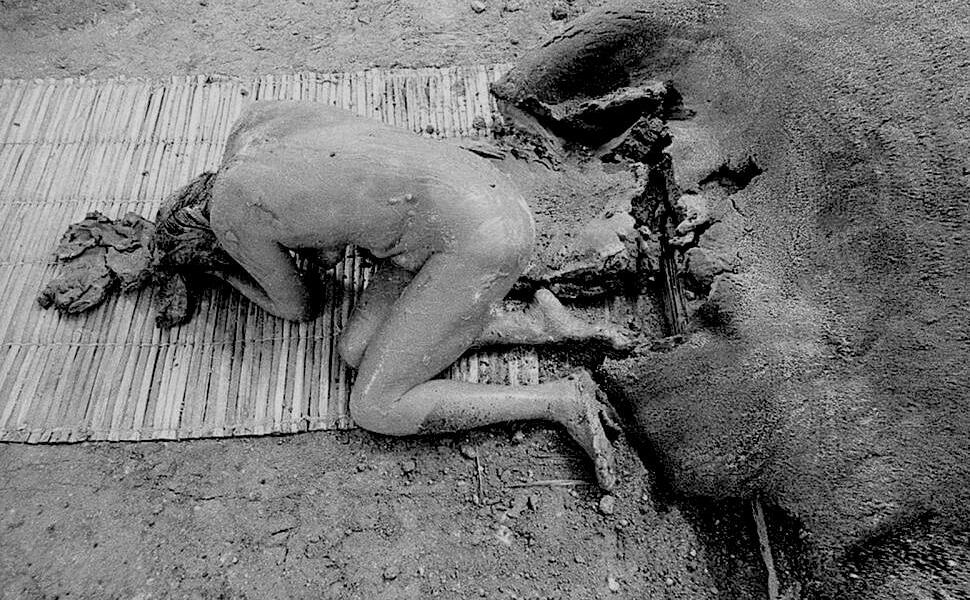
Passagem (1979) is a work that does not escape and resonates deeply with the most attentive subjectivities. With the help of two assistants, Celeida is enclosed in a liquid clay vase installed in an apartment in Botafogo, south of Rio. The helpers completely close the container and, after an agonizing time, to say the least, break the object and she heads out. Crossing attributes of performance, photography and sculpture (this living and moving, a three-dimensional one that goes beyond spatial limits), the 23 records and a poem that form Passagem are inscribed as one of the memorable moments of Brazilian art, whose readings are greater than the political. It has a power similar to that of a work that is also pivotal, Ovo (1967), by Lygia Pape (1927-2004), undoubtedly one of the main national artists and currently exhibiting at Hauser & Wirth in Los Angeles. From Celeida, the exhibition also features the installation Amassadinhos (1991), also made of clay and made up of 142 small-scale pieces that tell a lot about her poetics, which moves between the handling of an essential materiality and the obsessive gesture.
-
Celeida Tostes - Passagem - 1979/2021 - Impressão sobre papel fotográfico - Conjunto de 23 imagens + poema - Imagens horizontais: 23,5 × 35 cm. Imagens verticais: 35 × 23,5 cm. Poema: 35 × 23,5 cm - Registros fotográficos de Henri Virgil Stahl
-
Celeida Tostes - Passagem - 1979/2021 - Impressão sobre papel fotográfico - Conjunto de 23 imagens + poema - Imagens horizontais: 23,5 × 35 cm. Imagens verticais: 35 × 23,5 cm. Poema: 35 × 23,5 cm - Registros fotográficos de Henri Virgil Stahl
-
Celeida Tostes - Passagem - 1979/2021 - Impressão sobre papel fotográfico - Conjunto de 23 imagens + poema - Imagens horizontais: 23,5 × 35 cm. Imagens verticais: 35 × 23,5 cm. Poema: 35 × 23,5 cm - Registros fotográficos de Henri Virgil Stahl
Anna Bella, whose production has been well regarded in the country and abroad, places the question of land in data more linked to the discussion of a national identity and from a social perspective. Brasil Nativo / Brasil Alienígena (1976-77), polyptych of 18 postcards, and History of Brazil: Little Boys & Girls (1975), polyptych of six photographs, question the clichés about indigenous people in the country, among other approaches, and gain poignancy when they reflect on the difficult conditions of the first nations in the political, economic and social context of Brazil, which are further exacerbated by the Covid-19 pandemic. "Having experienced the events of the second half of the 20th century, in Rio de Janeiro, her work’s operational field has been as much a critical or resistance response as the pure play of the language possibilities of the materials," writes Briton Guy Brett (1942-2021) about the carioca.
And considering the continental dimension of Brazil, the presence of artists outside the Rio-São Paulo axis is highly commendable. Rio Grande do Sul is a very active center of the visual arts and, in O Ventre ..., it is represented by Vera Chaves, who has a foundation for her work and in dialogue with other avant-garde names in Viamão, Porto Alegre metropolitan region, and Mara Alvares, Vera's partner in the provocative Grupo Nervo Óptico (1976-78). Epidermic Scapes (1977) is Vera's flagship series, in which portions of her body are poured into photographic close-ups and the skin bulges like a special type of landscape. Mara has the series Adansônia (1976-77) on display, polyptychs in which the artist merges with panoramas of nature and, in a way, anticipates ecological concerns. In formal data, it blurs the configurations of the languages of photography, performance and sculpture (here seen more as an idea, with pulsating contours). From the Northeast of Brazil, Sérvulo Esmeraldo (1929-2017) has exhibited the book of artist Trilogia (Poema-Objeto), from 1976-2012, in dialogue with the literary creations of Silva Ramos (1919-1992).
-
Vera Chaves Barcellos - Epidermic Scapes - 1977/2020 - Pigmento mineral sobre papel - 91,5 × 107,5 cm cada
-
Vera Chaves Barcellos - Epidermic Scapes - 1977/2020 - Pigmento mineral sobre papel - 91,5 × 107,5 cm cada
-
Vera Chaves Barcellos – Memórias – 1978 - Fotografia analógica - Políptico de 20, 18 × 24 cm cada
-
v
-
Vera Chaves Barcellos – Memórias – 1978 - Fotografia analógica - Políptico de 20, 18 × 24 cm cada
-
Mara Alvares - Jogo de Esconder em 6 Toques, da série “Adansônia” – 1976 - Conjunto de 6 fotografias 45 × 43 cm
-
Mara Alvares - Jogo de Esconder em 6 Toques, da série “Adansônia” – 1976 - Conjunto de 6 fotografias 45 × 43 cm
The MNMA Studio expography deserves attention, which overcomes the coldness of the typical white cube of exhibition spaces but without noisy interferences in the observation of the works. And also the polished writing of Pollyana Quintella, an emerging art critic and rising curator in Brazil, a student of the production of Mário Pedrosa (1900-1981), one of the medallions of art criticism in the country and, why not, of Brazilian culture.
The Earth's Womb
Critical text: Pollyana Quintella
Until May 22nd, 2021
Galeria Superfície
Rua Oscar Freire 240, Jardins
01426-000 São Paulo
Related Topics
May interest you
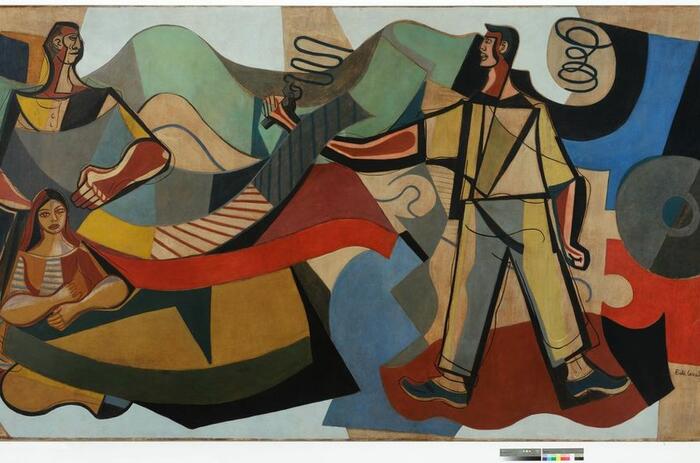
MODERNITIES IN MOVEMENT - TARSILA, DI CAVALCANTI AND THE GOMIDE-GRAZ FAMILY
The narratives of the Brazilian avant-garde in the arts go through an intense revision. Due to the centenary of the Week of 22, the emblematic event that in the thesis launched the foundations of modernity through different languagesand fields of activity in the country, three exhibitions currently on the billboard rotate and bring new elements from the production of two icons of Modernism in Visual Arts - Tarsila Do Amaral (1886-1973) and Di Cavalcanti (1897-1976). In addition, they cast more emphatic lights on three not-so-famous characters within the journeys within the movement and the modernist winds: Antonio Gomide (1895-1967), John Graz (1891-1980) and Regina Gomide-Graz (1897-1973) .
LYDIA AZOUT EXHIBITS “OLD EARTH-NEW EARTH” IN DOT FIFTYONE GALLERY MIAMI
The Colombian artist presents a selection of sculptures that flesh out her vision in accordance with what is currently happening: What happens when a space of clarity becomes a vitiated, expressionless space? Absurdity is negative. Is negativity always the end? Or is it rather a path to make way to the new? This is a personal thought process that has become matter; rather than purely conceptual, “Tierra Vieja / Tierra Nueva” is a risk, a medication, a vulnerability opened to the rebirth of pleasure and freedom.