

By
Patricia Avena Navarro
Grand Palais, Paris
Leandro Erlich's works take over the galleries of the Grand Palais in what marks his first major monographic exhibition in the French capital. The show offers an exceptional opportunity to explore a broad and representative selection of his career, enhanced by the inclusion of recently created pieces. Throughout the exhibition, visitors are invited to break away from daily monotony and step into an environment where the most familiar elements of urban architecture — doorways, elevators, staircases, façades — are subtly yet powerfully transformed. Here, visual play is not aimed at outright deception, but functions as a catalyst for awareness, placing the viewer at the true center of the experience by forcing them to question their own senses and convictions.
Erlich (Buenos Aires, 1973) has earned international recognition for his colossal immersive installations that turn the audience into active participants in the work. His pieces move beyond mere objects of contemplation to become walkable, experiential, and questionable spaces that blend ingenuity, emotion, and play. His practice brings together buildings that can be virtually scaled, houses suspended in midair, elevators that lead nowhere, escalators tangled in chaotic loops, and films that rupture normalcy. Together, these elements recontextualize the everyday within an extraordinary framework, where nothing is quite as it seems and traditional notions of space and reality dissolve entirely.
With three decades of work behind him focused on architectural-scale projects that envelop the visitor, the effectiveness of Erlich's practice lies in its direct connection with the public. Rather than presenting passive images, he designs environments of experimentation in which individuals find themselves challenged and driven to examine their surroundings — since the artist is drawn to architecture not for its practical function, but for the sensations and interactions it can trigger.
The exhibition unfolds through the Grand Palais in a gradual sequence that simulates a passage between reality and the artist's mind. Upon entry, visitors are plunged into total darkness that serves as a threshold into the realm of dreams. Within this suspended setting, the vessels of Port of Reflections come to life, alongside the cloud-like structures of The Cloud and the indiscreet perspectives of The View — pieces designed to distort the perception of space and generate a kind of silent vertigo that forces viewers to doubt what they see.
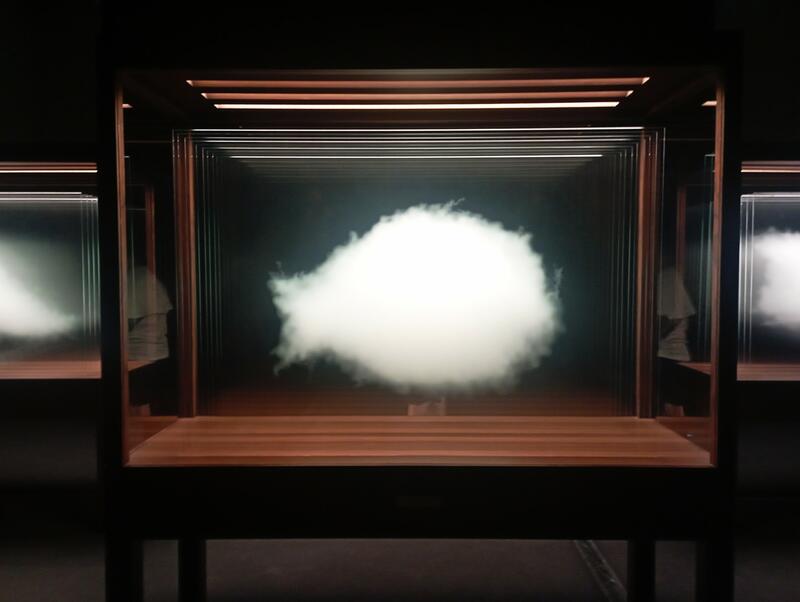
From the very first room, the artist invites us into the environmental installation Port of Reflections (2014), where visitors walk alongside a channel of dark water in the half-light, watching brightly colored boats appear to float. On closer inspection, however, the water turns out not to exist at all — the reflection of the boats is in fact a solid, sculpted structure multiplied through a system of mirrors. This loss of spatial coordinates is a recurring device in his practice, a visual trick that generates perceptual illusions. Likewise, in The Cloud (2018), Erlich captures the intangible by encasing cloud formations in imposing display cases reminiscent of the curiosity cabinets of centuries past.
Further along, something as ordinary as a staircase becomes, through the artist's lens, the reflection of a building brimming with everyday sounds and movement in Cage d'escalier (2026). As visitors move past mailboxes overflowing with letters and neighboring entrances, a cinematic illusion emerges — proof of Erlich's ability to turn an ordinary passage into a spark for the imagination. Bâtiment (2004), meanwhile, his most celebrated creation, invites visitors to lie down on a building façade replica placed flat on the ground and see themselves reflected in an enormous mirror, creating the delirious illusion of hanging from a balcony or a cornice.
Although a strong sense of play runs throughout the exhibition and draws an enthusiastic, participatory response from audiences, Erlich's artistic vision also engages with far weightier themes. Window and Ladder – Too Late for Help (2008), which depicts a fragment of a wrecked building suspended above the ground by a ladder, was conceived in the aftermath of Hurricane Katrina in 2005 as a meditation on the inability of memorials to truly repair the damage left by catastrophe.
The fourteen works gathered here show how, by disrupting familiar modes of perception, everyday objects and scenes take on unexpected meaning within the museum, allowing routine to coexist with disorientation and reshaping our sense of what is real.
On the upper level, the exhibition opens into Documentation Room: de l'imagination à la réalisation, conceived as a documentary survey of the artist's creative development between 1994 and 2026 across more than forty projects. This space brings together his major past urban interventions and offers glimpses of future plans, serving as a pedagogical pause that helps situate the coherence of his ongoing exploration between illusion and everyday life. It also includes the photographic record of Turismo, a 2000 project created in collaboration with Judi Werthein for the Bienal de La Habana. As absurd as it was revealing, the installation consisted of a photo set simulating a winter ski resort in the heart of the Caribbean, allowing local residents to be photographed with sleds and artificial snow as though on an alpine holiday.
The exhibition continues with installations that heighten spatial disorientation and multiply perspectives, as in Elevator Maze (2011), a labyrinth of open elevators in which visitors discover that many of the apparent interior mirrors are in fact empty openings connecting to adjoining cubicles. At the end of this gallery, visitors encounter the oil paintings from the Proximamente series, reinterpretations of some of Erlich's best-known installations that evoke scenes from classic films. Next come the iconic Window and Ladder – Too Late For Help, Infinite Staircase, and Elevator Pitch (2011) — the latter composed of elevator doors anonymously embedded into the walls, which burst open with a rhythmic sound to reveal fantastical, shifting scenes that break the exhibition's linear flow and evoke the literary atmospheres of Jorge Luis Borges.
The final section brings together the most physically interactive works, where the experience becomes fully immersive. Visitors can physically enter the piece, inhabit the artist's universe, and emerge from it disoriented. In Changing Rooms (2008), we step into elegant dressing rooms mirrored on three sides; rather than reflecting our own image, however, the boundaries stretch into infinity, revealing that the cubicles are interconnected — even producing unexpected encounters with strangers within the visual labyrinth. Confusion and the fear of losing oneself give way to the fascination of the encounter.
The exhibition closes with the monumental installation Bâtiment (2004), originally created for Paris's Nuit Blanche and since adapted to various architectural settings around the world. Its mechanics remain unchanged: a building façade laid flat on the ground is reflected by a mirror tilted at 45 degrees, allowing visitors to play with architectural ornamentation while their vertical reflection simulates a total loss of gravity.
Erlich's creations, exhibited at institutions around the world, reveal layers of interpretation amplified by interactivity and their enormous viral reach in the digital sphere. In this way, his work breaks through the museum's physical walls to spill into public space, becoming emblematic images of the fragilities of our era and sparking debate around the volatility of reality, isolation, and the ways we present ourselves to others.
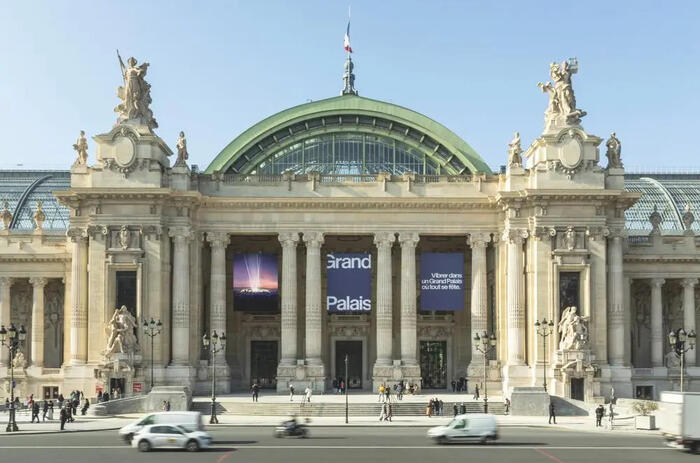
The Buenos Aires artist has turned the prestigious French building into his new stage: climbable structures, houses suspended in mid-air, and impossible staircases, through September 6.