
By
Álvaro De Benito
The videographic universe of Jonathas de Andrade (Maceió, Brazil, 1982) is only one part of his broader artistic practice. It is, of course, significant—complementing other worlds that shape the ideology and imaginary embedded in both the work and the persona of the Brazilian artist. For this reason, the selection of exclusively audiovisual works under the title Tiempo, sueño, olor (Time, Dream, Scent), on view at Madrid’s Centro de Cultura Contemporánea Condeduque, offers a concise, representative, and necessary approach that ultimately bears witness to a part for the whole.

With an implicit emphasis on the importance of the senses beyond the visual, De Andrade affirms his commitment to performative creation that transcends the audiovisual. His video works oscillate between instrumentality and their role as conduits for something more. The six pieces selected by Marta Ramos-Yzquierdo for this occasion attest to personal strands that have emerged or solidified over a decade of work, from 2013 to 2023.
Through his audiovisual practice, the artist engages with his environment in a way that transforms events, concepts, and individuals into protagonists—at once of fictional narratives and real worlds. Theoretical considerations of the visual as a construct of what audiovisual production should aim to be take a back seat. Instead, the act is materialized, recorded, or constructed out of a creative necessity. While certain formal aspects shape De Andrade’s videos, they are all permeated by themes of love and violence, and of human relationships with their environments—even when those environments are not explicitly named or recognized.
This dichotomy of human contradiction is clearly perceived in O Peixe (2016) and Columbófilos (2023), two works with different origins but converging in various ways. In both, the actions of humans and animals unfold within specific environments, but the essential focus lies in gesture. Encouraged to emphasize the mimetic as a language of emotion, the communities portrayed in the two pieces—fishermen and pigeon fanciers, respectively—are vastly different. Yet in both, the shift from routine to a consensual gesture (a pre-mortem kiss or a fictitious release) is translated into real expression.
O Levante (2013) more explicitly challenges the boundaries between fiction and reality. Possibly the most cinematic of the six works, it portrays an unreal event made tangible. The artist proposed a way to address a situation of apparent injustice by navigating the interpretation of regulations. In a city where the use of animals by farmers and vendors was prohibited, he proposed organizing a race that could only legally take place as a fictional event—thereby making the act itself possible through fiction.
While aware of the conditioned semiotics of documentary, De Andrade also engages with its aesthetic dimension. In Nó na Garganta (2022), the mechanical expressions of the participants reflect a conscious disconnection from their surroundings. With a certain political weight, the images grow more intense through technical choices, highlighting the gestural as a mirror of a shared, horizontal narrative.
Jogos Dirigidos (2019) likewise emphasizes the importance of gesture. The work documents a series of expressive exercises within a community of deaf-mute individuals. The fact that De Andrade consistently works with non-professional groups does not prevent moments of transformation from emerging—within spontaneity—when faced with the still-powerful presence of the camera.
This intrinsic element does not alter the formal outcome but does affect the process, where improvisation can shift the direction of the original idea. In Olho da Rua (2022), De Andrade introduces the camera into a group of unhoused individuals to visually document performative actions. The camera’s impact disrupts or enhances the spontaneity, elevating the production into a performative space where the extraordinary arises from the everyday.
Jonathas de Andrade. Tiempo, sueño, olor is on view through July 20 at Centro de Cultura Contemporánea Condeduque, Conde Duque 11, Madrid (Spain).
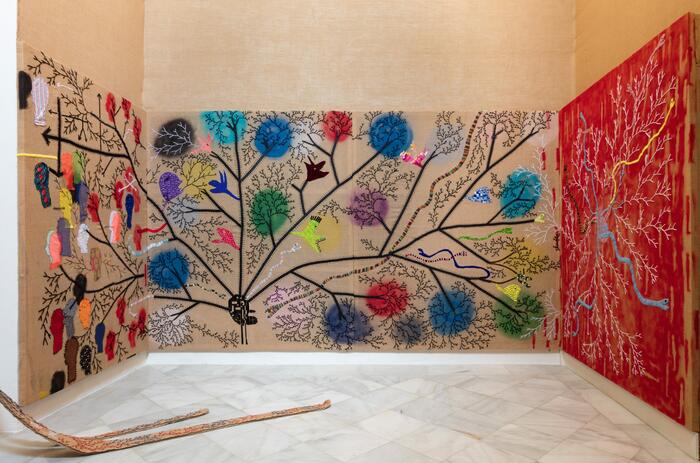
The Andalusian Center of Contemporary Art (CAAC) presents Sensemayá. Cánticos para matar a la Culebra (Sensemaya. Chants to kill the snake), the first solo institutional exhibition in Spain by Claribel Calderius (Havana, Cuba, 1986). Conceived specifically for the San Bruno Chapel, the project is a site-specific intervention that draws on the space’s historical and spiritual resonance—qualities that align seamlessly with the symbolic universe of the Cuban artist.

The Fundación Casa de México in Spain presents the exhibition Lourdes Grobet y el Laboratorio de Teatro Campesino e Indígena, a selection of nearly seventy photographs from the project developed by Lourdes Grobet (Mexico City, Mexico, 1940–2022) around the Laboratorio de Teatro Campesino e Indígena (LTCI) (Peasant and Indigenous Theatre Laboratory).

The Elba Benítez Gallery in Madrid is currently hosting an exhibition of photographs from A Sônia, a project by Claudia Andujar (Neuchâtel, Switzerland, 1931), created in 1971. This body of work stands as one of the most significant early explorations into the creative manipulation of the photographic snapshot. For this occasion, the exhibition focuses on a carefully curated selection of images that establish a dialogue of balance, intensity, and chromatic richness with the surrounding space.