
LANDMARK OLGA DE AMARAL RETROSPECTIVE DEBUTS AT THE PULITZER ARTS FOUNDATION IN ST. LOUIS
Weaving the Infinite brings together 86 works curated by Stephanie Weissberg and will be on view in September.
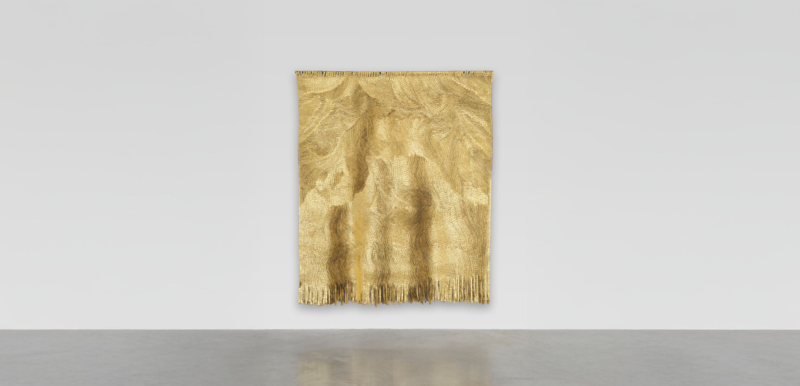
The Pulitzer Arts Foundation presents Olga de Amaral: Weaving the Infinite, the most wide-ranging investigation to date into the work of Colombian fiber artist Olga de Amaral (b. 1932). Co-organized by the Pulitzer and Cooper Hewitt, Smithsonian Design Museum, and curated by Stephanie Weissberg, the exhibition will open in September with 86 works of art; it is the first in-depth exploration of how Amaral's practice transcended boundaries between art, craft, and design.
"Amaral's work has only recently begun to receive the broad critical recognition it deserves, and comprehensive scholarship on the full breadth of her career remains limited. This exhibition is an opportunity to help change that," says Cara Starke, Executive Director of the Pulitzer.
-
Crédto Malba
This exhibition follows Amaral's continual experimentation with material, scale, and technique over the course of 65 years, from the early pieces she produced while studying at Cranbrook Academy of Art to the large-scale fiber works created over subsequent decades. Of particular focus is the artist's engagement with architecture, beginning with her Muros tejidos (Woven Walls) series from the 1970s. Drawing on her early training in architectural drafting, Amaral evolved her work from flat weavings made using traditional techniques into complex constructions that respond to space, light, and the surrounding built environment. By incorporating structural materials such as heavy wool and horsehair and assembling woven elements off of the loom, she expanded both the scale and dimensionality of her work, allowing viewers to experience it from multiple perspectives.
The exhibition also features two panels of Amaral's most ambitious work, El gran muro (The Great Wall), 1976. This monumental, 16-panel fiber artwork was commissioned by architects John Portman & Associates for the atrium of the Peachtree Plaza Hotel in Atlanta.
-
Crédto Malba
Amaral's design work and functional textiles are prominently featured in the exhibition, with a particular focus on Telas Amaral, the studio she co-founded with her husband, Jim Amaral, in 1957. On view is an array of samples of thick carpets in leather, horsehair, wool and cotton, as well as upholstery woven from natural fibers, synthetic threads, and metallic materials. A woman's dress suit in Telas Amaral cloth and a richly colored tunic inspired by the garments of Colombia's Indigenous Wayuu people represent the studio's fashion output. By pairing these materials with Amaral's fiber art, the exhibition demonstrates the connection between these two bodies of work previously considered separate.
Amaral pushed beyond convention, devising innovative techniques that broadened her creative freedom. Works from the 1970s onwards reveal her increasingly experimental approach, incorporating materials like acrylic paint, gold leaf, Japanese paper, and gesso to explore color, luminosity, and form. In doing so, Amaral has blurred the boundaries between painting, drawing, sculpture, and textile, redefining the possibilities of fiber art.
The exhibition will be on view from September 10, 2026 through January 31, 2027 at the Pulitzer Arts Foundation, 3716 Washington Boulevard, St. Louis, MO 63108, United States.
Related Topics
May interest you
THE MONUMENTALITY OF THREAD: OLGA DE AMARAL AT MALBA
The museum presents the artist’s trajectory in relation to her contexts, documenting her artistic networks, her interventions in architecture, and her pioneering role in the development of textile practice in the Americas.