ARMANDO VILLEGAS: CENTENNIAL RETROSPECTIVE AT MAMBO IN BOGOTÁ
The exhibition spans sixty years of a career and more than one hundred solo shows by a pioneer of modern art in Colombia.
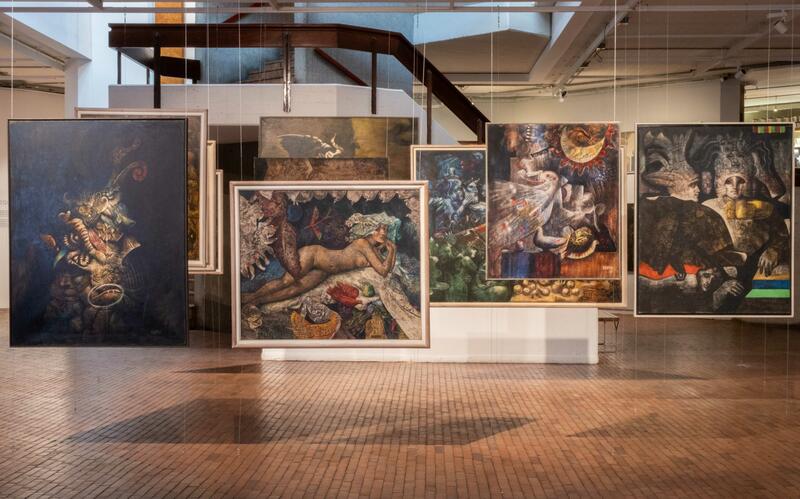
The Museo de Arte Moderno de Bogotá (MAMBO) opened Villegas 100 años. Retrospectiva Armando Villegas this September. Curated by Valentina Gutiérrez Turbay, it is on view through January 17, 2027.
Armando Villegas was a pioneer of modern art in Colombia, widely debated by the critics of his day and unavoidable in the consolidation of artistic modernity in the country. Abstract, figurative and magical, his vast body of work moved fluidly among a multiplicity of styles, themes and materials, taking cultural hybridity as a way of making art: bringing academic training and craft, Cubism and Inca geometric textile motifs, abstraction and the figure to coexist within a single painting, without melding them.
-
Vista de instalación. Cortesía de MAMBO
Born in the Peruvian Andes in 1926, he grew up surrounded by colonial painting and a strong family lineage of artisans. In the early 1950s he arrived in Bogotá on a scholarship, and his impact was immediate. Of his first exhibition, in 1954, a young Gabriel García Márquez wrote: "I have the satisfying impression of witnessing the beginning of an astonishing pictorial oeuvre."
Historiography has traditionally held that Villegas "painted cultural hybridity" through his warriors, virgins and fantastical creatures. This exhibition, however, proposes a different hypothesis: in Villegas's work, hybridity is not simply a thematic matter or an iconography, but its grammar and its compositional logic. In his canvases, assemblages and collages, Villegas joins different worlds and imaginaries without fully melding them. He combines academic technique with craft and sets the history of Western art in dialogue with ancient Inca geometric patterns.
-
Vista de instalación. Cortesía de MAMBO
A teacher by vocation, Villegas devoted nearly fifty years to teaching at various universities in Bogotá. He was director of the Visual Arts program at the Universidad Nacional and co-founder of the Fine Arts program at the Universidad de los Andes, where he trained some of the most prominent artists of the generation after his own. In 1993, in recognition of his contributions to the country's art and culture, President César Gaviria granted him Colombian citizenship.
On the centennial of his birth, this retrospective celebrates his legacy by bringing together more than 150 works spanning from the 1950s to 2013. Along the way, we see how he reinvented himself tirelessly across more than one hundred solo exhibitions and sixty years of career. As he himself put it: "What cannot be allowed is pigeonholing."