AMALIA PICA TURNS A MIAMI BEACH MUSEUM INTO A LIBRARY OF COLLECTIVE AUTHORSHIP
The interactive installation by the Argentinian artist covers walls, furniture, and objects in chalkboard paint and invites the public to draw and write with colored chalk.
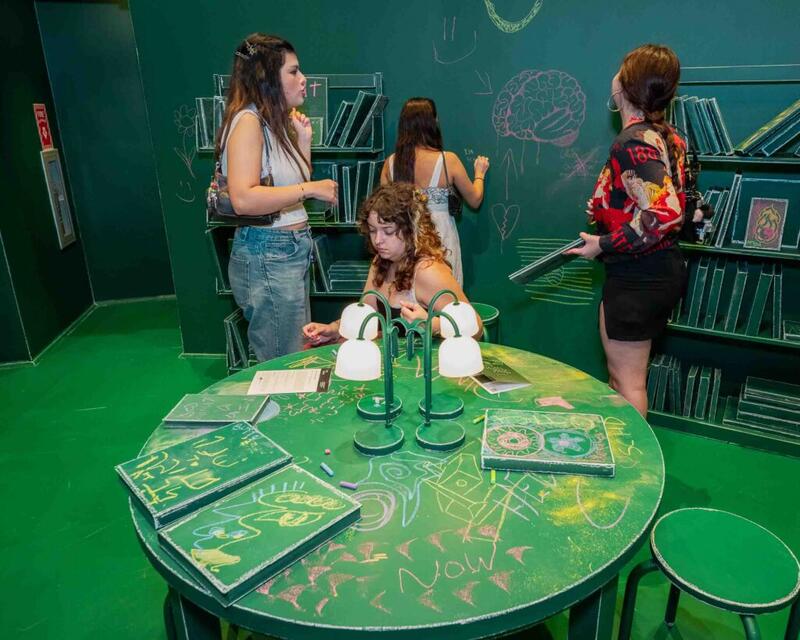
The Bass in Miami Beach presents Lecturas Posibles (Possible Readings) by Amalia Pica (Neuquén, Argentina, 1978), an immersive, interactive installation in the form of an almost two-dimensional library. The exhibition is on view through February 12, 2027.
Pica takes imagination, language, and play as fundamental tools for human connection, and constructs environments that encourage participants to redraw, rewrite, and recontextualize their surroundings. In this installation, every surface becomes a site of inscription and image: walls, furniture, and familiar objects are rendered in chalkboard paint and traced with white, hand-drawn outlines, creating a flattened, graphic environment that oscillates between object and image, presence and representation.
Bookshelves, desks, and seating areas, populated by reclaimed and repurposed objects, evoke the architecture of a library. The fused-shut books function less as fixed repositories of knowledge than as catalysts for imagination, prompting associations with educational systems, narrative construction, and the authority of the written word.
-
Amalia Pica: «Posibles lecturas», 2026, vista de la exposición en The Rotunda. Fotografía de Zaire Aranguren. Cortesía de The Bass, Miami Beach
-
Amalia Pica: «Posibles lecturas», 2026, vista de la exposición en The Rotunda. Fotografía de Zaire Aranguren. Cortesía de The Bass, Miami Beach
-
Amalia Pica: «Posibles lecturas», 2026, vista de la exposición en The Rotunda. Fotografía de Zaire Aranguren. Cortesía de The Bass, Miami Beach
-
Amalia Pica: «Posibles lecturas», 2026, vista de la exposición en The Rotunda. Fotografía de Zaire Aranguren. Cortesía de The Bass, Miami Beach
-
Amalia Pica: «Posibles lecturas», 2026, vista de la exposición en The Rotunda. Fotografía de Zaire Aranguren. Cortesía de The Bass, Miami Beach
The exhibition was partially inspired by The Bass's history as a library. The building first opened in the 1930s as the Miami Beach Public Library and Art Center and was the first public exhibition space for art in South Florida. In 1962, a new library was built in Collins Park with The Rotunda as its gathering space, and in 1964 the museum opened through the donation of a private collection by John and Johanna Bass to the City of Miami Beach. The library was demolished in the 1980s, but The Rotunda was preserved because its circular structure is encased by a concrete bas-relief sculptural mural, The Story of Man, by Albert Vrana, which venerates the significance of writing and words throughout human existence. After learning this history, Pica reimagined the space as a communal "reading" room and a site of shared authorship.
Visitors can activate the installation by drawing, writing, and marking its surfaces with colored chalk, turning it into a continuously evolving record of collective expression. Chalk, chosen for its ephemerality, foregrounds the experience of participation over the permanence of its results: marks accumulate, overlap, and are periodically erased. What begins as a monochromatic environment, at once precise and abstract, gives way to the unpredictable and often playful contributions of its audience.
Pica's practice, shaped in part by her early experience as a primary school teacher, frequently returns to pedagogical frameworks, both formal and informal, as sites where meaning is produced, negotiated, and contested. By positioning the visitor as both reader and author, Lecturas Posibles proposes an understanding of knowledge as something constructed through interaction rather than passive transmission.
Amalia Pica: Lecturas Posibles is on view at The Bass, 2100 Collins Avenue, Miami Beach, United States, through February 12, 2027.
Related Topics
May interest you
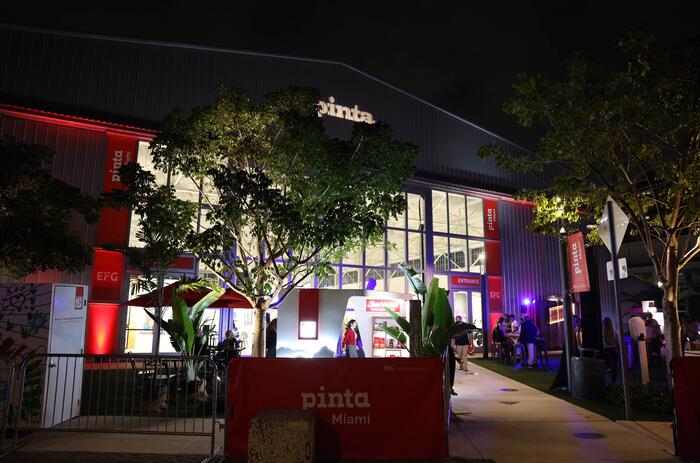
PINTA MIAMI TURNS 20 AND CELEBRATES WITH 42 GALLERIES FROM THE AMERICAS AND EUROPE
From December 3 to 6, The Hangar, in Coconut Grove, will host an edition that includes a Main Section curated by Irene Gelfman and a program of conversations.
PICASSO, KLEE AND MATISSE AT PÉREZ ART MUSEUM MIAMI
Nearly 100 works from one of Europe’s great modern art collections arrive in South Florida.
PÉREZ ART MUSEUM MIAMI PRESENTS "JOHN BALDESSARI: THE END OF THE LINE”
The first major institutional Baldessari survey in South Florida brings together nearly 40 works spanning five decades, drawn from the Craig Robins Collection.
FROM MIAMI TO PROVIDENCIA: MAHARA+CO OPENS IN SANTIAGO WITH AUGUSTA LECAROS
The exhibition inaugurating the space, Escondida llora alguien hoy por la frustración de su deseo, brings together sculptures and objects that have been altered, displaced, or diverted from their usual functions. The gallery’s opening expands its platform for dialogue between Miami, Chile, Latin America, and the Caribbean.