
_Between Two Continents: Spanish Geometric Abstraction in Latin America_
Ideobox Art Space, Miami
Starting with its title, this exhibition rescues an almost forgotten chapter in the global history of geometric abstraction, which was the axis of the modernist dream in Spain.
The omnipresence of informalism at the national level partially overshadowed the legacy of the representatives of this other movement. But international ignorance of this branch of the movement is also due to the fact that unlike abstract geometric artists from Latin America and from other confines, Spanish geometric artists desisted in general from the construction of the abstract language that was linked to utopia and went back to figurative painting and its social potential.
The contribution they made during the period comprised between the late 1950s and the early 1960s, however, was remarkable, and for this reason the review of their work in places like Miami is transcendent. Adolfo Wilson’s curatorship at Ideobox prioritized − from among the group of pioneers with which José de la Mano Gallery has been working − those Spanish abstract geometric artists who held a dialogue with their peers on the other side of the world, whether through participation in exhibitions or through geographic transits. Jesús de la Sota resided for some time in Caracas, where he designed furniture. He and José María de Labra participated in the 1961 Sao Paulo Biennial. In 1960, De Labra had participated in the exhibition Arte normativo español together with Manuel Calvo and José Duarte, a member of the original Equipo 57 that created a closer connection between art and design in its more humanistic sense and challenged authorship.
But unlike the MADI artists or the members of the Arte Concreto Invención movement, who radically rejected any vestige of representational art, the Spanish artists retained certain links with reality. Thus, Jesús de la Sota’s Chairs are works showing an impeccable geometric composition that integrate their lines and their structure in duplicated planes and that make reference to the sought-after artistic integration.
The works by José María de Labra showcased in this exhibit include Odysseus - Odiseo, 1958, with cubist traits that de-compose the figure of the blind hero, but also a beautiful untitled watercolor on kraft paper with visual vibrations created by alternation and rhythm of the black stripes − varying in number and spacing − on the neutral paper.
Likewise, several works included in the show allude to cities, even though their formal resolution reveals a rigor and a language bordering on the aspiration to a concrete invention. De la Sota refines the representative function and his work culminates in abstraction as revelation of the essence. The lines that connect structures of geometric shapes on the high horizon synthesize one of the drawings inspired by the city of Fuengirola. In another piece, the contours of the buildings are barely visible, while details such as openings and windows or interstices form attractive black geometric figures.
In 1958, the same year in which De la Sota created Fuengirola, Labra, trained as an architect, synthesized the vision of the town that retains in its architecture traces of successive colonization by Romans, Byzantines, Visigoths, and Arabs. The magnificent vinyl on tablex board unifies the constructed city and the horizon by means of opalescent grays, transparencies, and two parallelepipeds in black and white.
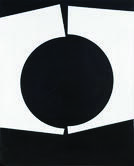
In the same way, Manuel Calvo produces the acrylic on cardboard Belo Horizonte, in the manner of a window in which one of his open black circles incorporating perceptual plays gravitates against a blue horizon. Abstraction also prevails in Granada : acrylics in intense yellow and brown alternate the concepts of background and form. The artist’s search privileges the tensions of forms in space. In Calvo and Duarte’s work we witness the emergence of the curvature of lines that brings the geometric close to the organic, and a ludic sense in the plays of planes and repeated forms.
The exhibition faces us with an unfinished dialogue which these artists initiated half a century ago, and activates the spectators’ participation in the rereading of the history of geometric abstraction.
-
 Oviedo, 1939. Open Circle/Círculo abierto
1960. Acrylic on board / Acrílico sobre tablex.