
WHAT DO WE SEE WHEN WE LOOK?
Astonishing inventions by Leandro Erlich (Buenos Aires, Argentina, 1973) are now on exhibit as part of an extensive tribute to writer Jorge Luis Borges (Buenos Aires, 1899-Geneva, 1986) being held in Buenos Aires on the thirtieth anniversary of his death. The outstanding interdisciplinary show Borges: Ficciones de un tiempo infinito at the Centro Cultural Kirchner ties the prodigious writer not only to the greater field of letters, but also to the visual arts, film, mathematics and other sciences through, among other things, the author’s classic image of the labyrinth.
In Ascensores [Elevators], Erlich once again surprises us with a participatory piece, where an ordinary situation (walking into an elevator) becomes extraordinary (not seeing one’s reflection and seeing one’s reflection endlessly). “A viewer walks into a familiar setting, in this case an elevator, but sees the reflection of another person rather than of his or her own reflection; fromanother perspective, the viewer’s image multiplies. At stake in this work is a labyrinthal situation and the idea of an ‘other,’ both of which have to do with the Borgesian imaginary,” Erlich explains.
Indeed, reality and appearance, the illusory and defamiliarization, are recurring themes in Erlich’s work. But his visual traps disturb perception not in order to fool viewers, but rather to shake them out of their conformity. “It’s not about the trick; the mechanism is in plain sight,” he says. The experiences offered by spaces constructed according to a distorted Cartesian logic are as playful as they are unsettling. In all of his works, Erlich proposes a situation that the viewer then interprets with the same autonomy that the artist enjoys in constructing it.
In most cases, his installations that blur the limit between the space and the work are large-scale and high impact. It is on that scale that the artist finds the freedom to express himself. “I started working on this scale as a way to go beyond the limits that define the object,” he explains.
Erlich once again surprises us with a participatory piece, where an ordinary situation (walking into an elevator) becomes extraordinary (not seeing one’s reflection and seeing one’s reflection endlessly)
-
Monte- Muebles. L'Ultime Déménagement, 2012. Ph: Martin Argyrgoglo.
-
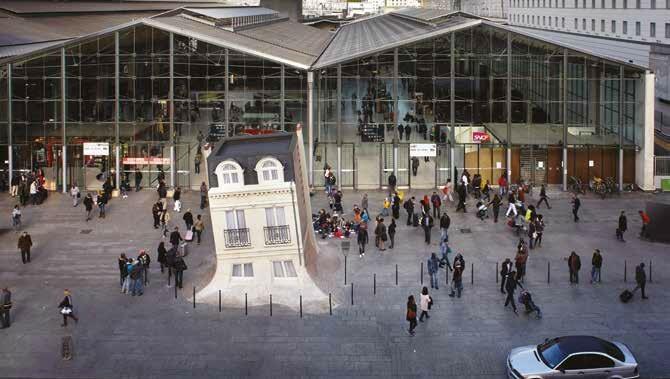
Edificio Buenos Aires. Ph: Estudio Leandro Erlich.
-
Edificio Buenos Aires. Ph: Estudio Leandro Erlich.
-
El Consultorio del Psicoanalista, 2005. Ph: Clara Cullen.
-
The Swimming Pool, 1999. Ph: Galería Continua, San Gimigniano, Beijing. Le Moulin.
Living Worlds
Whether in institutions or public spaces, Erlich’s works invite viewers to delve into their memories and experiences, to be drawn in by the artist’s hidden devices, and to let imagination run free. The Borgesian Ascensores was exhibited in May at the entrance to the Barrio Joven Chandon section of the 25th edition of arteBA, while the installation Postes [Power Lines] was in the street in front of the fair—where, for two months, it turned power lines into sculpture. In it, the lines between the posts—usually black wire—were made of light, connection them to the idea of the energy they convey.
With intelligence and humor, Erlich’s conceptual and technically ingenious art questions normalcy and space with mechanisms that awaken fantasy in us all. Simulacrum and interaction with viewers are key to works that change again and again with the presence of beholders. His installations, objects, sculptures, videos, and photographs are living worlds that make the viewer feel like a protagonist, an essential part of a journey to other realities and situations.
His visual traps disturb perception not in order to fool viewers, but rather to shake them out of their conformity
Maker of illusions, Erlich and his provocative works have traveled around the world since the late nineties. After he moved to New York, his career took off pursuant to an intervention produced for the Whitney Biennial in the year 2000. His work La pileta [The Swimming Pool] formed part of the Argentine exhibition at the 2001 Venice Biennale (he was also part of the country’s 2005 exhibition at the Biennale). That work, which made use of a great many devices to produce a powerful illusion, was displayed in the courtyard of the Fondaco dei Tedeschi, which currently houses the Venice office of the Italian Postal System. In it, the artist built a large white cube which he covered with an acrylic sheet that was, in turn, covered with a thin layer of water that moved gently thanks to a hidden mechanism. Visitors walked in the giant installation through an opening on the side of the cube that, seen from the building’s upper levels, looked like a swimming pool with fully dressed people walking inside. Was that pool really holding the illusion of a calm blue liquid under which visitors walked rather than actual water?
In recent years, Erlich has not only exhibited at Ruth Benzacar gallery, but also brought a number of his traveling installations to Buenos Aires. El consultorio del Psicoanalista [The Psychoanalyst’s Office], which was first exhibited in France, was shown at Fundación Proa in 2009—what could be betterfor one of the most psychoanalyzed cities in the world? “The work was conceived in Paris, where I lived until 2006. Perhaps the most surprising thing was how much the work had in common with certain optical experiments that Lacan had used to represent and to explain certain psychoanalytic questions— experiments entirely unknown to me when I started working on the piece.” That installation, Erlich explains, occupies two spaces divided by a pane of glass. One is a psychoanalyst’s office with its typical furniture and objects, and the other isan empty space that contains only some cubes. When the viewer walks into that second space, the visitor to the first becomes a performer, interacting and generating a fiction that also constructs a metaphorical image since his or her image is reflected through the glass onto a real object in the other room (the psychoanalyst or patient’s chair, for instance).
Illusion and defamiliarization are also at work in La democracia del símbolo [The Democracy of the Symbol], Erlich’s work on and with the Buenos Aires Obelisk that once again demonstrates how his art both hides and reveals. The supposed disappearance of the monument’s tip caused uproar in the city; it was seen by millions whether on the Internet, in the news, or “live.” As early as 1994, when the artist was twenty-one years old, he wanted to move the Obelisk to a plaza in the La Boca section of the city. At that time, he showed his model—and his intention to use art to broaden frontiers—at Ruth Benzacar gallery as part of a show of participants in the Taller de Barracas. Inside the tip of the Obelisk that the artist had removed or cut off for a few weeks occasioning commotion amongst passersby are four projections showing what is seen from the urban monument’s seventy-meter height; the tip was at MALBA at the end of 2015; it is now on the esplanade of the Usina del Arte, a magnificent recycled cultural center in La Boca.
-
La Democracia del Símbolo, 2015. Ph: Javier Agustín Rojas.
Edificio [Building] was installed in the main gallery of the Usina del Arte in 2009. The work was great fun as it created the illusion that people were boldly scaling a building’s façade. But to appear to be climbing, it was necessary to lie down on the floor, where the fake construction was located. The rest was the work of an enormous mirror that reflected the unlikely stances of visitors.
Located on the shores of the Río de la Plata, the Universidad Nacional de Tres de Febrero’s Centro de Arte Contemporáneo (MUNTREF)—which is housed in a section of the former Hotel de Inmigrantes—presents the work Puerto de Memorias [Port of Reflections]. In the Buenos Aires version of this site-specific piece first exhibited in Korea, the boats docked in the river are set in motion thanks to a mechanism created by the university’s Robotics Department. The work partakes of the intangible memory of the artist’s grandparents who came to Argentina from Europe.
His installations, objects, sculptures, videos, and photographs are living worlds that make the viewer feel like a protagonist, an essential part of a journey to other realities and situations
Between presences and chimeras, the production of this artist who lives and works in Buenos Aires and Montevideo vacillates between certainties and possibilities and asks the viewer the same question he asks himself: what do we see when we look?