Volf Roitman
The Patricia & Phillip Frost Art Museum. Florida International University
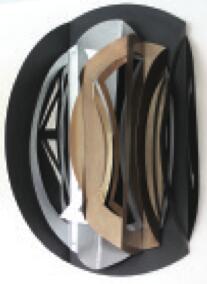
One day, talking with Volf Roitman, he confessed to me that he saw everything in the shape of the geometric forms that the MADI movement had created. What was this geometry? Roitman was certainly not referring to the classic shapes: Squares, Rectangles, Circles or Triangles. Knowing of his passion for the elaborate aesthetics of the MADI Group, I thought that Roitman was envisioning the dislocation of a geometric world in the manner in which the Greeks had conceived it. Nothing more alien to the old Pythagorean conception of “harmony”, or to the “congruence” of the scholastics, than that which Roitman intended. If for the Middle Age authors, heirs of the Hellenic civilization, the aesthetics of proportion had formed part of their notions of beauty, for modern art beauty based on symmetry had no relevance. The cubist painters dismounted the scaffolding of reality, disarticulating its components until they created new primitive rhythmic structures, analogous to the ones conceived by musicians like Stravinsky. But despite the efforts of analytic cubism, reality continued to be perceived after it had apparently collapsed. It was therefore at that moment that abstract art made its appearance, sweeping away the last vestiges of representational art.

Without examining the details that led painters like Kandinsky, Mondrian, or Malevich to conceive an art completely unrelat- ed to reality such as we conceive it, we can highlight two essential aspects of that new current: the concrete and the expressionist ones. It was the former that eventually triumphed in the case of the ideas conceived by the MADI artists. But while this is true, we must also point out that a Kandinsky more inclined towards the second current contributed to formulate their ideas. In works of his executed during the 1920s, Kandinsky painted a series of pictures and framed others in which the exact proportions of the square were eliminated. When the MADI movement came to the fore twenty years later, one of its first steps was to do the same. Freed from the traditional frame, the artists who formed that group in Argentina and later in different parts of the world, managed to create a midway point between painting and sculpture. Volf Roitman was the direct heir of this trend, but with a difference. For him, as it has already been emphasized on more than one occasion, the ludic treatment of art is essential.
This treatment is, therefore, the point of departure for a whole conception of forms that acquire in his paintings and constructions a personal meaning. Volf Roitman takes to the limit some of the proposals that Kandinsky considered during the last two decades of his career. If in the paintings of the Russian master color plays a musical and even a metaphysical role, in Roitman’s works that role is a part of play, that is, of that free activity without which, according to Johan Huizinga, the manifestations of culture cannot be explained. Thus we observe in Roitman’s art the development of a series of elements ranging from the distortion of the picture to the uti- lization of a strident color gamut, which includes hues whose musical tones we can perceive. For we cannot discard music from the work of this artist. It is not a music whose strains possess a symbolic value in the way in which Kandinsky or the composer Scriabin conceived it, but a music that is implicit in the generative force of the colors and in the forms they adopt. And so we see that during Volf Roitman’s long “Madist” career, the modulations of space, the disarticulations of the structures, the color dissonances, led him to create a new reality. Roitman incorporated that new reality in his utopian project of transforming buildings into a great MADI show. Ludic architecture was for him the habitat of the future, where the human being would be able to feel free from the socio-economic burden that cornered him. Hence that in order to understand and appreciate his work, our worn out conceptions of art would have to undergo a radical change. Art is and will always be, in its great general guidelines, a ludic act. Roitman understood this, and he devoted his entire life to the fulfillment of his dream.