
Patricia and Juan Ruiz-Healy: Collection of Contemporary Art of Oaxaca
Instituto de Cultura de México
Collecting art today implies a kind of dialogue between one’s own imaginary and that of the works that one chooses to be one’s own. That is to say, it implies building a bridge towards forms of collective iconography. This was very clear to Patricia and Juan Ruiz Healy from the first moment that a Rufino Tamayo fell into their hands. Since 1980, they have devoted themselves to collecting Mexican art. Their point of departure: the creators who have had their origin in what has come to be called the School of Oaxaca. Those who have somehow followed the tradition of the great master who made of his eroticism, instinct and expressiveness, a contribution − parallel to, yet divergent from that of Rivera, Orozco, or Siqueiros − essential to the history of Mexican art of the 20th century.

If we take as a point of departure that the painter who declared that “a true artist is the one who outlives his own style,” and that he never had any offspring from his relationship with the pianist Olga Flores, the exhibition might perfectly well be titled Testimonio y obra de los hijos de Tamayo (Testimony and Works of Tamayo’s Children). And even though this lineage does not imply obedience to or imitating the father, some characteristics may be observed that suggest a tribute in works such as Jesús Urbieta’s Bodegón I, where the watermelons or carrots from the orchard alternate with fish or sea crabs, in a superimposed and colorful composition. Or in the deliberately simple and equally moving collages that Rodolfo Morales shows in a series of women represented with lace pads over their bodies, creating a sort of naïf atmosphere over their everyday lives.
In a line of work perhaps more strongly influenced by Paul Klee and his relationship with the cosmos and the night world, three artists stand out: Rubén Leyva, Victor Chaca, and Sergio Hernández. Of the latter artist, one of the works which, in my opinion, honors the movement itself and enhances the quality of the show is Juguetes y Fantasmas, 1993. This piece establishes a dialogue between children’s recreative objects − mainly airplanes and cardboard horses − which contrasts with a row of black ghosts apparently facing a dreamer who is omitted in the canvas. On an opposite line, more connected to surrealism, special mention may be made of Cecilio Sánchez’s Sintiendo la música, 1992, for the symphonic transformation of his particular bestiary of marine animals, birds and primates. Also noteworthy are the canvases more related with an emphasis on materials and texture and with popular figuration, respectively, by José Villalobos, Tierra Colorada, 1998, and by the artist of Japanese origin but with strong links with Mexico, Shinzanburo Takeda, with Tierra del Lagarto III, 2006.
And as in every family there are always favorites among the children, I choose to close this commentary mentioning a disciple who shares the gesturality of the more expressinist Matta or Lam, with the only difference that he adds even more nuances and a different narrative to his figures: Alejandro Santiago. This can be appreciated in a series associated to the world of immigration, through the border with the the US: Coyote encuentra un zapato 1994. To conclude, I would also like to highlight the unbiased, yet representative exhibition of some prints and a gouache by the renowned artist Francisco Toledo, to whom Tamayo left his brushes in Paris, before returning to Oaxaca: El Mono y el Cangrejo, 1984, a work referencing two metaphors connected to this origin on the ability and the slowness of time.
-
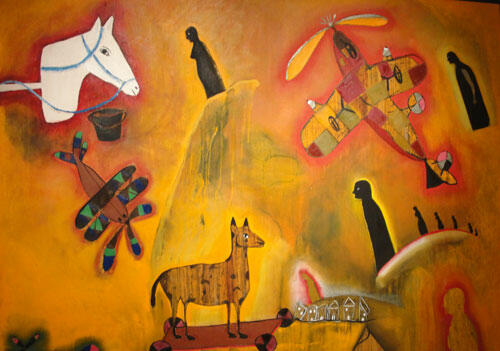 Juguetes y fantasmas, 1993. Oil on canvas, 80 x 80 in. Courtesy Ruiz-Healy Collection. Óleo sobre lienzo, 203,2 x 203,2 cm. Cortesía Colección Ruiz-Healy