
OLGA DE AMARAL AT FONDATION CARTIER POUR L'ART CONTEMPORAIN
Shocking and enigmatic, this is the first major retrospective in Europe that the Cartier Foundation for Contemporary Art presents of Olga de Amaral, a key figure in the Colombian art scene and Fiber Art. The exhibition brings together nearly 90 works created between the 1960s and the present, many of which have never been presented outside Colombia.

In addition to the vibrant gold leaf creations that contributed greatly to the artist's fame, the exhibition reveals her early textile research and experiments, as well as her monumental pieces. Although internationally recognized, Olga de Amaral's work has rarely been presented in Europe. The exhibition offers a new and comprehensive approach to the artist's career and reveals the full complexity of her practice. Without following a strictly chronological path, it highlights her different artistic periods: from her formal investigations - on the grid and color - to her experiments - on materials and scale - as well as the influences that nurtured her - constructivist art, Latin American crafts, pre-Columbian times. With this exhibition, the Cartier Foundation reveals the value of the textile art, for a long time relegated to a secondary role, since it is perceived as a decorative art practiced mainly by women. Closely linked to the dynamics of post-World War II abstract art, Olga de Amaral's ambitious creations presented in this retrospective undoubtedly move away from the conventional framework of traditional tapestry and show in particular her essential contribution to the artistic avant-garde of the 1960s, 1970s and 1980s.
-
Olga de Amaral. Fondation Cartier pour l'art contemporain, Francia © Daniel Avena
-
Olga de Amaral. Fondation Cartier pour l'art contemporain, Francia © Daniel Avena
-
Olga de Amaral. Fondation Cartier pour l'art contemporain, Francia © Daniel Avena
-
Olga de Amaral. Fondation Cartier pour l'art contemporain, Francia © Daniel Avena
Born in 1932 in Bogota, Olga de Amaral is an emblematic figure of the Colombian art scene. After graduating in architecture, she continued her studies at the Cranbrook Academy, -1954- 1955- in the United States, close to the German Bauhaus education. There she discovered textile art in the weaving workshop of Marianne Strengell, a Finnish-American artist and designer who was one of the first to promote the structure and grid of textiles over patterns; this encounter led her to develop a deep interest in color and to carry out radical experiments with matter, composition and geometry. Upon her return to Colombia in 1955, she combined this learning with knowledge of the ancient textiles of her country and deployed a spontaneous and expansive style inspired by the history and landscapes of her native land: the high Andean plateaus, valleys and vast tropical plains inspire her works with their shapes and tones. Two large series presented in the exhibition especially express this interest: Estelas (Stelae) and Brumas (Mists). Begun in 1996, Las Estelas take the form of golden stelae, composed of a structure woven in very rigid cotton and covered with a thick layer of plaster, then adding acrylic paint and gold foils that almost make you forget the fabric. In 2013, Olga de Amaral started a new series entitled Brumas, aerial fabrics in three dimensions, slightly moving and revealing simple geometric motifs painted directly on cotton threads. This time, it is a cloud, a fine rain of color that the artist invites us to go through.
-
Bruma. Olga de Amaral. Fondation Cartier pour l'art contemporain, Francia © Daniel Avena
-
Bruma. Olga de Amaral. Fondation Cartier pour l'art contemporain, Francia © Daniel Avena
-
Bruma. Olga de Amaral. Fondation Cartier pour l'art contemporain, Francia © Daniel Avena
-
Estelas. Olga de Amaral. Fondation Cartier pour l'art contemporain, Francia © Daniel Avena
Since the 1960s, Olga de Amaral has tirelessly explored textile materials in all their forms - linen, cotton, horsehair, plaster, gold leaf or palladium - and practiced a multitude of techniques such as weaving, knotting, braiding or interlacing threads, marking with her approach a true revolution within textile art to create immense three-dimensional works. Unclassifiable, her art is inspired as much by modernist principles, which she discovered at the Cranbrook Academy of Arts in the United States, as by the vernacular traditions of her country and pre-Columbian art. After presenting six works from the Brumas series as part of the Géométries Sud exhibition in 2018, the Fondation Cartier retraces Olga de Amaral's entire career and celebrates an artist who marked a true revolution in textile art. Monumental installations and three-dimensional pieces covered in gold and silver transport us to her iridescent universe where high Native American folk traditions blend with the brilliant geometry of abstraction. The woven pieces attract attention by their colors and the way they reflect the light that only the movement of the threads can allow.
-
Olga de Amaral. Fondation Cartier pour l'art contemporain, Francia © Daniel Avena
-
Olga de Amaral. Fondation Cartier pour l'art contemporain, Francia © Daniel Avena
-
Olga de Amaral. Fondation Cartier pour l'art contemporain, Francia © Daniel Avena
-
Olga de Amaral. Fondation Cartier pour l'art contemporain, Francia © Daniel Avena
It was in the 1970s when Olga de Amaral discovered, through her friend the ceramist Lucie Rie, the Japanese technique of kintsugi, which consists of repairing an object by highlighting its flaws with gold dust. This metal quickly became one of her favorite materials, allowing her to transform the fabric into an iridescent surface that diffracts and reflects light; a procedure that inspired her to create several of her pieces such as Fragmentos Completos, which is covered with this precious material.
To give Olga de Amaral's art its full grandeur, French-Lebanese architect Lina Ghotmeh dared to create a spectacular scenography where spaces are balanced to highlight the monumental textile installations, along with her smaller creations. On the first floor of Jean Nouvel's building, surrounded by Lothar Baumgarten's garden, she created a landscape of rough slate stones that unite the interior and exterior and define the space for the artist's extraordinary textile works. In the second space, on the first floor, the viewer discovers Brumas (2013) suspended from the ceiling. Here, Olga de Amaral offers us a metaphorical representation of air and water whose threads covered with plaster and acrylic paint undulate and recall the fine rain that follows the fog. As for the lower floor, as if to better integrate into the world of Olga de Amaral, the visitor enters through a sort of cocoon of dark colors, an almost embryonic environment conducive to intimacy with the works presented. The architecture of this space evokes a spiral, a motif found in several pieces by this visionary Colombian artist to guide the viewer into an enveloping space, where all of the artist's research gradually unfolds. Playing with contrasts, scales and the location of the canvases, at ground level or suspended, the scenography tells the story of the artist's work while weaving the space of the Cartier Foundation.
-
Olga de Amaral. Fondation Cartier pour l'art contemporain, Francia © Daniel Avena
-
Olga de Amaral. Fondation Cartier pour l'art contemporain, Francia © Daniel Avena
-
Olga de Amaral. Fondation Cartier pour l'art contemporain, Francia © Daniel Avena
-
Olga de Amaral. Fondation Cartier pour l'art contemporain, Francia © Daniel Avena
-
Olga de Amaral. Fondation Cartier pour l'art contemporain, Francia © Daniel Avena
-
Olga de Amaral. Fondation Cartier pour l'art contemporain, Francia © Daniel Avena
By intertwining the horizons of her native Colombia and the ruins of a bygone civilization, Olga de Amaral, 92-year-old Fiber Art star, continues to question us about space and time, and enchants us like a magician in a golden, aerial atmosphere, iridescent as an Inca treasure. A hybrid proposal, a meeting of diversities, with a deep interest in the presence of the ancestral and the spiritual in all aspects of nature, close to the mythical-magical world founded in pre-Columbian culture. Her abstract and monumental works reject any categorization: at the same time paintings, sculptures, installations and architectures surround the public in the sensorial and intimate universe of the artist, offering a dialogue with our memory, our senses and the landscape that surrounds us. Timeless creations that captivate the visitor and invite to reflection and meditation; they immerse the visitor in a timeless moment, rich in emotions and sensations. The course of reflection that Olga de Amaral follows is manifested in her unpublished large-scale works, which arouse curiosity and the displacement of the vision, and awaken the senses, imposing a progressive and attentive reading, a time for the work.
Related Topics
May interest you
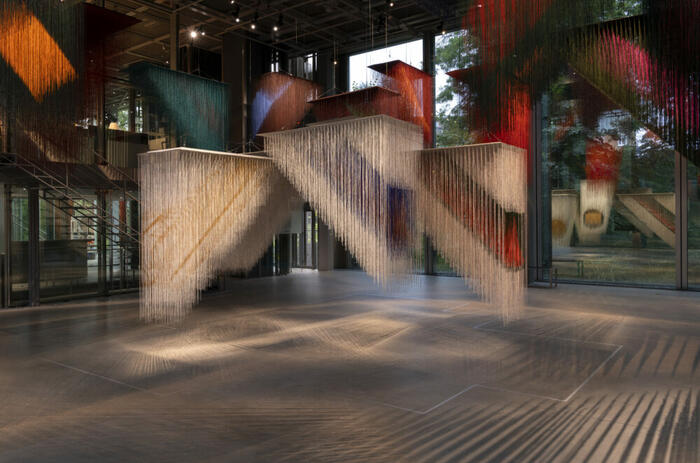
OLGA DE AMARAL IN PARIS: AN EXHIBITION AT THE FONDATION CARTIER
The Fondation Cartier pour l’art contemporain is presenting the first major retrospective in Europe of Olga de Amaral, a key figure of the Colombian art scene and of Fiber Art. The exhibition brings together nearly eighty works made between the 1960s and now, many of which have never been shown before outside of Colombia.

PINTA MIAMI: LATIN AMERICA FROM NORTH TO SOUTH
Pinta Miami celebrated its 2024 edition from December 5th to 8th, 2024 with more than 16,500 visitors, 45 galleries and 14 countries present. The fair at The Hangar, Coconut Grove led to good sales –where over 90% of the galleries reported sales– and enthusiastic overall attendance providing a true exchange between private, public spheres and opportunities for artists and galleries.
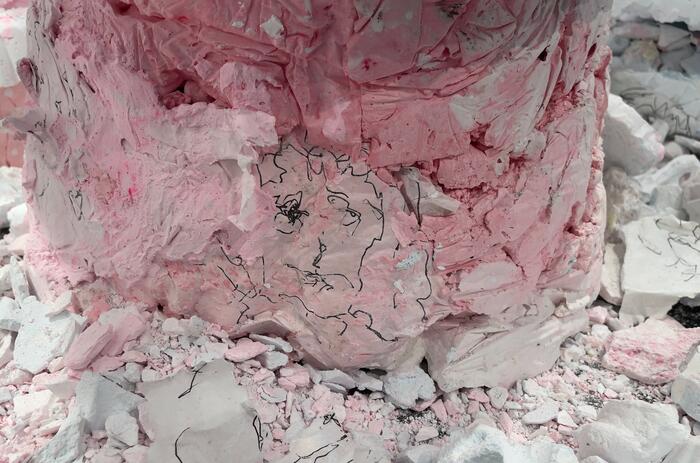
ADELA CASACUBERTA: MYCELIUM, FRAGMENTATION AND TRANSFORMATION
The Museo Nacional de Artes Visuales in Montevideo, Uruguay, presents the work of Mexican artist Adela Casacuberta. It is a site-specific installation Pink mushrooms in the museum's gardens and an exhibition of her most recent works.
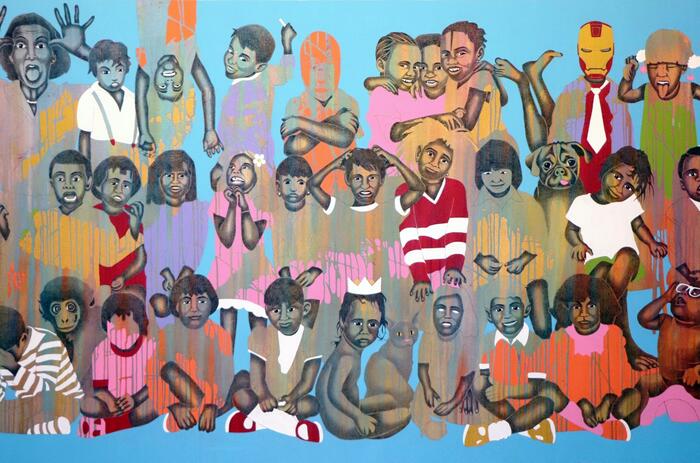
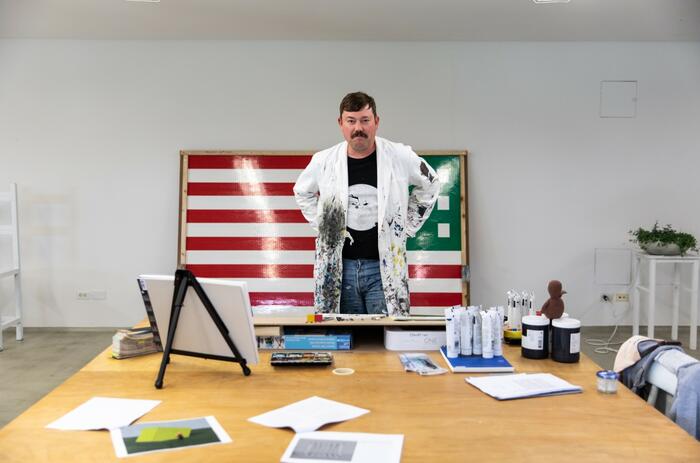
2026 ARTIST RESIDENCY PROGRAM APPLICATIONS AT THE WATERMILL CENTER
The Watermill Center’s Artist Residency is accepting applications for the 2026 year-round program, open to international artists 21+ years of age of all art disciplines. Deadline to apply: January 15, 2025.

THE MUSEUM LA TERTULIA LAUNCHES A NATIONAL CALL: VISIÓN DE CIUDAD
The Museum La Tertulia invites artists and creators, both Colombian and foreign residents in Colombia, to participate in the Visión de Ciudad (City Vision) call. This competition aims to integrate art, science, and technology into the creation of a sculptural project for the city of Cali. Deadline to apply: January 10, 2025.
THE BRITTLE POSTCOLONIAL PROPOSAL OF GRADA KILOMBA
The Reina Sofia Museum presents in the exhibition Opera to a Black Venus a necessary journey to the work of Grada Kilomba (Lisbon, Portugal, 1968), forming the most complete exhibition of her work to date in Spain. The Portuguese artist presents a complete discourse, mainly expressed through the different languages of movement, from the body to performance, but without leaving aside other narrative and artistic techniques with which she analytically presents a certain introspective look at the world of history.