Mariana Rondón
Centro de Arte “los Galpones”, Caracas
In her first solo show in Venezuela, filmmaker and artist Mariana Rondón (Edo. Lara, 1966) delighted the public. Rondón has been doing research on the narrative possibilities of robotics for more than ten years.
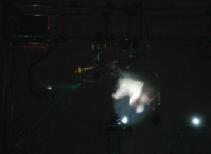
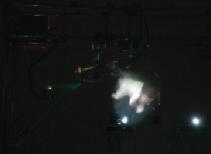
This investigation began the day that a scientist told her about the laboratories on genetics that had been discovered in Europe, and whose aim was to create not human beings, but mythological creatures. Since then Rondón has shown her installation “Llegaste con la brisa” in such distant places as Beijing and Santiago de Chile. For her presentation in Caracas, she brought the “3.0” version, comprised of four robots designed to produce giant bubbles which in turn served as screens for a series of images on video compiled by the artist. Once the bubble was formed and a precise dose of smoke was injected into its interior, the image levitated for some brief seconds and then disappeared once again in the air.
In so many words, Mariana Rondón is a storyteller. None of her narrative strength has been lost; quite on the contrary, it has been exponentially potentiated through the discovery, in these science fiction installation devices, of a new way to exploit her great virtues as a narrator; hence that the metaphor for the fragility of life at the core of “Llegaste con la brisa” did not go unnoticed. Although these robots trying to create new beings, a new species of humanoid hybrids, stem from a long science fiction tradition, they may be perceived, more than as a nostalgic approach, as a sign of melancholy. Hence that the overabundance of images of death and resurrection might orient us towards a reading that is less restrained than the tributary version. And since this work places the viewers in a passive position with regard to some overwhelming narrative resources, and turns them into obsolete voyeurs of some automatons, one may say that Rondón’s work brings us back to a place where we can think about, ponder on, and criticize the contemplative vision of history. A notion that differs greatly from a historiographic hegemony where the zones of silence prevail.