
By
Mariví Véliz
Alba Triana at Aluna Art Foundation, Miami
Alba Triana's most recent exhibition, The Music of Things, at Aluna Art Foundation in Miami is, like much of her work, an exploration of what Duchamp pursued through the infra-mince/infra-thin. Seduced by the sonic experiments of the Futurists, Duchamp understood sound as part of chance and the vibration of matter, something that dwells in the infra-thin: where things pass from one dimension to another, move and make sense. What previously seemed unconnected becomes connected. The small emerges in its grandeur, the microcosm of the universe. This is the same principle that Alba develops and carries into surprising sensory dimensions. For her, the infra-thin translates into electromagnetic fields, the interaction between waves, lights, dance, movement, vibration, and music. Her work is not aimed at the retina, but at the body, at all the senses. Through the creation and composition of microscopic interactions, this artist reveals and magnifies the presence of the imperceptible.
Upon entering the first room of the exhibition, a series of coils installed on the wall receive an intermittent voltage that attracts pendulums dancing at random. They oscillate between one another according to the distance and strength of the magnetic fields that attract them. As though dealing with the time between one note and another, Alba has programmed these electrical impulses that draw the pendulum toward the coil, leaving room for that "controlled" release by gravity, where movement is chance, chaos, and manifest order. The piece is a version of Diálogo con el mar primordial (2024–present), within the Campos delirantes series, which the artist began working on in 2019. In it, two coils and one pendulum form the basic unit of the visual composition that gives rise to multiple formal solutions—for example, a "trio," a "septet," or a "nonet." Here it is not simply a matter of music or dance; no dualities are possible. Everything is interconnection. These are the arts of time—what naturally unfolds—which Alba constrains within a space.
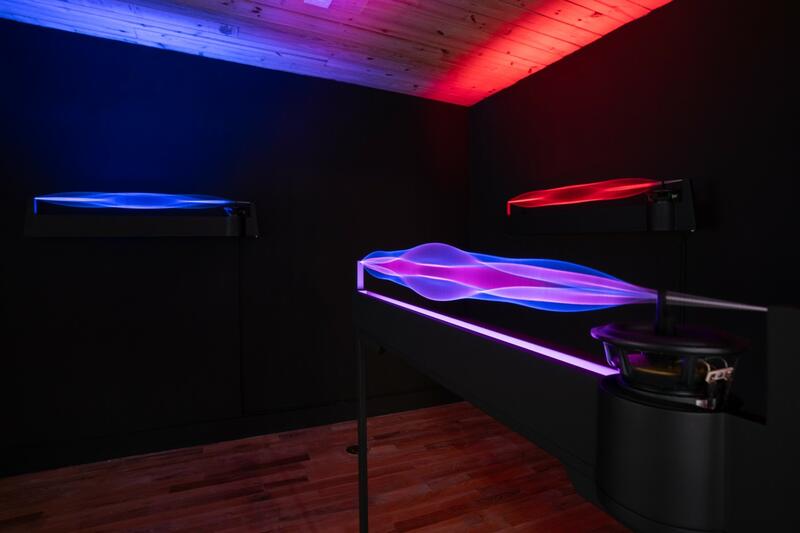
The Music of Things (2022), the piece that gives this exhibition its title, curated by Aluna Curatorial Collective (Adriana Herrera and Willy Castellanos), is precisely that. It is the result of wanting to capture something that flows imperceptibly, like mechanical and electromagnetic waves. This photographic series documents moments from her immersive work Movimiento armónico (2021–2025). Here, in a dark room, a cymbal is supplied with energy and laser light that render its vibration visible and audible. No human is the performer; the work is a self-generating system through the transformation of energy. The sound is accompanied by waveforms that become circles, ellipses, lines that compress, travel, float—alone and in parallel. This is what the installation The Music of Things attempts to capture. It consists of twelve stills of red figures on a black background, printed on brushed aluminum, reproducing the nature of waves—an exercise that, in Herrera's words, reflects Alba's poetic exercise, her constant effort to resituate, to make visible, the astonishing fabric that interconnects matter.
Other works present in the exhibition at Aluna, such as the different versions/colors of Frase luminosa/roja, Frase luminosa/azul (2019) or Órbita/amarilla, Órbita/verde (2021), approach painting in an evanescent way. Following the same principle of "coloring" through technological means, the waves are made visible. They show the most elastic, most spectral quality of color, at the threshold of tones, where other possibilities announce themselves. Together with the rest of the pieces—including Ballet entrópico (2024), in which 24 needles dance suspended above the surface of an electromagnetic field, or Materia vital No.I (2022), where the vibration–movement–sound–song of a cymbal appears hyperbolized in its shadow, pointing toward the performative quality of things—these create the sensory-perceptual environment of the gallery. It is a space taken over by optics, listening, movement, waves—a kind of augmented reality that opens scientific knowledge to experience and aesthesis, relinquishing possession and control of the experiment in favor of dazzlement, fascination with the vitality that moves the smallest things: the particles of the infra-thin that interested Duchamp, which John Cage later investigated, as Alba does, through vibration and sound. What is interesting is that for many women artists this pursuit had been reduced to the symbolic, the ritual, and the esoteric. Mastering and creating with skill, drawing on high-technology resources, knowledge, and devices, was, until very recently, the province of male artists. Women whose work pointed, for example, toward the connection between a star and a particle were considered spiritualists. Many of them resorted to poetry or ritual to do so. Alba, however, in The Music of Things, does it through science, the applied arts, and what has been considered rational from a Cartesian perspective, thereby demonstrating that sometimes seeing or feeling what cannot be named is not so irrational, nor so much a matter of spirit. It is part of another harmony, where only art remains to reveal what is felt.
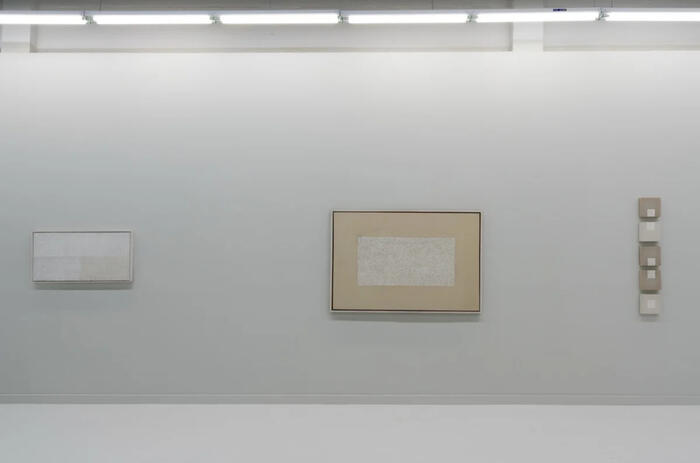
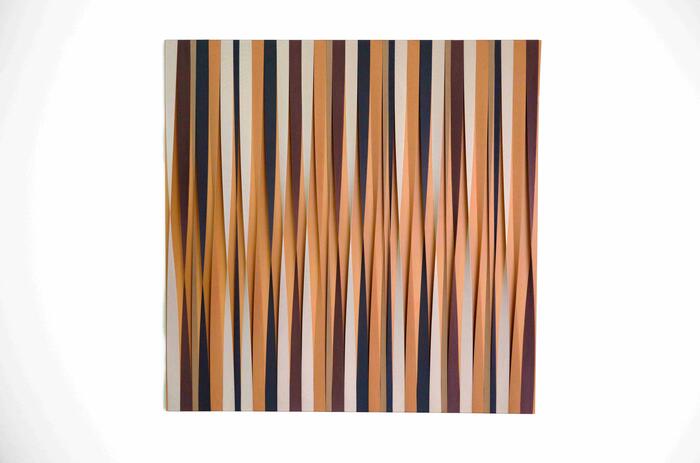
Curated by Katherine Chacón, Movement in Suspended Time activates a surface that evokes the loom as originary matrix, transposing onto the picture plane the tension between artisanal tradition and abstract modernity.
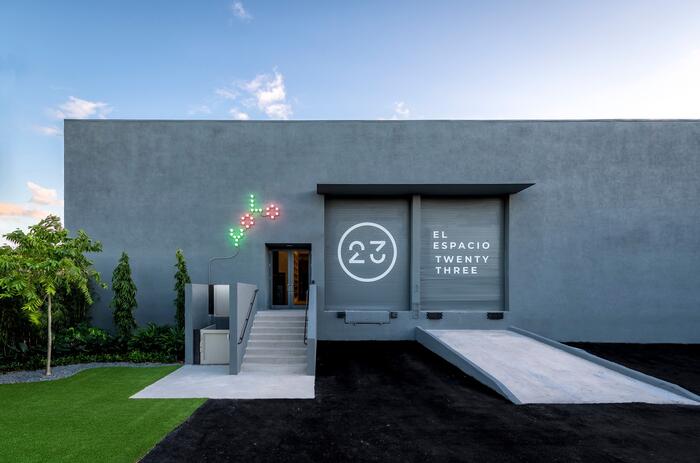
The first collaboration between El Espacio 23 and Fundación Ama Amoedo places two Argentines at the heart of one of the most dynamic ecosystems for Latin American art.
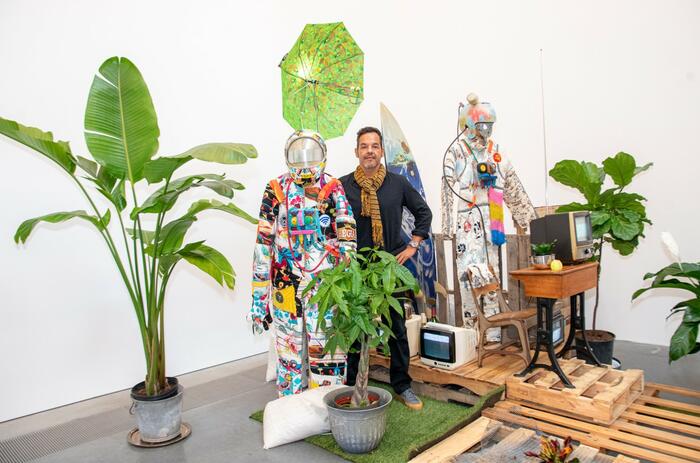
Works by Beatriz Cortez, Simón Vega, Walterio Iraheta, and Verónica Vides are now part of one of the most important collections in the world, thanks to a donation by collector Mario Cáder-Frech.