
LYDIA OKUMURA’S THOUSAND AND ONE EYES
Recognizing the importance of Lydia Okumura (São Paulo, 1948) and the impact of her pioneering and experimental work from the seventies on the genesis of contemporary art in Brazil, as well as the integrity of her later production, is key to the task of re-writing the history of Latin American art. That is why the exhibition 1.000.000 mm at Ideobox in Miami, and Roc Laseca’s excellent work as its curator, is cause for celebration. Sponsored by the Fundación Saludarte, the exhibition, with its careful selection of works, recovers documentary materials and recreates seven installations from the seventies and eighties, including the work for which the show is named, an all-encompassing installation the artist created in 1972 for the São Paulo Biennial.
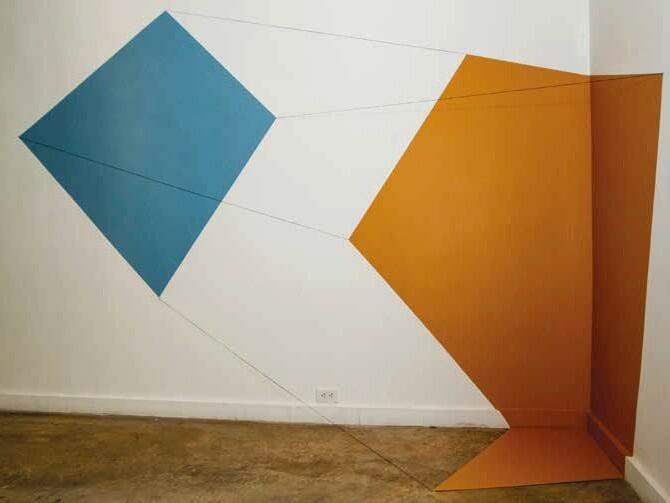
Okumura’s art, duly appreciated thanks to this event, conveys the pure experience of astonishment that the philosophical notion of “arche” expresses. The work relentlessly interrogates the real by operating on materials like time, space, existing objects, and one’s own being, to multiple its possibilities. Okumura employs a methodology of efamiliarization, maneuvering the relationships between forms and their unfurling in space in different media to alter perception and to open up new experiences of it.
The operations that, almost since the time she was a teenager, the artist has enacted on reality entail endless forms of spatial experimentation. Her work is characterized by the use of minimal elements—threads, geometric planes in paintings or installations, mirrors and geometric shapes inserted in the space—arranged such that familiar perceptizon is put on hold. Deconstructing habitual vision means throwing visual assumptions into disarray which, in turn, produces a state of openness to new meanings and senses in imagination and, even, suggesting other worlds. Very early on, Okumura discovered that thread was the easiest and most powerful way to “trace” a line that not only had volume and cast shadows, but that could assert its three dimensionality “in a corner, in an angle.”
This meant giving space a new dimension to alter its overall perception. The interrelations the artist establishes between geometric planes, whether black and white or color, and threads that extend sometimes to link works on different walls operate metonymically as representation of the visible and of the invisible in the dimensions of the physical locus where they are placed. As such, they make way for the possibility of splitting reality to open up unimaginable planes. In works like Prismatic Appearance (1975), which Laseca wisely chooses to recreate on a black wall, Okumura formulates the idea of discontinuity by means of the back and forth between the painted lines and the colored threads used to construct the volume. The interruptions of the three-dimensional lines act as the intersection of the invisible. The volume is, above all, empty; it takes shape in the imagination. At play as well is a rhythm, a specific progression between that void and the lines, which suggests perfect scales and intimate harmony.
Okumura employs a methodology of defamiliarization, maneuvering the relationships
between forms and their unfurling in space in different media to alter
perception and to open up new experiences of it
Okumura multiplies planes of reality and tacitly engages the viewer’s body and vision rendered inverted mirror on which others sorts of translocations are reflected as well. The act of translocation in the work Ponto de vista (1971) —recreated in 2014 at the Museu do Solar da Marquesa in São Paulo by Isobel Whitelegg and documented in this show at Ideobox—entails creating in painting the fiction of a beam of light that makes itself into the exhibition venue through a nonexistent interstice. Another such translocation is the act of inserting the surface of a mirror on a mound of grass in order to duplicate the unusual form of a triangle sculpted from earth. 1.000.000 mm documents that early venture into intervention in nature, a gesture at stake as well in the history-making installation for which the show is named: a winding thread of cotton turns the space into a kilometer- long labyrinth containing multiple steps, the discovery of sculptures, as well as the meandering of thought.
Deconstructing habitual vision means throwing visual assumptions into
disarray which, in turn, produces a state of
openness to new meanings and senses in imagination
Other translocations recreated in the show are Different Dimensions of Realty (1971), a painting of squares within squares that strangely “comes off” the wall to turn into a three-dimensional installation that repeats itself on a very small scale and in a sequence that occupies the real volume of the space. In the installation U/T (1974), the names of colors appear on strips of color that, to our surprise, we eventually realize are not the right names—more cracks in the relationship between words and things. All of these operations imply a deliberate act of moving off scene, a subversion of our ideas of the natural order of space and of tacit laws of correspondence. As such, they reveal—with delight—the fragile and shifting nature of perception as well as it multidimensionality. The coordinate of time, tugged by the thread of the viewer’s moving vision or body, is pervasive; it produces the experience of simultaneity rather than the idea of successive displacement.
-
Lydia Okumura.
Languages, orders, multiple visions
The daughter of Japanese immigrants, Okumura grew up in Brazil. The language at her home showed her another way of seeing the world. Her formal education at a Catholic school was in Portuguese; her mother, a Buddhist, and her father, a Shintoist, performed their own rites. The twofold experience of languages and religions instructed her in the multiplicity of perception of time and space in the world. In 1971, while working at a communications agency for three months, she registered her artistic activities on a timesheet.
That act—the origin of an exhibition—is recognized as a seminal work in Brazilian conceptual art. In those same years, she formed the pioneering Equipe 3 group with Genilson Soares and Francisco Iñarra. Equipe 3 expanded experimentation in art in the seventies by combining individual and collective creation in practices such as happenings and works of ephemeral art. While Equipe 3’s work has been documented by major institutions in Brazil and abroad (the Museum of Modern Art in New York and the Hara Museum, for instance), its living memory and ongoing impact on
the history of the Brazilian avant-garde merits revision.
Okumura explains that the group never had plans for the future; the story of how it disbanded when she moved to New York deserves further study. The effort of the Jaqueline Martins Galeria to salvage the group’s collective work has been valuable. A single event at the Museu de Arte Contemporânea in Sâo Paulo in 1972 reveals the nature of Okumura’s work from those years and her vision: though she alone had been granted a space in the museum, she included the rest of the group which, jointly, undertook the project “Include the Excluded,” producing the projects of excluded non-resident artists like Jannis Kounelis and Daniel Buren.
I do not believe I am mistaken when I assert that the need to review—that is, to take another and deeper look at— Okumura’s underappreciated work is just the tip of the iceberg. The prodigious art of the seventies and the soul of a time when art was not driven by the market merits revision as well. It is essential to recognize that when, in those years, Latin American art was exhibited at major international galleries, it was constricted to a separate category and, as such, did not lead to a dialogue that would have made it possible to go beyond hegemonies. This is one of the factors responsible for the failure of pioneers from the global south to receive due recognition. In Okumura’s case, the shadow cast over her figure abroad was twofold, since she was both a woman and of Brazilian-Japanese descent.
The coordinate of time, tugged by the thread of the viewer’s
moving vision or body,is pervasive; it produces the experience of simultaneity
rather than the idea of successive displacement
But if history is rewritten, the timelessness of art will prevail as the rediscovery of figures like Lydia Okumura demonstrates. “Who are we?” she asks, and then replies, “There is the basic being and then countless ways of seeing. The more you can imagine, the greater the wonder. I think that art is one of the simplest ways of saying that there is more than one way of seeing.” Her work will never cease to give us a thousand and one eyes with which to imagine.