
José Luis Landet
Document Art, Buenos Aires
To appropriate, make something one’s own. José Luis Landet (Argentina, 1977), who is having his first solo show in his native country at Document Art Gallery, works on the basis of this principle, the principle of original appropriation.
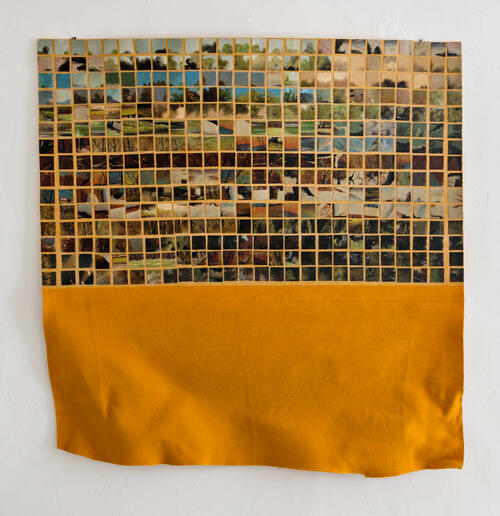
Landet appropriates 38 anonymous landscapes that he acquired in a traditional used furniture market of Buenos Aires, the Mercado de Pulgas (Flea Market), reticulates them and breaks them into small 5 by 5 centimeter pieces which he classifies by color, and from this material, he structures a new work.
Why the landscape? The landscape as a pictorial genre is defined as bucolic, romantic, sublime, national. José Luis Landet, in a conceptual operation, takes the bucolic representation of the landscape and turns it into the support of his work and at the same time, he places another image on its surface. From the beginning of his career as an artist, Landet has used this resource to investigate the image as related to the other processes of memory, oblivion, fantasy and daydreaming.
In this exhibition he presents eight works which he numbers, and the ninth work is made from the edges of these same anonymous canvases, with their limits. The tenth work, a landscape, which could well represent a Mexican courtyard, is submerged in a fish bowl and its natural inhabitants – fish – navigate between the shores of reality and fantasy.
This young artist, born in Buenos Aires and currently living in Mexico City, studied art at the Pueyrredón National School of Fine Art in Buenos Aires until 2000, when he migrated to Mexico. In this country he graduated at La Esmeralda National School of Painting, Sculpture and Engraving; he has been the recipient of a scholarship from the Centro de Investigaciones Artísticas (CIA) in Argentina and from the Fondo Nacional para la Cultura y las Artes – FONCA (National Endowment for Culture and the Arts- FONCA) in Mexico.
Landet comes and goes between both countries, navigates between both cultures, and appropriates both landscapes, fragments them and reorganizes them and turns them, legitimately, into an identity of his own. As much his own as his work.
-
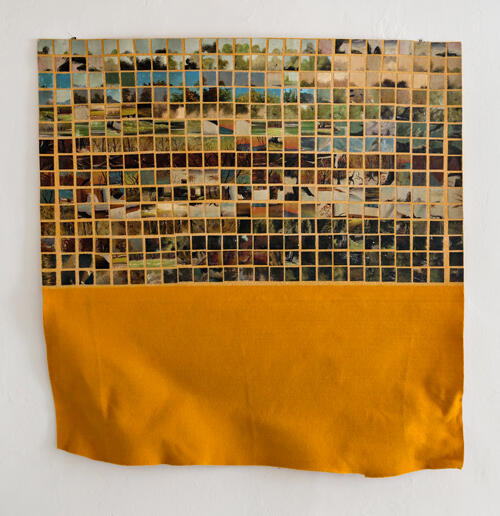 Paisajes Apropiados, #8, 2013
Oil on canvas /Óleo sobre tela