
José Bedia
Fredric Snitzer Miami
“Une Saison en Enfer”, (A Season in Hell), José Bedia’s exhibition at Fredric Snitzer Gallery, takes its name from the poète maudit Arthur Rimbaud’s long and only poem, and marks the most terrible descent journey of this artist who has based his practice on the pilgrimage to territories where myths oppose the narratives of the official history.
Initiated in the early 1980s into the Palo Monte cult, which does not have an iconographic pantheon with visual characteristics as precise as the santería characters, Bedia has forged a visual universe for this tradition to which he himself is attached. Parallel to this, his pilgrimage has included constant trips that include the continent of origin, particularly Zambia in Central Africa, and the indigenous territories throughout America, from the lands of the Lakota to those of the different tribes inhabiting Mexico and Peru, where he has shared shamanic rites in visits that do not only trace other symbolic maps but that also recount the history of the vanquished. Hence, too, his interest in figures like the Cubans Quintín Banderas and Andrés Petit, or Papa Liborio, in the Dominican Republic.
Yet while each of these trips implies a sort of vindication of sacred traditions that were denied or condemned by the dominant cultures, and a challenging re-valuation of the periphery’s cults, in the case of this exhibition the pilgrimage is marked by an unusual violence. The sign of scandal, and even repudiation and disgust, characterize this series of works that depart from a vindicatory view and from an iconography created to sacralize initiation practices.
Instead of a visual poetics drawing inspiration from ancestral traditions, Bedia recreates his own descent to hell representing the perversion of the rites practiced in large cities where even the secret spiritual knowledge has become corrupted. Very distant from that painting titled Enséñamelo todo, in which at the top of the universe a woman pointed the way to the stars, in this caustic series originating in disenchantment, he paints voluptuous women yielding to lust with other women to give pleasure to the tyrannous male character who exercises his manhood by sexually enslaving them.
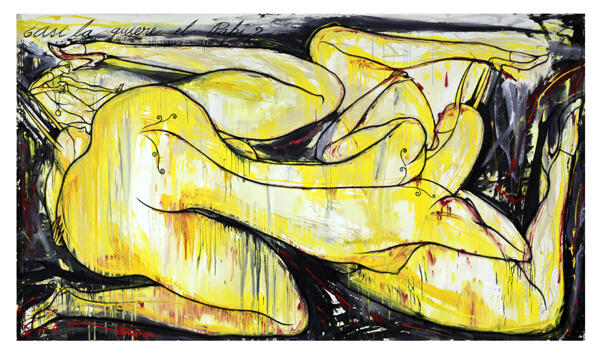
The recreation of what in Santo Domingo is associated to the “tigeraje” of the pimp, who does not become involved in sex games but encourages them, is mixed with iconographies of what once belonged in a sacred realm. In ¿Así la quiere el papi? − a revealing title that represents the voice of the subjugated woman − a tiny character wearing glasses and a gold chain and holding a glass in his hand observes the scene of sex between women with horns on their heads and long nails painted in red, whose bodies painted in strident yellow, naked and with high heels, fill the space with a grotesque excess. The iconography of evil is reinforced by vulgar texts. In Blessing in the Miami River, the scene involves a devastating irony: while two elderly women accompany the horned one that strips off her clothes, men hidden on the river banks practice onanism inspired by this vision which no longer represents an initiation into the sacred but a distorted rite. We are, indeed, just like the title of the painting with the blood-red background containing a frontal and dripping rendering of a she-devil, in the kingdom of “Pomba Gira”, the Umbanda she-devil-whore, and the satanic connects with the sexual to produce the terrible image of the crucifixion overlapping the stark, violent nudity of the body of a she-devil.
The remarkable thing is that, through this visual catharsis, José Bedia transgresses the conventions of his own language, uses colors he had never touched before, tears up all the investitures of his own art and shows that he is not an artist resting comfortably on the recognition of his own iconography, but that he is capable of allowing himself to be hurt by the destruction of the world that supported it.
-
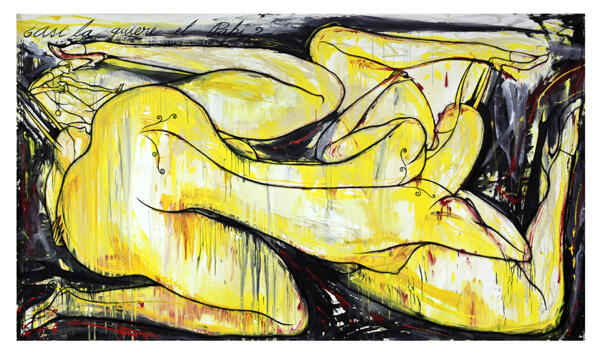 ¿Así la quiere el papi?, 2012. Acrylic and Conté on canvas, 82 x145 in. Courtesy Fredric Snitzer Gallery, Miami
Acrílico y lápices Conté sobre tela, 208,3 x 368,3 cm. Cortesía Galería Fredric Snitzer, Miami.