
Jesús Soto
Grey Art Gallery, New York University, New York
The exhibition “Soto. Paris and Beyond, 1950-1970” curated by Estrellita Brodsky, brings together twenty years of work by the Venezuelan master painter Jesús Soto (1923-2005).
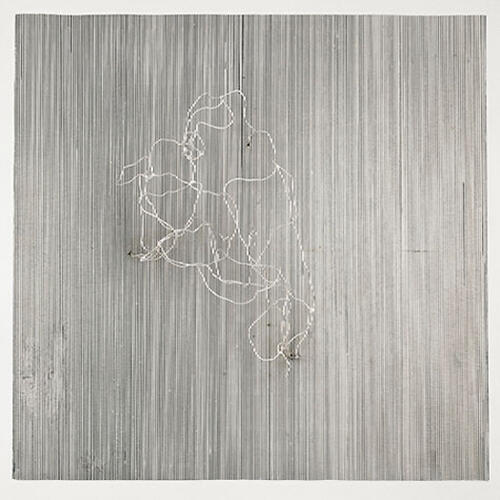
Tired of the repressive environment in his country, Soto migrated to Paris in 1950. He soon got in touch with artists who had attended, like himself, the School of Fine and Applied Arts, and who rejected all forms of figurative art. Narciso Debourg and Alejandro Otero, among others, introduced him in the Salon des Réalités Nouvelles, devoted to the presentation of “Abstract-Concrete-Constructivist-Non Figurative” work by artists like Jean Arp, Kandinsky or Mondrian. He was invited by Vasarely to participate in the Le Mouvement exhibition at Denise René Gallery in 1955, which implied his consolidation as an active and important member of the kinetic movement. Later, his friendship with Yves Klein and their mutual admiration entailed the incorporation of everyday materials in the explorations of dis-integration that Soto had been carrying out.
The exhibition is divided into five chronological sections that emphasize Soto’s interest in exploring and invalidating the notion of stability. Through formal resources that potentiate the feeling of displacement and introduce the notion of vibration, he radically transformed the relationship between the object and the audience − a transformation which culminated in his Penetrable environments of the late 1960s. Thus, the itinerary of “Geometric Abstraction” begins with several planar compositions reflecting Mondrian’s influence. However, they take a distance from the static quality of the latter artist’s work, introducing broken lines and fragmented planes, abrupt changes in direction that produce instability. “Serial Composition” and “Overlay” constitute two of the most interesting sections in the show. In the first of these, Soto concerns himself with a “pure” language, detached from the emotional content of the abstract expressionists and resorting to music and in particular to dodecaphony − based on twelve musical notes with similar value. In Sans titre (Étude pour une série) (c. 1952-53), he employs eight colors to which he assigns a numerical value and which he distributes following a predetermined algorithm − as if it were a schoenbergian musical composition. He thus seeks to eliminate every trace of manual intervention, while at the same time endowing his sequences with rhythm and movement.
Points blancs sur points noirs (1954) is the first work in which Soto resorts to the transparency of Plexiglas to potentiate the feeling of vibration and of spatial creation. The works displayed in the “Overlay” section are the ones that best illustrate the compositions built on layers of superimposed lines, which are modified through their interaction with the spectators. Such is the case of La cocotte (1956), a mobile that flirts with the viewer as it changes its position unexpectedly, producing different sensory experiences and getting the viewer involved.
In “Immaterial” and “Language/Perception”, Brodsky gathers together works that reveal the influence of the Nouveaux Réalistes such as Klein, Tinguely, Spoerri or Mack. The question is to reach the immaterial starting from ordinary elements. To this end, Soto introduces textures and found materials in compositions structured on wires, which substitute or cohabit with the underlying, precise layers of lines. These works gave rise to his Écritures, which he began to create in 1962, a time that witnessed the repression of Latin American intellectuals. Thin wires twist up in a tortuous imitation of the written word, which becomes visible and invisible. Those years also marked the artist’s final shift to immersive works which demanded an active audience and an art capable of recognizing the space around it − rather than one that sought to conquer it.
-
 1957. Paint on wire and board. Collection Florence Soto Pintura sobre alambre y panel de madera. Colección Florence Soto.