
Guillermo Kuitca
Hauser & Wirth, London
Guillermo Kuitca’s (Buenos Aires, 1961) London solo show at the prestigious Hauser & Wirth Gallery marked the definitive presence of Latin American art in the British capital. Kuitca, who has shown in the course of his career a growing interest in maps and architectonic diagrams, incorporated on this occasion new central motifs to his cartographic traces aimed at questioning the perception of the social spaces we inhabit.
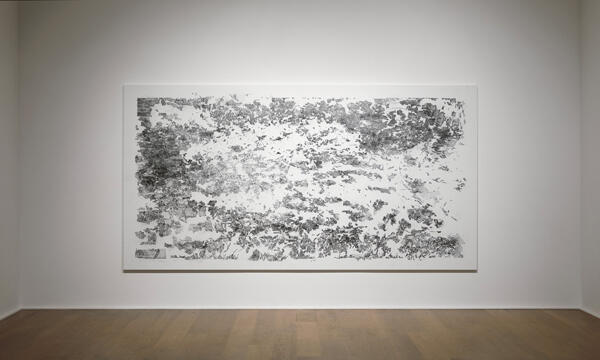
Especially noteworthy in the South Gallery, alongside small experimental pieces in wood, was the series Encyclopédie (2010), seven works in which the artist represented the deconstruction of European modernism. The French Encyclopedia symbolized for the Western World both the synthesis of human knowledge and the triumph of individual, scientific and technological values. Values which were encouraged by the modernist project, under the conviction that they would lead the world to the highest levels of evolution and progress. The huge current inequalities, suggested by Kuitca through the manipulation of some images of Neoclassical architectonic iconography seemed to contradict those assumptions and reflect on the impossibility of reconstructing the traces of the past.
The North Gallery was dominated by the large-format work in which the artist requested the viewer to focus on his geography, confronting national emblems with supra-national symbols. Geometric art has a long tradition in Argentina. Since it was adopted in the 1940s, it has been interpreted as the awakening of the Southern Cone to the promises of development and social welfare of the modernist project. Here the artist intercalated the recognizable cartographic traces that characterize many of his works into the imaginary of the geometric tradition. Kuitca has eliminated all the names of cities and highway numbers, combining elements from many maps, thus contrasting the aspirations to autonomy with the geopolitical maelstrom that characterizes our globalized era.
The work of Guillermo Kuitca in its different stages represents in an analytical manner the great paradigms of the 21st century. This is, undoubtedly, one of the reasons why he has earned wide international acclaim.
-
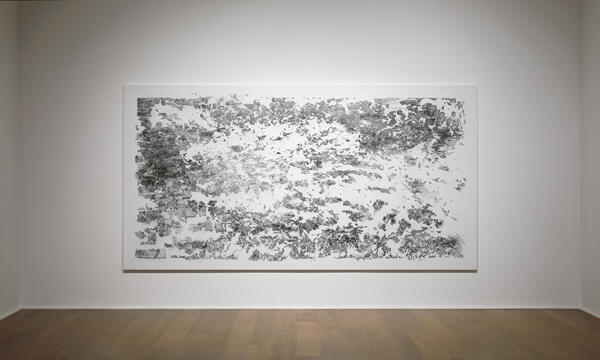 Hauser & Wirth London, 23 Savile Row, London, England, 2012
© Guillermo Kuitca - Courtesy the artist and Hauser & Wirth
Photo: Alex Delfanne
Vista de la instalación de Guillermo Kuitca en la galería Hauser & Wirth, Londres. 23 Savile Row, Londres, Inglaterra, 2012
© Guillermo Kuitca. - Cortesía del artista y Hauser & Wirth
Foto: Alex Delfanne