Wu Galería presents "Contingentes" by Alberto Casari
Wu Galería presents "Contingentes" by Alberto Casari
Having developed since 1994 the PPPP Project (Peruvian Products for Thinking), as an art company, where the artist is depersonalized through the creation of several alter ego like Alfredo Covarrubias and alias El Místico, Alberto Casari decides to end that stage at the end of 2016. In 2017 he abandons the signing of his works with the PPPP logo and recovers his own name.
Being his second exhibition as Casari, the selection in the sample Contingents presents two sets of works produced between 2013 and 2017. The distinction of each group is not arbitrary, but responds to an intuitive selection spirit that classifies formal and sensory aspects. Each one of the two rooms addresses different ways of apprehending the subject that shapes the artistic object, also distinguishing the degree of intervention that the author has with the objects - natural or artificial - that surround him in his everyday life.
The influence of Arte Povera, developed during his stay in Italy in the eighties and nineties, is evident from the attempt to decontextualize objects, focusing on their visible material quality. Thus, the work can be seen in direct contact with nature. You can see installed industrial production elements thought as aesthetic objects from the observation of their most elementary qualities: trunks or slats of wood, leather, wax, painted cloth; some elements already altered in principle, are collected and reused. Casari's form of intervention distinguishes his need for free action in favor of a poetic reflection, similar to an act of epiphany.
The contingency is the indetermination of everything that can happen, and the way of dealing with the unintelligible will depart, by default, from an objective approach. Nevertheless, the work of Casari demands previously and almost in opposition to it, a sensory and subjective approach; a full approach to materiality, to then think about its symbolic potential.
Casari explores brilliantly, in the first room, all the possibilities of the concept of inversion or disappearance of the painting. The traditional support of the fabric and frame are altered to be the woods of the frame the ones covered with fabric and placed as elements of the geometric composition on a plate of technopor. The sculptures hanging on the wall are bamboo or wood slats wrapped in cloth; taken to its ultimate consequences become a cumulative sculpture of several elements wrapped in cloth, painted in blue tones.
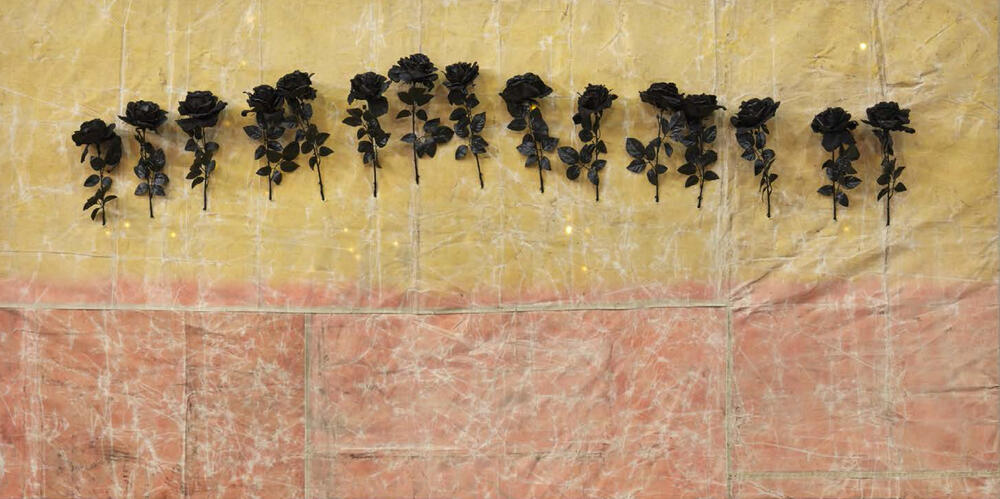
The works of the second room baffle the viewer by the familiar elements that do not give more information but rather give a sensation in the surfaces seen through the fabric of truck hoppers because they have been painted on the back. We experience contradictory elements: from dragonflies twinkling in a field of black plastic flowers, to a smooth cumulative surface of suede leather with buttons, to one whose surface is covered with tackshells; mnemonic elements whose results lead us to another meaning, whose compositions are only contingent proposals where nothing is one or the other and where the sculpture of the frozen pot represents the cusp of the contingently possible without being so.
About the artist
Alberto Casari was born in Lima in 1955. He studied Literature at the Catholic University of Lima (1973-1975) and Painting at the National School of Fine Arts (1975-1977). In 1994, during his stay in Italy, he created the PPPP Project and in 1998 he began to experiment with textile and carpet design. In 2001 he founded PPPPdesign together with the architect and designer Eva Pest. In 2016, the PPPP project concludes.
He has participated in the XLIV and LIV Venice Biennial (1990 and 2011), IV Biennial of Havana (1991), I Ibero-American Biennial of Lima (1997), II International Biennial of Design of Saint Etienne (2000), XXX Biennial of Sao Paulo (2012). It is represented by the Pilar Gallery, in Sao Paulo and Gallery Nosco, Marseille, France.
The show can be visited from January 17, 2018, Monday through Friday from 2:00 pm to 7:00 pm.
Av. Saénz Peña 129, Barranco, Lima
Telephone 247-4685
For more information: info@wugaleria.com
www.wugaleria.com