
Walls of Air: Brazil Pavilion at the 16th Venice Architecture Biennale
In response to the curatorial proposal for the Venice Architecture Biennale 2018, whose theme for this edition is FREESPACE, Brazil’s official participation in Venice has been named Walls of Air.
Under the curatorship of the architects selected by the Fundação Bienal de São Paulo, Gabriel Kozlowski, Laura González Fierro, Marcelo Maia Rosa and Sol Camacho, the exhibition is built around the ways in which to read, challenge and transgress the material and immaterial boundaries of Brazil and its architecture. While understanding the wall as an element of Brazilian identity, the exhibition explores the act of breaching it as an invitation to celebrate the richness of cohabitation instead of the indifference of coexistence.
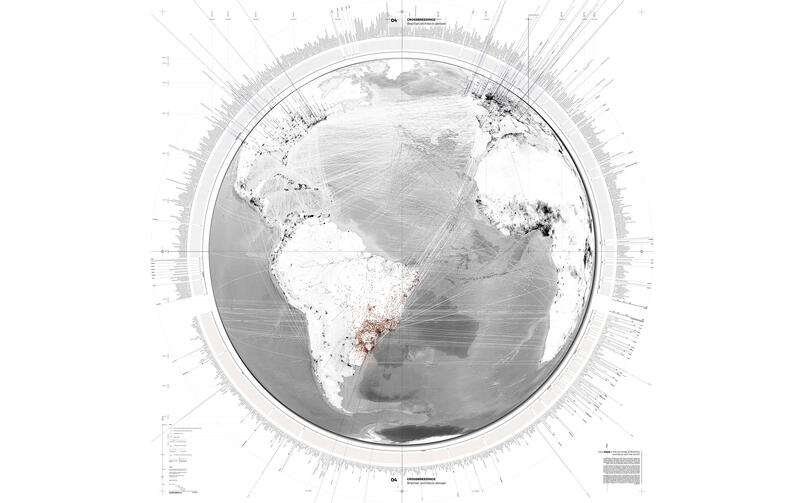
Walls of Air is organized on two exhibition design fronts. The first consists of the presentation of ten cartographic mappings created based on research developed with a network of collaborators, consultants and institutions, as a way of visualizing the forms of spatial and conceptual separation that have resulted from the Brazil’s urbanization processes. The second focuses on architecture and urban projects chosen through a public open call—first ever in the history of Brazil’s participation on this event. Out of the 289 projects submitted in over 60 Brazilian cities, the curatorship selected 17 examples, designed by both renowned and younger local architects, that reflect on the possibility of conceiving architecture as a means to re-conceptualize the barriers found within our cities.
With the selection of projects, the curators intend to present cases where architecture is deployed as an instrument for the negotiation of antagonistic, sensitive urban situations, while illustrating a variety of processes that are faced by architects during the moment of design, which include: transforming private areas into spaces for public use; connecting isolated neighborhoods; bridging urban divisions generated by large infrastructure corridors; opening new fronts of the city to the sea; revitalizing vulnerable communities by introducing new programs and decent social housing; and maintaining spaces for culture in neighborhoods undergoing drastic transformation.
"Diverse in scales and types, all projects represent intriguing ways of enhancing the public sphere by rearticulating the existing physical, social and political barriers present in each of their contexts. At the same time, the selected works show the enormous challenge of building and realizing projects of this nature in contemporary Brazil," explain the curators.
Participants and projects
Open Call: Liberdade Boulevard – Corsi Hirano Arquitetos. Where you don't see where you are – Pedro Varella, Gru.a Arquitetos. From the plan to the project: SESC Parque Dom Pedro II – Laboratório de Urbanismo da Metrópole / LUME FAUUSP, Una Arquitetos, H+F Arquitetos and Metrópole Arquitetos. Amata Building – Triptyque Architecture. School without walls: Jardim Damasceno Cultural Center – Sem Muros Arquitetura Integrada. Maré Lighthouse – Pedro Évora. Brincante Institute – Bernardes Arquitetura. Children Village – Rosenbaum + Aleph Zero. UNIFESP Osasco Student Housing – H+F Arquitetos. Novo Santo Amaro V Park Housing – Vigliecca & Associados. Ilha Comprida Seafront – Boldarini Arquitetos. Pirajussara 5 – Libeskindllovet Arquitetos, Jansana, de la Villa, de Paauw, arquitectes. Children square – Studio MK27. Open Centralities Program – SP Urbanismo. Sesc Ribeirão Preto – SIAA + HASAA. Terreiro Oxumaré – Brasil Arquitetura. Crossings – sauermartins + Metropolitano Arquitetos.
Cartographic Designs: The map is not the territory; Succession of edges; Fluid landscape; Crossbreedings; Human flows; Material flows; Geography of the Real Estate Market; Inhabiting the house or the city?; Solid Divisions; Power encryptions. Research developed by the 4 curators with: Gabriel Duarte, Pedro Camargo, Cota 760, Conselho Científico da Escola da Cidade, ETH Zurich, Global Forest Watch, Lab Cidade, MIT SA&P.
In response to the curatorial proposal for the Venice Architecture Biennale 2018, whose theme for this edition is FREESPACE, Brazil’s official participation in Venice has been named Walls of Air.
Under the curatorship of the architects selected by the Fundação Bienal de São Paulo, Gabriel Kozlowski, Laura González Fierro, Marcelo Maia Rosa and Sol Camacho, the exhibition is built around the ways in which to read, challenge and transgress the material and immaterial boundaries of Brazil and its architecture. While understanding the wall as an element of Brazilian identity, the exhibition explores the act of breaching it as an invitation to celebrate the richness of cohabitation instead of the indifference of coexistence.
Walls of Air is organized on two exhibition design fronts. The first consists of the presentation of ten cartographic mappings created based on research developed with a network of collaborators, consultants and institutions, as a way of visualizing the forms of spatial and conceptual separation that have resulted from the Brazil’s urbanization processes. The second focuses on architecture and urban projects chosen through a public open call—first ever in the history of Brazil’s participation on this event. Out of the 289 projects submitted in over 60 Brazilian cities, the curatorship selected 17 examples, designed by both renowned and younger local architects, that reflect on the possibility of conceiving architecture as a means to re-conceptualize the barriers found within our cities.
With the selection of projects, the curators intend to present cases where architecture is deployed as an instrument for the negotiation of antagonistic, sensitive urban situations, while illustrating a variety of processes that are faced by architects during the moment of design, which include: transforming private areas into spaces for public use; connecting isolated neighborhoods; bridging urban divisions generated by large infrastructure corridors; opening new fronts of the city to the sea; revitalizing vulnerable communities by introducing new programs and decent social housing; and maintaining spaces for culture in neighborhoods undergoing drastic transformation.
"Diverse in scales and types, all projects represent intriguing ways of enhancing the public sphere by rearticulating the existing physical, social and political barriers present in each of their contexts. At the same time, the selected works show the enormous challenge of building and realizing projects of this nature in contemporary Brazil," explain the curators.
Participants and projects
Open Call: Liberdade Boulevard – Corsi Hirano Arquitetos. Where you don't see where you are – Pedro Varella, Gru.a Arquitetos. From the plan to the project: SESC Parque Dom Pedro II – Laboratório de Urbanismo da Metrópole / LUME FAUUSP, Una Arquitetos, H+F Arquitetos and Metrópole Arquitetos. Amata Building – Triptyque Architecture. School without walls: Jardim Damasceno Cultural Center – Sem Muros Arquitetura Integrada. Maré Lighthouse – Pedro Évora. Brincante Institute – Bernardes Arquitetura. Children Village – Rosenbaum + Aleph Zero. UNIFESP Osasco Student Housing – H+F Arquitetos. Novo Santo Amaro V Park Housing – Vigliecca & Associados. Ilha Comprida Seafront – Boldarini Arquitetos. Pirajussara 5 – Libeskindllovet Arquitetos, Jansana, de la Villa, de Paauw, arquitectes. Children square – Studio MK27. Open Centralities Program – SP Urbanismo. Sesc Ribeirão Preto – SIAA + HASAA. Terreiro Oxumaré – Brasil Arquitetura. Crossings – sauermartins + Metropolitano Arquitetos.
Cartographic Designs: The map is not the territory; Succession of edges; Fluid landscape; Crossbreedings; Human flows; Material flows; Geography of the Real Estate Market; Inhabiting the house or the city?; Solid Divisions; Power encryptions. Research developed by the 4 curators with: Gabriel Duarte, Pedro Camargo, Cota 760, Conselho Científico da Escola da Cidade, ETH Zurich, Global Forest Watch, Lab Cidade, MIT SA&P.