The End of History…and The Return of History Painting at the MMKA in the Netherlands
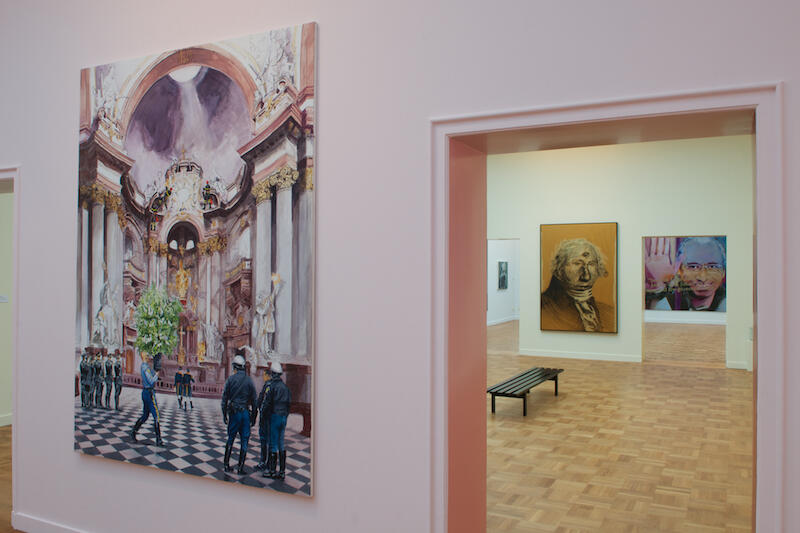
The curator Paco Barragan presents the exhibition End of History… and the Return of History Painting at the Museum voor Moderne Kunst Arnhem (MMKA) in Arnhem, The Netherlands, with the participation of artist from different places of the world, including an interesting selection of emergent Latin American artist: Miguel Aguirre (Peru), Pablo Alonso (Spain/Germany), Matthias Köster (Germany), Ignacio Goitia (Spain), Ronald Ophuis (The Netherlands), Pedro Barbeito (USA), Tomas Espina (Argentina), Maryam Najd (Iran/Belgium), Nicola Verlato (Italy), Trevor Guthrie (Canada), Simeón Saiz (Spain), Pascal Danz (Switzerland), Gamaliel Rodríguez (Puerto Rico), Carlos Salazar (Colombia), Sandra Gamarra (Peru), Iñaki Gracenea (Spain), and Judy Sirks (Norway). Barragán presents the concept of the exhibition in the following terms:
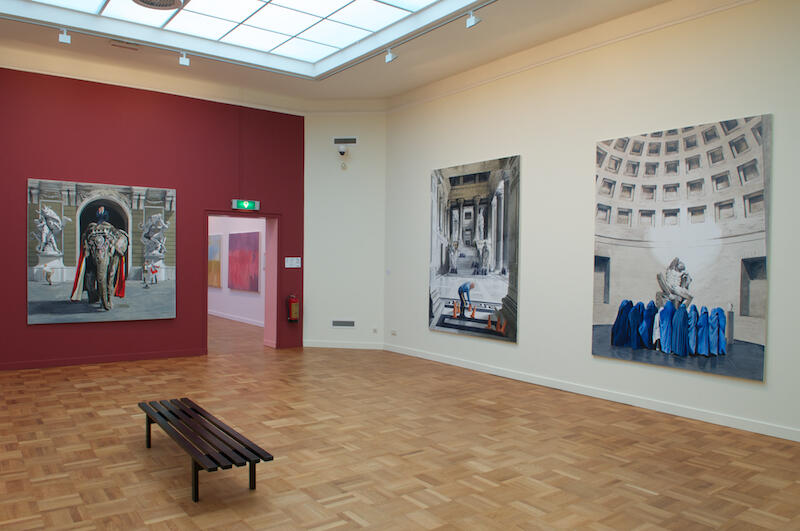
End of History… and the Return of History Painting references a long line of theories on “Ends of History” by thinkers such as Hegel, Kojève and Fukuyama. In Fukuyama’s thesis “The End of History”, 1989, he proclaimed the end of all ideological evolution and the world-wide triumph of liberal democracy. Departing from his thesis this exhibition analyzes the return of painting as both a consequence of a more conservative zeitgeist and as a response to historical events like September 11. Within this painting ‘revival’ there’s a return among a group of artists, engaged in a critical analysis of today’s society, to a kind of ‘history painting’.
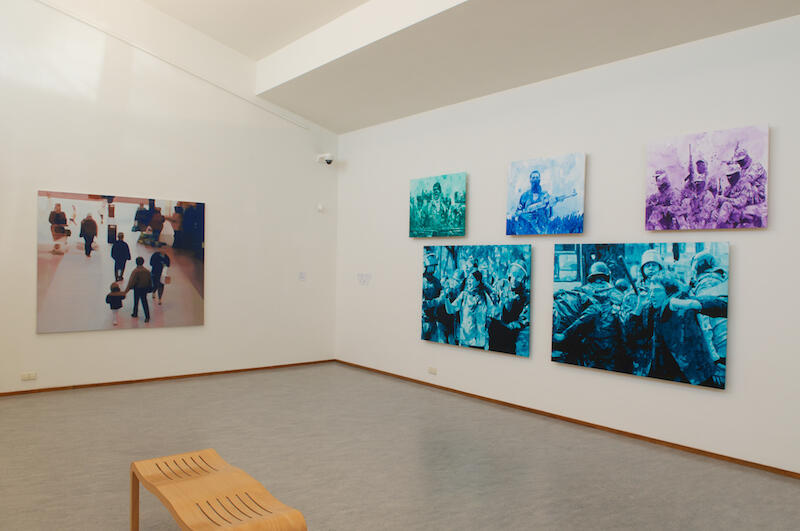
The artwork in The End of History… and the Return of History Painting reflects on the relationship between painting and our historical moment as well as investigating paintings’ relationship to photography, video and television - the media that usurped its role as documenter of history.
The Ends of History
The central theory of Fukuyama’s essay1 proclaims that humanity has achieved a final point in its ideological evolution with the triumph of Western liberal democracy over its presumed imitators at the end of our last century. Both Fascism, which
disappeared with the Second World War and post-war Communism which vanished with the fall of the Berlin Wall, gave way as threats to Capitalism. The end of history doesn’t entail the cessation of change or conflict, but once competitors have been deprived of all ideological or military components, all adversity will be reduced to economic matters. This means basically that, once Fascism and Communism had been defeated, Western liberal democracy emerges as the final form of human government, which will bring history to an end.
The Return of Painting
Since the mid 90’s we have experienced the return of painting, which has coincided with the peak of neo-conservatism and liberal capitalism. Actually, we should talk not so much about the return of painting, as much as a blowout/excess of the artistic medium par excellence. “It is said that the actual interest –writes David Lillington2- is the consequence of 9/11. The art world has panicked and goes back to the most safe, commercial, and conservative art form: painting. Maybe it’s true, maybe not, but it is evident that painting is witness to a small resurgence.” History always repeats itself, albeit with a small retouching here and there. Back in the 80’s, Benjamin Buchloh3 had already outlined, in the form of “a new classicism”.
The Return Of (Anti-)History Painting
From its origins, history painting has been one of the most important pictorial genres. Monarchs and kings commissioned artists to depict scenes of tournaments and battles with splendor and ceremony, and also the Church used religious themes as a tool for propaganda. But after the manipulation and the discredit of history painting throughout centuries, it is quite comprehensible that this genre has practically disappeared until today.
All this has taken us to the advent of a kind of ‘anti-history’ painting in which it’s not
about melodramatic and idealized compositions at the service of a national
conscience, glorification of the past or certain heroes4, but a critical analysis of
relevant recent political or historical events: from the War of the Balkans, Iraq, to the terrorist attacks in New York and Madrid, Guantanamo, the guerrilla in Colombia, religious Islamic and Christian fundamentalism, war on terror, and the fallacies of ‘neo-con’ capitalism.
Painting and mass media
Today’s information and mass media society have brought about a diffused
‘aestheticization’ hat freely mixes political and war images with those proceeding
from adds, commercial cinema and entertainment. Be it by hiding images behind
layers, making them transparent or pixelating them, applying faded colors and thick
paint, time is being slowed down through a physical rendering. But, besides this
‘slowness’ and physicality that we traditionally associate with the painting medium,
it’s also paradoxically going through an ‘acceleration’ process through its newfound
relationship with I-phones, scanners, Photoshop, Facebook, satellites, digital
cameras, and 3-D programs.
The artists portrayed in The End of History… and the Return of History Painting show that painting as a medium offers renewed possibilities and is able to provide an alternative and more critical reading of contemporary history while it engages with its own technological and mass-media context.
1 Fukuyama has taken a.o. on Hegel’s idea of the ‘present escaping from barbarism’ and the ‘exhaustion of spiritual forms’, and Kojève’s economical theories in which ‘wars and revolutions were the propelling forces of history’, and as a last resort ‘the market and its products would decide its end’.
2 Lillington, David Is schilderkunst weer urgent?, Metropolis M, 2003, nr. 2, p. 57-58
3 Buchloh, Benjamin "Figures of Authority, Ciphers of Regression," reprinted from October 16 (Fall
1981), pages 39-68 and published as part of an essay collection titled Art After Modernism: Rethinking Representation, various authors, Brian Wallis (ed.) The New Museum of Contemporary Art, New York,1984, pages 107-137.
4 On some occasions we find challenging and critical visions against state oppression; this is particularly the case with Jacques-Louis David’s ‘Oath of the Horatii’ (1784), Goya’s ‘The Third of May 1808’, or Gericault’s ‘The Raft of the Medusa’ (1819).