“The Artists’ Congresses: A Congress” at dOCUMENTA (13)
During the first week after the public opening of dOCUMENTA (13), The Artists’ Congresses: A Congress gathers artists and scholars from the fields of art history, philosophy, and cultural studies to address questions related to the history of the artist’s voice.

A series of five consecutive events delve into the genealogy of public institutional programming and the nature of the congress format as a platform for the production of meaning. Following a brief introduction to the day’s subject, the speakers present significant cases from the history of artists’ ideological and public congresses throughout the twentieth century, concluding with a roundtable discussion and an open Q & A session.
With the emergence of these platforms for artists, which evolved in tandem with the historical avant-gardes, a new social reading and perception of the artist developed: as producer rather than as outsider, genius, bohemian, or academic. These terms referring to the artist as an exception were replaced by a vision of the artist as an active participant in the construction of the social body. If the salon had earlier been the semi-public place in which conversations were activated, feeding the need of the upper classes to regard themselves as both patrons and receivers of artistic activity, the avant-garde positioned the street as a space and the artist as a maker of a new collective mind. This was a turning point where the subjective voice of the artist presented itself and its knowledge in a different arena: the meeting, and the congress. A new syndicate of forces, as well as a different way of understanding the role and function of speech, and therefore language, started to appear in the realm of art exhibition.
How do the different morphologies, from the free academies that were initiated by artists from the late 1960s on, to the many temporary structures that they are inventing in order to present works and ideas today, affect the institutional life of art? How do they relate to the emergence—starting in the mid-1960s—of specific museum departments dedicated to the production of “parallel” discursive events? How does the programming of talks and conferences as part as the exhibition context, as dOCUMENTA has done from its very first edition in 1955, affect the reception of art?
-
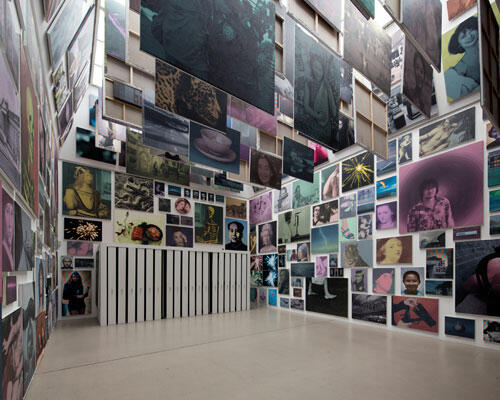 Limited Art Project, 2011-12 , 360 paintings, oil and acrylic on canvas. Commissioned and produced by dOCUMENTA (13) with the support of Galleria Continua, San Gimignano - Beijing - Le Moulin, Tang Contemporary Art, Beijing
360 pinturas, óleo y acrílico sobre lienzo. Comisionada y producida por dOCUMENTA (13) con el apoyo de Galleria Continua, San Gimignano - Beijing - Le Moulin, Tang Contemporary Art, Beijing.
-
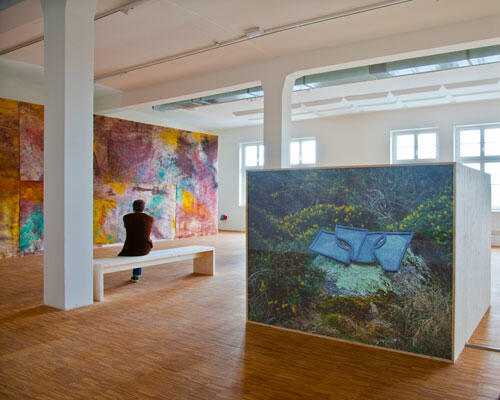 in her "Pintura del mar", Minack, 2012. Fabric, tint. Commissioned and produced by dOCUMENTA (13) Courtesy of the artist; Gaudel Stampa Paris
en su "Pintura del Mar", Minack, 2012, tela, tinte. Comisionado y producido por dOCUMENTA (13) Cortesía de la artista; Gaudel Stampa de París.
-
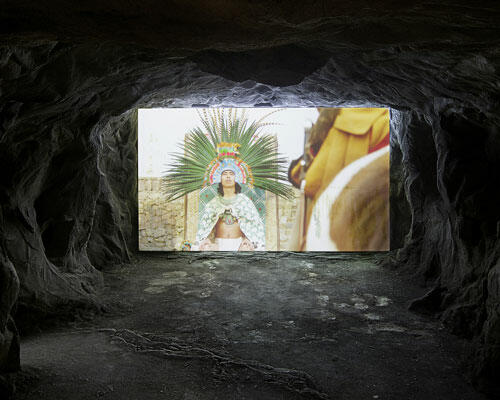 Altrauds Cueva, 2012. Installation. A channel of digital cinema projection. Commissioned and produced by dOCUMENTA (13) and Peter Kilchmann Gallery, Zurich.
Altrauds Cueva, 2012. Instalacion. Un canal de proyección de cine digital. Comisionado y producido por dOCUMENTA (13) y Peter Kilchmann Gallery, Zurich.
-
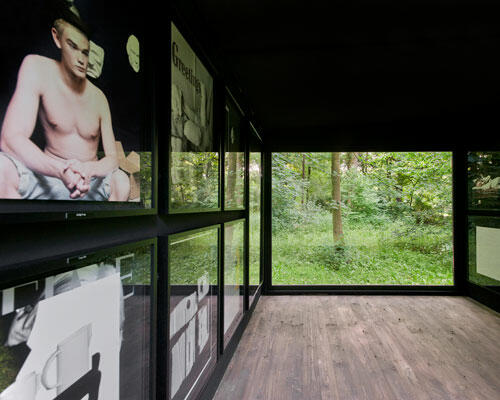 Tea Party Pavilion, 2012, wood, metal, mixed media. Provided by Sprüth Magers Berlin London. Commissioned and produced by dOCUMENTA (13) and Sprüth Magers Berlin London.
Tea Party Pabellón, 2012, madera, metal, técnica mixta. Proporcionado por Sprüth Magers Berlín Londres. Commisionada y producida por dOCUMENTA (13) y Sprüth Magers Berlín Londres.