
THE FEMINIST ART REVOLUTION
From a transparent dome that induced a profound sense of privacy, surrounded by a vibrant city drippling with art and culture, the Spanish professor and art critic, Estrella de Diego, spoke with the Argentine art historian, Diana Wechsler, in a meeting open to the public. The Buenos Aires Art Week arrived at a historic time for Argentina. In light of women’s spotlight in the international scene these past years, the Government of the city brought to Buenos Aires the matter of gender studies in the artistic scene. In their conversation, the experts outlined the impact the current feminist revolution has had on the development of contemporary art, alongside its effects on the criticism of art itself.
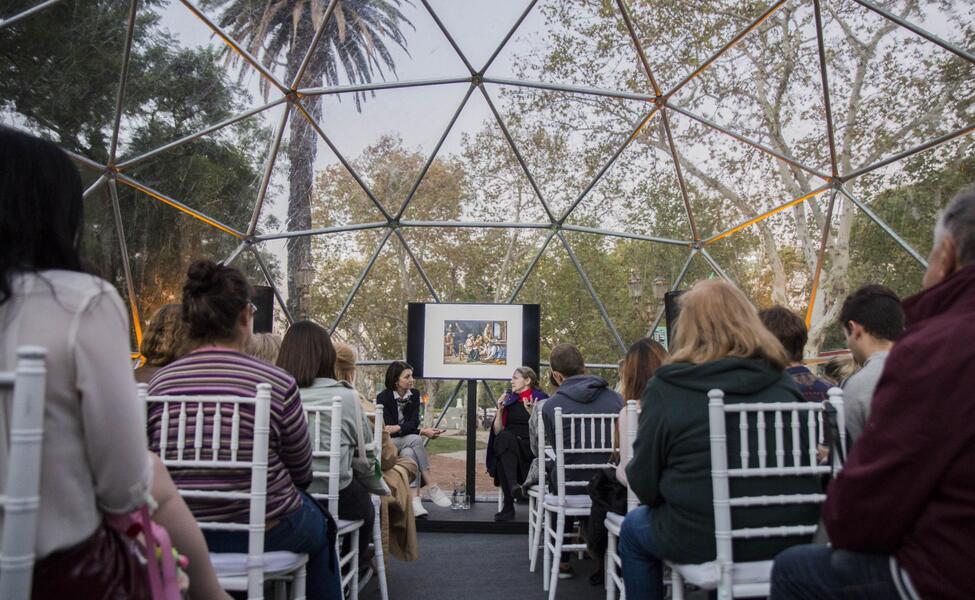
Estrella de Diego is a professor of contemporary art at the Complutense University of Madrid. She dedicated her career to studying art through the lens of gender and post-colonial studies, and was awarded the Gold Medal for Merit in Fine Arts from the Spanish government. Diana Wechsler is an art historian, researcher and critic. She is in charge of curatorial studies at the UNTREF (Universidad Nacional de Tres de Febrero) and is the director of BIENALSUR (Bienal Internacional de Arte Contemporáneo de América del Sur). Brought to Buenos Aires by Art Basel, an international art fair, both intellectuals discussed the effects gender studies have had on the current artistic scene.
In their conversation, the experts showed themselves both enthusiastic and preoccupied about the ongoing feminist revolution. On the one hand, they rejoice in the rupture from a binary system and its consequent structures, and celebrate the now possible duality of women. On the other hand, they warn against the replacement of one binary system for another. Feminism today is an omnipresent issue that, as Weschler put it, “taints any comment one makes”. The new perspective it has introduced to art is a double-edged sword. Museums, in an attempt to please the public, have included works of art made by women to their permanent collection, consequently exiling masterpieces to the attic. Some female artists have begun to enjoy more fame than deserved, as is the case of Hilma af Klint, according to Wechsler and de Diego, who was recently honored in the renowned Guggenheim Museum in the United States. Not all her artworks were worthy of such admiration, the experts argue. While during Klint’s time being a woman put her at a disadvantage, today it has its privileges. Instead of succumbing to yet another canon, this time one in which women are benefitted, Wechsler and de Diego propose learning from our marginalization to incorporate to the status quo the inclusion of everybody. “Let us not trade one power for another”, begged de Diego.
The feminist revolution completely altered the structures of art criticism. We find ourselves questioning the origin and purpose all art paradigms, which, inevitably, transmits to the re-questioning of all artworks. “All art is contemporary art”, explained Wechsler. A work of art is defined by its viewer’s perspective, and today more than ever our frame of mind has changed. From a theoretical framework of gender studies, one same piece may change its meaning completely. Such is the case of Sophie Taeuber-Arp’s work, the artist and swiss ballerina that participated in the Dada movement, who combined her Dadaism with techniques typical of surrealism. Her art later expanded to textile design and dance, but her avant-gardism transcended her time. While Picasso could belong to many etiquettes at the same time—cubism, surrealism, neo-classism, Tauber-Arp had to correspond exclusively to one. Her position as a woman allowed her only one facet.
“Us women have only had our bodies”, explained Estrella de Diego. We were demanded intelligence; men not to be stupid. The actual context of the inclusion of women into the art scene allows for the re-discovery of artists like Sophie Taeuber-Arp and her many facets. Women never created within the lines of society’s canon because we never were a part of it. Contrary to men, we lacked our genealogy, thus allowing us an absolute freedom of creation. Nietzsche and Foucault believed that the origin of the established order lies in power relationships (which, according to them, is the nature of all relationships), and Estrella de Diego agrees. She explained how the discovery of women’s genealogy created the rupture from our subjugation and allowed for the uncovering of our originality.
This revelation has created new issues to keep in mind. We must continue asking ourselves if what we now deem valuable effectively is so, or if we believe it because that is what we have been taught. This philosophical matter was profoundly elaborated and explored by the art historian of the XIXth century, Ernst Gombrich. It is ever-present in the field of art criticism, and must not be forgotten. The inclusion of a previously marginalized social actor entails a break from the established convention, yes. But it also threatens objectivity, especially during the apogee of such a rupture, as is the moment we are living today. Estrella de Diego gave the example of the famous artist, Artemisia Gentileschi. She wondered why some of her pieces are more renowned than others, and questioned the archetype with which the value of art is defined. Through a reflection that contemplated the lack of an answer to this question, the professor conveyed not only the ambiguous beauty of art, but also the urgent importance of being alert to such an ambiguity. This vigilant state will allow us to make a conscious, rather than complacent, critique.
In an encounter that can only be described as harmonic, Diana Wechsler and Estrella de Diego outlined the ramifications of the XXth century feminist revolution in the art scene by manifesting the intrinsic relationship between the humane and artistic production. Through a well-balanced speech, the experts called to find an intermediate territory between the different frames of mind. Their attachment to the feminist cause, combined with their preventive wisdom, led them to seek mediation between all disciplines and ideologies. “I don’t want anyone to rule”, explained de Diego, in a call to revise our thoughts and beliefs. The conversation advocated for the questioning of all social and artistic preconceptions, in the spirit of making room for a pure and free artistic expression.