Shattered Glass
at Carrillo Gil Art Museum, Mexico
The National Council for Culture and the Arts, the National Institute of Fine Arts and the Carrillo Gil Art Museum invite to Shattered Glass. Reinterpreting the Collection of the Carrillo Gil Art Museum, a fresh and renewed approach to the MACG Collection, through the notion of violence as the linchpin of research and content. This exhibition is the result of a collaborative project between the MACG, Americas Society and the Graduate Program in Art History at the UNAM, with the intention of contributing to the formation of a new generation of historians and art critics.

The seminar development used the violence subject as a support, because is a common generic when we reflect on humanity, and characterizes the Carrillo Gil Collection that is oriented towards universal issues of great drama. Chaos and disaster, prostitution and death in the style of José Clemente Orozco and David Alfaro Siqueiros, are sustenance, as a thematic offer of the collection. Interestingly, in third place (in number of pieces) was León Ferrari, Argentinian generous artist who has a unique history with the MACG, and that on two occasions (1982 and 2007) held exhibitions at the museum and both made substantial donations of his work.
Other authors included in the exhibition are printmaker artists of Popular Graphics Workshop and Gunther Gerzso. From contemporary acquisitions, they chose a series of photographs of Ambra Polidori, a photographic enlargement of an art action of Chicano artist Daniel Joseph Martinez, and two large format drawings of Alejandro Montoya. To the exhibition, at the same time, it added some jobs that do not belong to this group such as Carlos Aguirre, Carlos Amorales, Helen Escobedo, Marta Palau, Cannon Bernáldez, Artemio, Diego Berruecos, Mireia and Eniac Martinez Sallarès.
Shattered Glass links works from the Collection of Carrillo Gil Art Museum, all from different periods related by signs referring to the contemporary experience of violence. History has played a key role in Mexican art, which, of course, involves artists who are committed with a post-revolutionary nationalism. They attempted the construction of a visual system that stems from it. The figures and deeds of the heroes of the Revolution belong to an iconographic inventory the artists and critics dealt with, along with a combination of ideas on history painting as well as some radical avant-garde ideas. Although the selected works make use of these conventions and the representation mechanisms of the heroic, its juxtaposition with contemporary works allows a reinterpretation of the visual and discursive strategies of modern art.
It is, in short, submitting a national collection to an examination and renewal rather than seeking historical continuity, not the way Orozco argued violence was universal, nor by trying to demonstrate the stability of a national aesthetic. It is more like an exercise in reverse archeology that tries to find for evidence of the modernist production modes in contemporary art. Shattered Glass has three topics:
Dystopias: World Destruction
The artworks gathered here share one central theme: the process and result of destruction: bombs falling, ruins of war and collapsing buildings, human agglomerations in unsustainable cities. These artistic thoughts question the notions of civilization, foreshadowing a menacing future. At the heart of these explorations, we find the end of the world, a catastrophe caused by the violence of civilization. The wars of the twentieth century and the press images depicting bombed cities have marked our collective memory.
A Gun to the Head and the People in Flames Representational mechanisms about what is violence in politic by images.
This topic is a reflection on the relationship between identity and violence. The works all refer to historical characters and events, and call upon the viewer to take a position on the depicted images. The artworks also attempt to weigh upon their critical reception and more fundamentally, upon the construction of the social itself. The similarities end at this point. Therefore, we analyze how media produces meaning in a shared political area. What is highlighting here is how the materiality of the work affects the space where the body of the potential audience finds it. Next, we study how the works are embedding in a given imaginative system. From this anchor, we can stretch out emissaries of a (new) truth, a truth understood as a valid perception of the world, to share with the viewer. Finally, we analyze how that perception connects the body to identity as a place of violence. The links offered by the artworks proposal, through these represented bodies, lightening on how the viewer understand, justify or reject violence.
Physis Rupta: Fragments of the Body and the Psyche
In constructing a curatorial discourse, a common denominator among the works selected were the different historical and experiential horrors, and even those apexes found in violence, like perversion or harm. Although the reflection and treatment of the images link to the human body and to a subjective (individual, internal, spiritual) violence, even the deplorable physical harm of lynching, they never considered as a painful or suffering body, but as a historically ruined and broken body. Body, psyche, determination and lapse of time, assimilated as natural conditions but with an obliged and assisted development, that fragmenting or mutilating them, are physical, figurative and emotional extensions of the social body and the body of life, about what there is only grief and resignation.
-
 León Ferrari, Ángel apocalíptico, 1988. Collage, fotocopia a color sobre papel opalina, 42 x 32 cm. En trámite de donación al acervo CONACULTA-INBA / Museo de Arte Alvar y Carrillo T. de Carrillo Gil. Collage, color photocopy on paper, 42 x 32 cm. In donation process to CONACULTA-INBA / Museo de Arte Alvar y Carrillo T. de Carrillo Gil.
 -
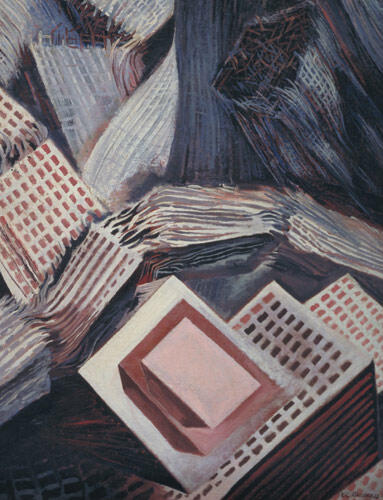 José Clemente Orozco, Los muertos, 1931. Óleo sobre tela, 112 x 92 cm. Acervo CONACULTA-INBA / Museo de Arte Alvar y Carrillo T. de Carrillo Gil. Oil con canvas,112 x 92 cm. CONACULTA-INBA funds/ Museo de Arte Alvar y Carrillo T. de Carrillo Gil.
-
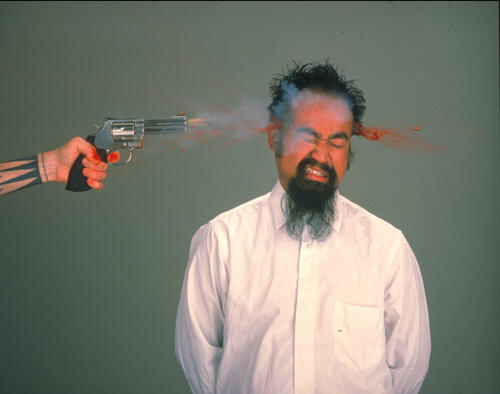 Daniel Joseph Martínez, Self Portrait # 7. George and Daniel. In an insane world it was the sanest choice or How one philosophizes with a Hammer After Harold Edgerton, 1964; Eddie Adams, 1969, 1999 - 2001. Impresión digital light jet / Plexiglas. 122 x 152.4 x 1.27. En trámite de donación al Acervo CONACULTA-INBA / Museo de Arte Alvar y Carrillo T. de Carrillo Gil, INBA. In donation process to CONACULTA-INBA / Museo de Arte Alvar y Carrillo T. de Carrillo Gil, INBA.
-
 David Alfaro Siqueiros, Caín en los Estados Unidos, 1947. Piroxilina sobre madera comprimida, 76 x 92,8 cm. Acervo CONACULTA-INBA / Museo de Arte Alvar y Carrillo T. de Carrillo Gil, INBA. CONACULTA-INBA Funds / Museo de Arte Alvar y Carrillo T. de Carrillo Gil, INBA.
 -
 José Clemente Orozco, Invierno, 1932.