Remembrance of Armando Morales
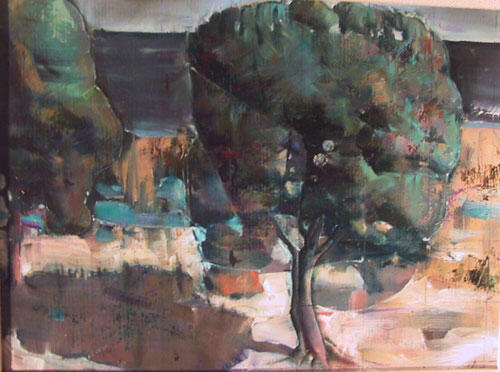
Armando Morales (Nicaragua 1927 - Miami 2011), one of the pioneering masters of dialogue with the modernist avant-garde on the continent and who also built his language-as modern and contemporary, on the vast expanse of the landscape of central and South America, with its vast jungles and wild places. His death does not extinguish the power of the landscape that is also a metaphor for the Latin American soul. Simply, it allows him to enter into eternity.
Since childhood, the tools of painting fascinated Morales. According to one of the galleries that once represented him -Rogallery- when he was seven years old, managed to keep an oil paintings box used by his sister to decorate crafts with a spatula.
Morales narrated that it was by 1938, when for the first time had made a “realistic” painting of some imaginary landscapes and pointed out the time as the start of his career. He studied at School of Fine Arts of Managua, where finally fulfilled the dream of starting learning the oil.
At 29 years old, even he then could only paint on weekend; Morales won the painting competition "September 15", with the work of a árbol-parlante ( tree-speaking), a figure that has roots in the Mayan tradition. Later, thanks to the vision of legendary art historian and director of the Museum of Modern Art in New York, Alfred H. Barr, MOMA acquired his masterwork for their powerful permanent collection. In 1957, he participated in the exhibition "Six Nicaraguan Artists" which opened in Washington. Morales received enthusiastic reviews and sold all his paintings at the exhibition. That same year, received a scholarship from the American Council on Education and in 1958 won a grant from the Guggenheim Foundation. Morales obtained the Ernest Wolf award of the Biennial, resulting in the "Best Latin American Artist" in a São Paulo Biennial.
In 1964, before settling in Cádiz, España, Morales received the "JL Hudson & Co." award at the Carnegie International in Pittsburgh. In 1966, he won "Industrial Tandil Award” at Third Biennial American in Córdoba, Argentina and established in New York.
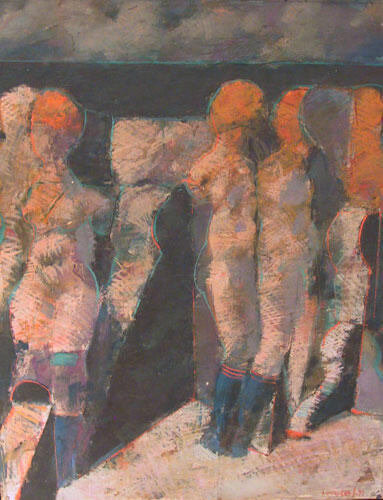
In 1970, he began to paint fruit evoking sensual softness of human skin and that led into the nudes achieved with huge pleasure on the details. After trying in vain to settle in Nicaragua in 1976, moved to Costa Rica, where he worked a black and white lithographs series for Herbert Kassner of Lithographic Editions and for Kyron editions workshop of Mexico City.
Although during his stay in New York, had a stage in which he was leaning toward the abstraction, from the late 60's returned to the two omnipresent themes in his work: the tropical landscape and the human figure, and the combination of these and textures or spaces that could recall that dream force from Chirico. Morales also had exhibitions in major museums in Peru, Bogotá, Caracas and Mexico, D. F., and others.
In 1972, he taught painting at the Cooper Union in New York and later served as cultural attaché of the Consulate of Nicaragua in this city. In 1982, the Sandinista government gave him the Ruben Darío Order. The trip to his country allowed him to visit the rainforest on the Atlantic Coast before moving to Paris and traveling in Africa. That journey led him even more deeply the path of the forests into his painting. In 1983, being alternate delegate from Nicaragua to UNESCO, he met the gallery owner Claude Bernard, who began to represent him and take Morales to art fairs like FIAC and Art Miami.
In 1993, he completed lithographs portfolios named The Saga of Sandino, which would be later exhibition at the Museo Rufino Tamayo in Mexico City and a portrait of García Márquez, one of the great admirers of his art and who wrote about the fascination that painter exerted. Morales said that his paintings did not have bright colors, colorful who people identified with the idea they had of the Latin American, but it was “a very Latin American way to approach the painting and its subjects ... They are always my still lives, my naked ones and my jungles”. He has now entered forever in those timeless forests oh his paintings.