Pinta London 2012: Dialogues between cronologies, geographies and creative fields.
Pinta London 2012’s panorama revealed a broad creative horizon not only thanks to the inclusion of Iberian and Latin American art, but also as a result of a special convergence of twentieth and twenty-first century geometric art, including conceptual inquiries of Post-Modernism that extend to the present, as well as other trends of contemporary art.

In its third edition, prestigious participating institutions − the Centre Georges Pompidou, the Middlesbrough Institute of Modern Art-MIMA, Tate Modern, and the University of Essex Collection of Latin American Art − acquired works at the fair thanks to the Acquisitions Program based on the matching funds system. The University of Essex Collection worked in association with England & Co. Gallery to organize a performance by the Bolivian emerging artist Aruma (Sandra de Berduccy), as well as the talks complementing the works exhibited at the gallery together with archival material related to Latin American art in London and in Europe in the 1960s and 1970s.
Aruma (b. Oruro, Bolivia, 1976) uses traditional Andean textile processes and techniques to create works with a strong conceptual content in mediums such as photography, video art, performances and site-specific installations. In the course of the fair, she performed a series of live acts inspired by the ancestral space of weaving, which was the form of expression closest to writing in some pre-Hispanic cultures and which played a fundamental role in certain myths. It was believed that every human being would take his/her life with him/her in the form of a woven textile in the journey to the afterworld, until their arrival in the windy hills where their actions would be examined. A strong textile in vibrant colors would reflect a similar life and would not break. Alongside other pieces by Aruma, who painstakingly interweaves Bolivian notes and natural fiber threads, the gallery exhibited works and documentary material by Cecilia Vicuña and a piece by the US artist John Dugger, Chile Vencerá, first hung in Trafalgar Square and currently on display at Earls´s Court.
Pinta will also include the participation of Jota Castro, who has staged political performances with the conviction that even though art cannot change anything, it can make people think. The presence of emerging contemporary artists was strong in this edition. Participants include, for example, the Colombians Adriana Marmorek, whose photographs, videos and installations revolve around “the architecture of desire”, questioning the imaginaries related to femininity, sexuality and desire, and Adriana Salazar, Suma Cum Laude in Philosophy, who explores the phenomenon of human actions, recreating their de-naturalization through kinetic sculptures. Her fellow countryman Rodrigo Echeverry creates beautiful, almost abstract works in wood that make reference to the coffins of those massively killed in an unrecognized war. The Spanish artist Bene Bergado constructs objects reminiscent of a non-existent time, recreating the myths of her adolescence. The Puerto Rican Gamaliel Rodríguez draws in ink a realistic documentation of architectures built under the fiction of collective fears induced with the aim of achieving forms of political control.
Photography has a growing importance in this generation, as may be perceived in the works that resort to this medium, not only in the case of photographers such as the Spaniard Germán Gómez, the Panamanian Sandra Eleta or the Guatemalan Luis González-Palma, but also of other artists who work in different media, such as the Cuban Carlos Garaicoa, the Chilean Patrick Hamilton, the Colombian Carlos Motta, or the Venezuelans Luis Molina-Pantin, Gabriela Moraweitz and María Fernanda Lairet.
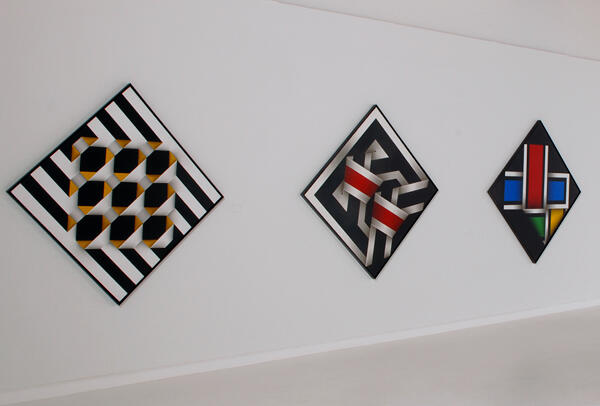
As is already traditional, geometry constitutes one of Pinta’s axes. And this edition is particularly rich and encompassing in this respect. It includes not only internationally acclaimed figures but also other prestigious artists whose works have not enjoyed the same amount of diffusion, and the continuation − or derivatives − of geometric abstraction among emerging artists. This broad range includes masters such as Gego or Lygia Pape or Ramírez Villamizar, and Fanny Sanín, Elizabeth Jobim, Omar Rayo, Emilio Sánchez, Francisco Sobrino, Alejandro Puente, Cinthia Marcele and Ricardo Alcaide, or Eduardo Serón, among countless names, including the Spanish artist the collective Equipo 57, José María de Labra, José Duarte, Manuel Calvo o Julio Plaza, among others.
Similarly, the fair featured sculptors belonging to different generations, such as the Cuban Agustín Cárdenas and the Spaniard Juan Luis Moraza, whose sculptures draw on the new society of knowledge, and abstract paintings by twentieth-century figures such as Wolfgang Paalen or Roberto Matta, and recent works by Emilia Suyer, as well as works by the Spanish painter Darío Villalba, belonging to that generation known as “El Paso” because it constituted a kind of transition between informalism and abstract expressionism, besides featuring pioneers in different branches of conceptual art in Latin America, such as the Argentinean León Ferrari, who combined icon and text, or the Colombian Álvaro Barrios, who mixed conceptualism with Pop Art, or Liliana Porter, who participated in the creation of a way of associating it to graphic art.
In addition to the names of other artists from different countries who combine painting and graphic art, as may be the case of Miguel A. Giovanetti and Jean Marc Calvet, the fair launched, with support from Mexico’s Tourism Board, the section named Pinta Design, featuring works such as Valentina-Gonzalez-Wohlers’s chairs, which show the close relationship between art and design in contemporary creation.