
Pinta 2011: an echo for artists’ new searches
and for the routes of the geometry of the South
One of the most interesting aspects of the fifth edition of Pinta New York was the way in which different gallerists chose to show some works by renowned artists which are not their best known pieces but which, however, have a particular significance, as well as to include recent series that change the direction of their investigations.
Nara Roesler Gallery featured an erotic series by Antonio Manuel, the guest artist who, parallel to this exhibition, is featuring his first solo show in the United States, curated by Claudia Calirman and Gabriela Rangel, at the Americas Society. If his works and actions challenged political censure during the Brazilian dictatorship in the 1970s, these drawings that combine phalluses in the foreground with faces with glasses are another way of practicing freedom of expression.
The booth of Milano Gallery −impeccably installed and devoted entirely to Anna Maria Maiolino, one of the most internationally renowned contemporary Brazilian artists − included a variety of works ranging from the early and already iconic pieces to the most recent ones, of a very different nature. Thus, it was possible to view that unforgettable map of South America in a box, drawn in black lines on white paper, in which the Brazilian territory − ruled with an iron fist by the dictatorial governments − appeared as three-dimensional on a completely black plane and containing a word: SOS. Her characteristic search of experiences involving language and the body linked to life, or the way in which she seeks to fuse the ancestral and everyday life or the representation of her own presence, is now being conveyed through a new series in which she portrays her own hands touching the painted face − in the manner of cave painting − of a male figure found in a book, which the viewer does not notice. It seems as though this experience of recording touch had not been mediated by centuries and by numerous representation techniques, but that it were an immediate experience.
Henrique Faría Fine Arts’s not-to-miss stand features, as always, remarkable selections − such as the image of Leandro Katz’s famous typewriter in which he replaced the types with the moon’s phases − and revelations of new pathways. In this case, he showed a recent series of works on paper by Horacio Zabala that responds to a present in Argentina in which the political horror of the 1970s, when exile and political proscription were part of the equation of his art, no longer exist. Now he proposes mathematical equations with geometric figures, which somehow function as the comeback equation, as an allusion to those movements that founded an identity of their own, such as MADI, and capable of modifying the assumptions regarding geometric abstraction in the world.
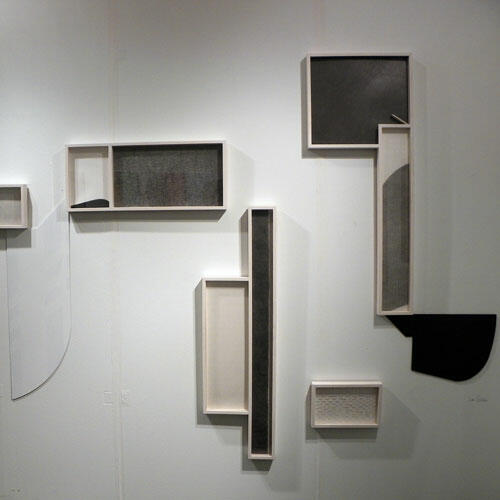
This gallery also presented Guatemala, an unusual geometric wall installation by the Colombian artist Luis Roldán, which represents a rupture with regard to his earlier almost floating elements such as threads or fabrics linked to the existential dimension in large cities: here he uses frames containing abstract drawings in graphite that function as interchangeable forms, with a playfulness that combines reliefs with arches, narrow rectangles and squares.
The Venezuelan artist Milton Becerra went beyond his habitual installations using mesh, threads or stones, to respond to an organic geometry engaged in a dialogue with the Pre-Hispanic aesthetic and mythology at Hardcore Contemporary Art. In Eikon (image, in Greek), he replaces the ancestral stones with three-dimensional images of the Statue of Liberty or the Eiffel Tower, paying homage to the great non-functional monumental works which constitute icons of human aspirations.
Ruiz-Healy Art presented recent works by Andrés Ferrandís that broke with the asepsis of his translucent geometric installations: it did not only include materials such as black velvet, or ambiguous forms in search of the volumetric, but also phrases such as “flying”, in a work that recreated the story of Icarus. It reflected a return to the unconscious, a return to the mythical in which, as Nietzsche proclaimed, rational logic is overflowed and a connection with other sources is reached. At Joseé Bienvenu Gallery, Darío Escobar’s geometric paintings surprised the viewers with a type of representation which was unusual in his case, until the latter discovered that instead of artistic oil he was using motor car oil to paint.
At Dot Fifty One’s booth, the Argentine artist Mauro Giaconi featured for the first time the drawings in pencil which he smudges as a way to make reference to vanishing and suggest an unceasing dynamics of destruction-creation, as is the case in a large scale installation with a surprising effect: he has replaced the theme of houses with a concept that fuses drawing with the architectonic structure, and in this way he has completely occupied the gallery’s white cube.
There was a whole range of works which were formally resolved on the basis of the geometric, but whose inquiry intertwined with the conceptual, and beneath their orderly appearance, hinted at a tension with underlying social, an even emotional, references. Athena Galería de Arte showed works by Mira Schendel, Cildo Meireles − a master of the fusion between political art and conceptualism −and a painting with the leit motif of Adriana Varejão’s floor tiles. Arte Espacio presented works by the emerging Chilean artist Pablo Jansana, capable of transferring the human inner space onto abstract tradition. W1 B1, of 2011, contains the volumetric gesture of an evasion that consolidates contemporary geometric creation.
GC Estudio de Arte showed recent works – such as Tres modelos para dibujar − by the Argentine artist Eduardo Costa, who after having joined in the 1960s the New York avant-garde movements that sought the de-materialization of art, was the first in rendering to painting a volumetric texture, in such a way that he moved on from the representation of the world to its duplication using the same painting transformed into volume.
-
 Guatemala, 2011. Graphite on paper, painted metal and wood frames. Dimensions variable / Grafito sobre papel, metal pintado y marcos de madera. Dimensiones variables.
 -

-

-
 Abstraction, 1950. Iron, 75⅝ in H. Hierro, 192 cm. de altura. $ 150,000. Courtesy/cortesía: Cecilia de Torres.
 -
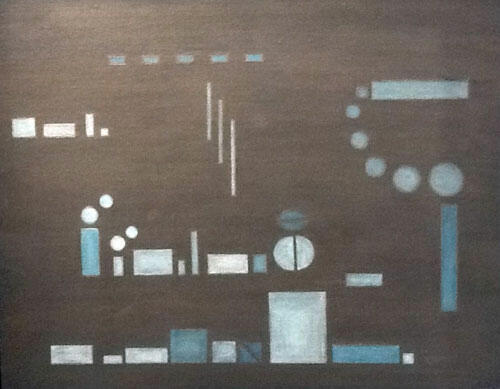 Sin titulo, 1956, 23 x 29 in. / Untitled, 1956, 58,4 x 73,7 cm. Courtesy/cortesía: Pan American Art Projects