Origin and Convergence. Gego Retrospective: 1950.1994
Sala Mendoza, Caracas
As part of the events organized by the Gego Foundation to commemorate the one hundredth anniversary of the birth of the Venezuelan-German artist, Sala Mendoza is presenting a retrospective exhibition curated by Josefina Manrique that includes works never exhibited before.

Gego (1912-1994) developed her entire body of work in Venezuela. A graduate of the Stuttgart Technical School, she emigrated to Venezuela in 1939, just before the outbreak of World War II, holding a degree in Engineering with a Special Mention in Architecture. Her knowledge of structures and spatiality allowed her to masterfully develop her future work
With time, Gego became a teacher, a draftsman, a sculptor and a printmaker. She excelled in all the different activities she embarked on. She was a constant researcher and a permanent innovator. Her oeuvre can be summarized into one word: coherence. So much so that this characteristic allowed her to revise earlier stages and successfully incorporate new contributions in each of them. Particularly noteworthy in her body of work is the utilization of materials that were little conventional, the neat joints and the knowledge of geometry.
Starting from a disciplined study of the line, which linked her to Albers and the Bauhaus artists, she would eventually evolve towards her early iron sculptures. After a period as a teacher at the School of Architecture of the Central University of Venezuela, she began to develop the environmental reticularea. This work was composed of repeated and interconnected geometric figures made of wire, with very simple elements, which she twisted to achieve a three-dimensional and spatial effect. This work revealed Gego to be a great artist. She then exalted nodal points, a knotting and linking procedure through which the joints acquired an enhanced value because they were the central detail of her proposal.
Then came the drawings without paper, in which through a process of bending, the artist eliminated the frames and generated reflections on the projected surface. In these works, detail plays a leading role. Both the reticuláreas and the drawings without paper have a mathematical quality to them that renders them fascinating: they function like a Möbius Strip. They are unidirectional pieces that vibrate to the rhythm of a cadence. They are three-dimensional bands with no beginning or end. The work of the Dutch artist M.C. Escher (1888-1972) is based on this mathematical theory. Gego decodes it, but in abstract terms. Besides, in her works Gego enhances the value of the nodes, that is, the joints that link the elements. In the drawings, she eliminates them. It is the eye that links the pieces. In the three-dimensional elements, they may be the key object of the proposal, constituting at the same time meeting points and points of departure.
There is an aspect that links her to her lifelong companion − Gerd Leufert − not only to the works that they executed in collaboration, but also to Leufert’s series of “ listonados”. In the drawings without paper, Gego eliminated the work’s support and frame to generate an ethereal space where the line had no foundation and its shadow was reflected on the surface. Leufert adopted the frame. The frame as a visual and manipulated object, solid but at the same time giving shape to a space, which would be the negative of the drawing without paper.
The analysis of the drawings, in ink or watercolor, reveals several essential aspects. Gego develops them in the manner of a two-dimensional exercise based on her three-dimensional work. In this case, the nodal point is not shown. The junction is a blank. It is the eye that joins the pieces together. Also, the foreground is featured in a dark color, and the background in paler tones. She thus achieves a three-dimensional effect with the first glance. On examining them in further detail, the viewer perceives that they are impossible geometries. The artist deceives the viewer.
Gego’s “ tejeduras”, small pieces comprised of strips of printed paper affixed to a support, contained a synthesis of all the elements in her work: weavings, joints without fastenings, simplicity, volume, color. They were made from cigarette wrappings, magazine pages, and so on. There is an influence from Johannes Itten, Gunta Stölz, but above all, from Anni Albers. All of them Bauhaus weavers. The “ tejeduras” epitomized her entire oeuvre: geometry, lines, two and three-dimensionality, economy of materials and a sublime sensibility. Gego is formal, but at the same time, she is an artisan. She destroys in order to construct a poem.
As a final commentary, I would like to mention a trait that may be perceived throughout the whole development of her work. And this is a deep joy. There is something mid-way between the excessively rational and the playful in Gego’s oeuvre. It is as though a sort of child genius were playing with mathematical formulas in her ludic craft. Perhaps this is the secret of the fascination of these pieces, which fluctuates between obsession and pleasure.
-
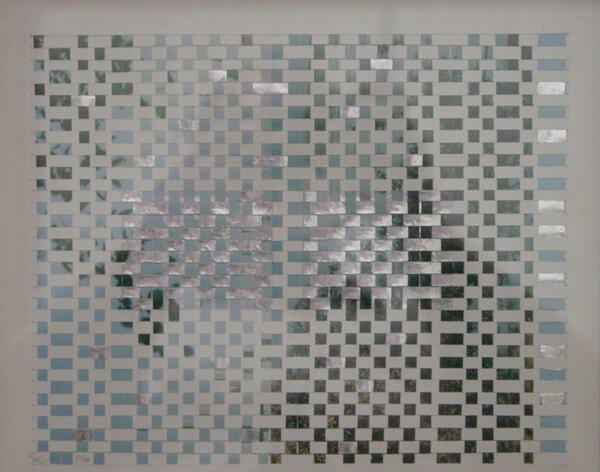 89/11, 1989 - Mixed paper piece on carboard * 8.7 x 10.2 in - Private Collection
Photograph: Beatriz Sogbe
Tejeduria 89/11, 1989 - Mixta de papel sobre carton - 22,2 x 26 cm - Coleccion privada
Fotografia: Beatriz Sogbe