
Maria Auxiliadora: Daily Life, Painting and Resistance at MASP
In the year dedicated to Afro-Atlantic histories Museu de Arte de de São Paulo presents the exhibition Daily Life, Painting and Resistance By Maria Auxiliadora (1935–1974).
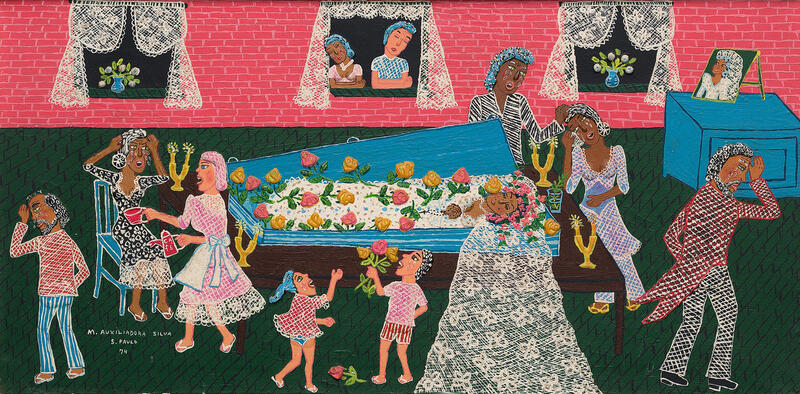
In the year dedicated to Afro-Atlantic histories at MASP—stories of inflow and backflow between Africa and the Americas across the Atlantic—this exhibition featuring Maria Auxiliadora (1935–1974) assumes a certain urgency. The artist’s delicate, precise, and harrowing paintings portray her daily life and culture, spanning several African-Brazilian themes: capoeira, samba, umbanda, candomblé, the orixás. Auxiliadora also represented the day-to-day lives of her relatives and friends in the suburbs of São Paulo, especially in Brasilândia and Casa Verde. Here, we are reminded of the feminist argument of the 1960s, first vocalized by Carol Hanisch: “the personal is political.” In the context of art history and a culture of museum collections dominated by European, white, elite representations and tastes, Auxiliadora’s work takes on a valence of resistance.
Of humble origins, and a descendent of slaves, Auxiliadora invented a new way of painting, far from academic and modernist precepts. Her singular technique became her signature: using a blend of oil paint, plastic adhesive, and strands of her own hair, she constructed reliefs on canvas. She was hardly among the canonized figures of art history, and sold her work at outdoor markets at Praça da República in the center of São Paulo, and at Embu das Artes, a city near the capital—places for meeting and exchange among those who can’t find opportunities at museums or galleries on the commercial art circuit.
The paintings in the exhibition are organized into six nuclei, each centered on one of the artist’s major themes. In “Self-Portraits,” Auxiliadora shows herself as an artist practicing her craft, but also as a bride or a sick woman (she died young, of cancer, at age 39). “Couples,” one of her main obsessions, centers on courtship and conquest, reflecting her romantic perspective. In “Interiors,” the day-to-day is registered and celebrated in situations characterized by affection and intimacy, especially in the meetings between women. In “Popular Manifestations” there are processions and festas juninas, capoeira, the bumba meu boi festivities, carnival street parades, samba, corner bars, gafieira balls. “Rural” features images of life and work in the country. And “Candomblé, Umbanda, and Orixás” is central to her work, given that in Brazil a fundamental part of black resistance is structured through religious worship of African origin.
Auxiliadora has suffered a long period of obscurity (her last big solo exhibition took place at MASP in 1981), and this presentation aspires to renew interest in this essential Brazilian artist, beyond the prejudiced, paternalistic, and reductive categories of “naive art” or “primitive art.” The presentation now of her work also proposes an answer to a crucial question for any museum that wants to dialogue effectively and be relevant to its home context: in what way can art represent cultures outside the dominant classes? Maria Auxiliadora offers us a life (and art) for our time—at MASP, in São Paulo, in Brazil, and in the world.
Maria Auxiliadora: Daily Life, Painting and Resistance, on view through June 3, 2018, is curated by Adriano Pedrosa, artistic director, and Fernando Oliva, curator, both of MASP. The catalogue accompanying the exhibition, edited by Pedrosa and Oliva, in Portuguese and English separate editions, has 290 pages and brings together new texts by Adriano Pedrosa, Amanda Carneiro, Artur Santoro, Fernando Oliva, Isabel Gasparri, Karen E. Quinn, Lilia Schwarcz, Lucienne Peiry, Marta Mestre, Mirella Santos Maria, Renata Bittencourt, Renata Felinto, and Roberto Conduru, as well as reprints of five historical essays from the 1960s to the 1980s, documents and photographs related to the artist’s life and work, and reproductions of 164 paintings by Maria Auxiliadora, located during the research, many reproduced here for the first time ever.