MARTA MINUJIN’S IRREVERENT FORCE AT THE JEWISH MUSEUM IN NEW YORK
The Jewish Museum will present the first exhibition in the United States of Marta Minujín, a defining force of Latin American art whose trajectory intersected with the major artistic developments of the postwar period while reflecting a singular spirit and vision infused by her sharp intellect, irreverent humor, and performative presence.
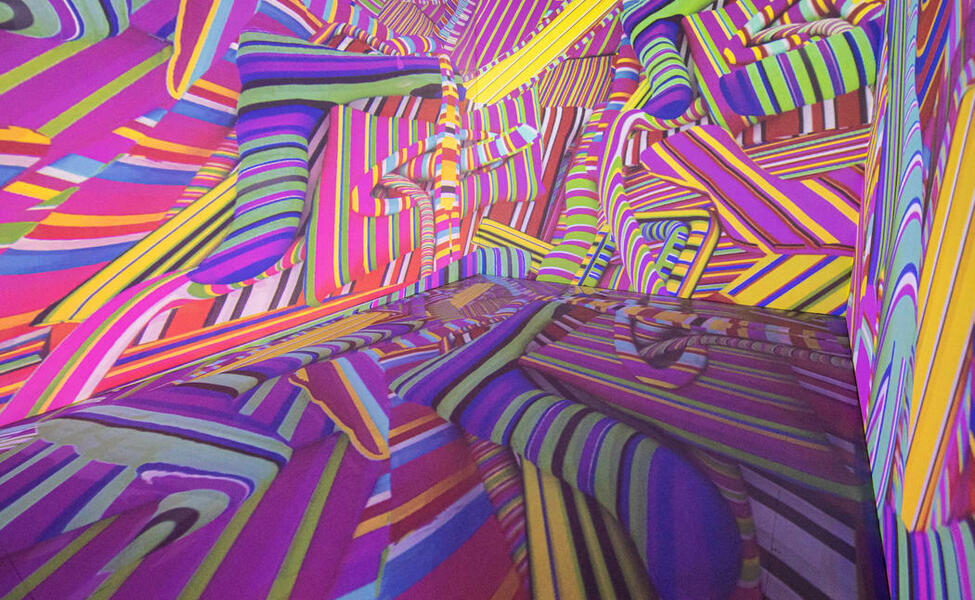
On view from November 17, 2023 through March 31, 2024, Marta Minujín: Arte! Arte! Arte! will reflect the genre-defying arc of the artist’s six-decade career. This timely exhibition responds to a renewed interest in feminist, Pop, and Latin American art by investigating one of their leading figures.
Organized to reflect her bold experimentation over six decades, the exhibition will chart Minujín’s influential career in Buenos Aires as well as time spent in Paris, New York, and Washington, DC, through a range of pioneering, mattressbased soft sculptures; fluorescent large-scale paintings; psychedelic drawings and performances; and vintage film footage. The artist’s ephemeral works –happenings, participatory installations, and monumental public art– will be presented through rarely-seen photographs, video, and other documentation.
-
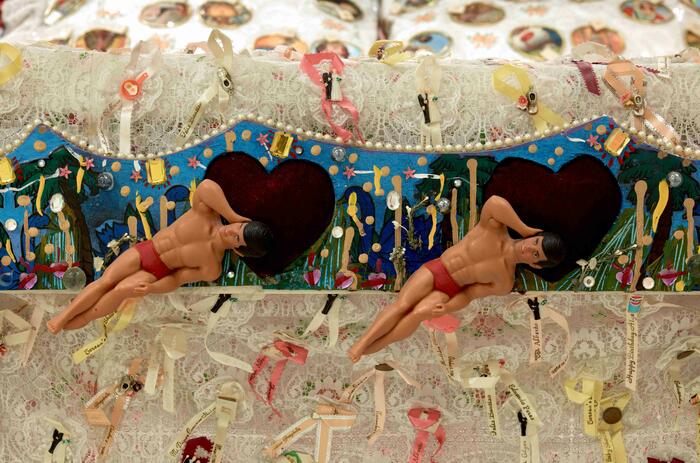
Marta Minujín, Para hacer el amor inadvertidamente (For Making Love Inconspicuously), 2010, acrylic, tempera, and lacquer on mattress fabric with foam rubber, 94 × 135 × 30 in. (239 × 343 × 76 cm). The Speyer Family Collection, New York. © Marta Minujín, courtesy of Henrique Faria, New York and Herlitzka & Co., Buenos Aires.
-
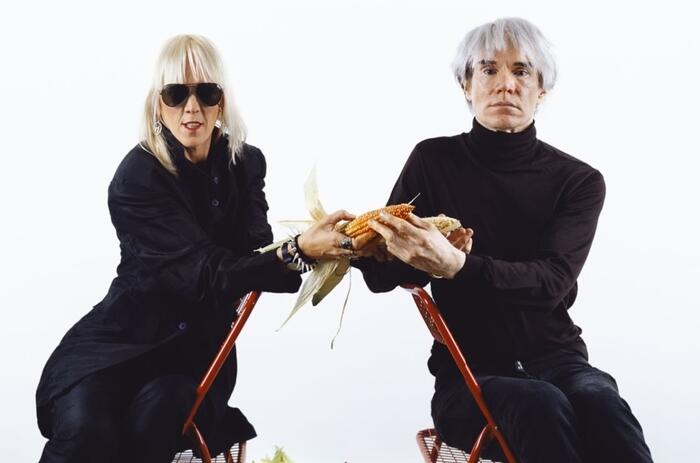
Marta Minujín with Andy Warhol, El pago de la deuda externa argentina con maíz, “el oro latinoamericano” (Paying Off the Argentine Foreign Debt with Corn, “the Latin American Gold”), New York, 1985 / 2011, C-print, 36 3/8 × 39 1/4 in. (92.4 x 99.7 cm). Collection of the artist. © Marta Minujín, courtesy of Henrique Faria, New York and Herlitzka & Co., Buenos Aires.
Marta Minujín established an international reputation as a key artistic voice at a young age. Born to a Russian-Jewish family in 1943 in Buenos Aires, Argentina, Minujín began her career in the late 1950s creating cardboard constructions and roughly hewn paintings. By the early 1960s, she had started to experiment with mattresses, creating colorful soft sculptures that would come to define her signature style. She also began to travel, living at various times in Paris and New York, where she would meet and collaborate with members of the American and French avant-garde, among them Niki de SaintPhalle, Christo, Charlotte Moorman, and Andy Warhol.
Minujín was an early and prodigious creator of participatory performance art. Her first major happening took place in Paris. For La Destrucción (The Destruction, 1963), she invited other artists to help set her sculptures on fire in an empty lot. Minujín soon developed a reputation for producing participatory events that were playful and defiant, often placing people in unexpected situations meant to “intensify experience.”
-
Marta Minujín, Minuphone, Howard Wise, New York, 1967. Marta Minujín Archive. © Marta Minujín, courtesy of Henrique Faria, New York and Herlitzka & Co., Buenos Aires.
-
Marta Minujín, Untitled, 1974, from the series Frozen Sex, 1973–75, acrylic on canvas, 50 × 50 in. (127 x 127 cm). Collection of Ama Amoedo. © Marta Minujín, courtesy of Henrique Faria, New York and Herlitzka & Co., Buenos Aires.
By the mid-1960s, Buenos Aires was a thriving cultural hub, with experimental art spaces like the Instituto Torcuato Di Tella providing crucial support for avant-garde artists. Minujín would stage some of her most iconic experiential artworks there, including the multiroom environments La Menesunda (Mayhem, 1965) and El Batacazo (The Long Shot, 1965–66); the technologically complex Simultaneidad en simultaneidad (Simultaneity in Simultaneity, 1966); and Importación-Exportación (Import-Export, 1968), which reflected her growing interest in the revolutionary counterculture of the United States.
While living in Washington, DC in the early 1970s, Minujín returned to painting, producing graphic, colorful, work that characterized the spirit of the sexual revolution and linked her to other feminist artists of her generation. The theme of sex, which had been present in her art since the tactile invitation of her early interactive mattresses, was made explicit in her Frozen Sex paintings, with their close-up views of the body during intercourse. These bold canvases, which were censored in Buenos Aires at the time of their creation, are a testament to Minujín's boundary-breaking practice.
-
Marta Minujín, El Partenón de libros (The Parthenon of Books), Buenos Aires, 1983. Marta Minujín Archive. © Marta Minujín, courtesy of Henrique Faria, New York and Herlitzka & Co., Buenos Aires.
-
Marta Minujín, neon panel depicting rugby players, 2010, originally created for El Batacazo (The Long Shot), Instituto Torcuato di Tella, Buenos Aires, 1965, and Bianchini Gallery, New York, 1966. Acrylic, neon, and transformers, 78 3/4 × 82 5/8 × 7 7/8 in. (200 × 210 × 20 cm). Collection of the artist. © Marta Minujín, courtesy of Henrique Faria, New York and Herlitzka & Co., Buenos Aires.
Minujín returned to Buenos Aires in 1975, just before Argentina fell under a brutal military dictatorship (1976-1983). The political situation became hostile to artists and others associated with leftwing activities. In response, Minujín found humorous ways to foreground themes of social fragmentation and failure in her practice, as in La academia del fracaso (The Academy of Failure, 1975). She also embarked on La caída de los mitos universales (The Fall of Universal Myths), an ongoing series of monumental public sculptures, designed to be toppled, pulled apart, and consumed, that interrogate established power structures and their symbols. El Partenón de libros (The Parthenon of Books, 1983), erected in the year democracy was finally restored to Argentina, covered a replica of the Greek temple in thousands of books that had been banned under the junta; the books were redistributed to the public at the close of the event.
-
Marta Minujín in her studio on rue Delambre in Paris, with her first multicolored mattresses, 1963. Marta Minujín Archive. © Marta Minujín, courtesy of Henrique Faria, New York and Herlitzka & Co., Buenos Aires.
-
Marta Minujín, Laberinto Blando (Soft Maze), 2010, acrylic, tempera, lacquer on mattress fabric, foam rubber on canvas, and neon lights, 39⅜ × 39⅜ in. (100 × 100 cm). Collection of the artist. Courtesy Marta Minujín Archive.
Since about 2007, Minujín has been working on densely layered canvases wherein thousands of thin strips of painted fabric are attached one by one to the surface. With their gyrating swirls, patterns of geometric color, and buzzing compositions, these recent paintings produce a destabilizing optical effect informed by the artist’s earlier experimentation with psychedelic drugs. The sensorial qualities of these canvases, however, do not negate their association with unfolding global realities. Minujín has always listened to the radio while working. In December 2019 she heard the news about the emergence of a new virus that turned out to mark the beginning of a worldwide pandemic. A period of enforced isolation followed, during which time the artist worked on what would become the Pandemia/Endemia (Pandemic/Endemic) paintings, for which it is impossible to disconnect the thousands of strips covering the surface of the works from lives lost during this health emergency.
-
Marta Minujín, Pandemia (Pandemic), 2020-21, acrylic and tempera on hand-cut mattress fabric strips glued with vinyl adhesive on canvas, 106¼ in. x 78 3/4 in. (270 x 200 cm). Collection of the artist. © Marta Minujín, courtesy of Henrique Faria, New York and Herlitzka & Co., Buenos Aires.
-
Marta Minujín, Untitled, 2021, from the ongoing series X x Y, marker and pencil on paper, 11¾ × 19⅝ in. (30 × 50 cm). Collection of the artist. © Marta Minujín, courtesy of Henrique Faria, New York and Herlitzka & Co., Buenos Aires.
Today Minujín is one of Argentina’s most recognized artists and celebrated cultural personalities. She continues to produce multimedia installations, participatory events, paintings, and sculptures, attesting to her unceasing versatility. Well into the twenty-first century, Minujín’s art persists with vital force, critical vision, and clarity of purpose.
Related Topics
May interest you
BODIES AND LANDSCAPES ETERNALLY IN FLUX: CIELO FÉLIX-HERNÁNDEZ AT SARGENT’S DAUGHTERS
MARK ROTHKO’S JOURNEY THROUGH ABSTRACT EXPRESSIONISM AT FOUNDATION LOUIS VUITTON
The Foundation Louis Vuitton presents a major retrospective of Mark Rothko’s work. Curated by Suzanne Pagé and Christopher Rothko, this is the first exhibition dedicated to the artist since the 1999 retrospective at the musée d’Art modern de la Ville de Paris.
FEMINISM, PROVOCATION AND INTROSPECTION. JUDY CHICAGO AT THE NEW MUSEUM
Judy Chicago: Herstory brings together six decades of the artist’s work. Hosted by The New Museum in New York, the show includes an exhibition-whithin-the-exhibition spotlighting women essential to the history of art and Chicago’s own practice.
SOUTH AMERICAN PERFORMANCE ART SERIES IN NEW YORK
Argentina Performance Art (APA), with the support of LATEA Theater and Grace Exhibition Space, will curate a three-night series to address critical and essential South American issues through the power of performance art.
MIGRATION, IDENTITY AND MEMORY: MURIEL HASBUN AT ICP
Muriel Hasbun: Tracing Terruño is the first comprehensive career survey in New York City of multidisciplinary artist, educator, and advocate for Central American culture and history, Muriel Hasbun.
NEW MUSEUM ANNOUNCES CAMILO GODOY AS 2023-2024 ARTTIST-IN-RESIDENCE
The New Museum announced Camilo Godoy as its 2023–24 Artist-in-Residence. The annual Artist Residency supports an artist or collective working at the intersections of performance, pedagogy, and participatory art to develop and present new work.
IRONY, LITERALITY AND CITATION. ARGENTINA’S DNA AT PAC MILAN
The exhibition Argentina. The night tells the day at Padiglione d’Arte Contemporantea (PAC) presents a selection of works created by more than twenty Argentinean artists of different generations over the last fifty years.
THE SECOND ROTATION OF EL MUSEO DEL BARRIO’S COLLECTION
El Museo del Barrio announced the second rotation of its permanent collection exhibition Something Beautiful: Reframing La Colección.
MARTA MINUJÍN WILL RESTAGE HER ICONIC 1985 PHOTO-PERFORMANCE
Argentine artist Marta Minujín will restage her iconic 1985 photo-performance Payment of the Argentine Foreign Debt to Andy Warhol with Corn, the Latin American Corn, at Americas Society, in collaboration with Jewish Museum. The event is free and open to the public and will take place on March 26, 2024, 6pm at Americas Society. Registration required.