INDIGENOUS AUSTRALIA IN JAPAN: FIRST NATIONS WOMEN ARTISTS ON VIEW
The work of First Nations artists from Australia is being given more importance and exposure than before as part of the recent international trend in contemporary art to reconsider works created in deeply rooted regional contexts.

Echoes Unveiled: Art by First Nations Women from Australia is the first group exhibition in Japan to focus on First Nations women artists from Australia. The groups of works on display are by seven individual artists and one collective, and include four artists with works in the Ishibashi Foundation Collection. It explores the enduring presence of traditional culture in Aboriginal art and examines how these artists practice decolonization in today’s Australian society, and how this process intersects with creativity, shaping the complex and multifaceted expression in contemporary First Nations Australian art.
The show takes place at Artizon Museum and will be on display until September 21, 2025. The participating artists are: Maree Clarke, Mirdidingkingathi Juwarnda Sally, Julie Gough, Emily Kame Kngwarreye, Noŋgirrŋa Marawili (Nonggirnga Marawili), Yhonnie Scarce, Tjanpi Desert Weavers and Judy Watson.
-
Maree Clarke, Walert-gurn barerarerungar: Tipperary, Ireland Dunstable, Britain Yorta Yorta Trawlwoolway Boonwurrung, Mutti Mutti, Warriba Wamba, 2020-21. Possum skin, National Gallery of Victoria, C Maree Clarke
-
Tjanpi Desert Weavers, Tangki-Donkey, 2021. Video. Tjanpi Desert Weavers, NPY Women's Council. Tjanpi Desert Weavers, NPY Women's Council.
-
Yhonnie Scarce, Hollowing Earth, 2017. Hand-blown uranium glass, Artizon Museum, Ishibashi Foundation. and courtesy of the artist and THIS IS NO FANTASY
Aboriginal Art Today
At the 60th Venice Biennale, in 2024, the Australian Pavilion presented a solo exhibition by an Aboriginal artist and was awarded the Golden Lion for Best National Participation, an achievement that indicates the height of global evaluation and interest.
Many First Nations women artists have become leaders in today’s Australian art scene and also an increasingly powerful presence in contemporary art worldwide. However, in the 1970s and 1980s, when contemporary Aboriginal art was emerging, the focus was on male artists, leaving women artists largely unrecognized. In 2006, they held Prism: Contemporary Australian Art and have been continuing to collect in that field ever since.
This exhibition, the first of its kind in Japan, focuses on First Nations women artists and explores today’s Australian contemporary art through the works of seven individual artists and one collective, whose backgrounds span multiple generations and regions. A distinctive feature of contemporary Aboriginal Art is the variety of techniques, themes, and materials being employed. Women artists have made important contributions to the creative breadth and richness it displays. Examples include mediums such as batik, jewelry, and weaving, as well as subjects exploring outside traditional Aboriginal mythology (The Dreaming).
-
Nongirrna Marawili, Baratjala (a Madarrpa clan estate adjacent to Djarrakpi), 2019. Natural earth pigments, recycled cartridge ink on stringy bark. Kerry Stokes Collection, Perth. © the artist. Courtesy of Buku-Larrngay Mulka Centre
-
Julie Gough, Some Tasmanian Aboriginal children living with non-Aboriginal people before 1840, 2008. Found wooden chair with burnt tea tree sticks, National Gallery of Australia, Canberra. Julie Gough
-
Judy Watson, red tides, 1997. Pigment and pastel on canvas, Art Gallery of New South Wales. Judy Watson. Agency. Photo: Art Gallery of New South Wales
Formerly not regarded as works of art, these women’s creations have now been elevated to the status of art. Furthermore, the artists featured in this exhibition address a wide variety of topics including social and environmental issues, colonial history, and the reclamation of lost cultures. Through their work, these women artists are actively engaging with and contributing to the discourse of decolonization in Australia. By thoughtfully displaying the breadth of their creative work, this exhibition highlights the vibrancy of today’s First Nations art in Australia.
The diversity of First Nations art reflects the sheer size of Australia itself. One key to understanding the works created by these artists is, therefore, to appreciate their locality, their association with different parts of this vast nation. This exhibition includes works by artists from remote communities, including Emily Kame Kngwarreye, Mirdidigkingathi Juwarnda, Sally Gabori, Noŋgirrŋa Marawili (Nonggirnga Marawili), and the collective known as Tjanpi Desert Weavers. In contemporary Australian society, where 80 percent of the First Nations population live in urban areas, artists who are from or work in cities must not be overlooked. Here we include works by Maree Clarke, Julie Gough, Yhonnie Scarce, and Judy Watson.
*Cover image: Maree Clarke, now you see me: seeing the invisible (detail), 2023. Photographic microscopy prints on acetate. Courtesy of the artist and Vivien Anderson Gallery, Installation view, Between Waves, Australian Centre for Contemporary Art, Melbourne. Photo: courtesy of Andrew Curtis. © Maree Clarke.
Related Topics
May interest you
A SHIPIBO-KONIBO ARTIST IN A PERUVIAN MUSEUM: ECOFEMINISM AND DEEP ECOLOGY
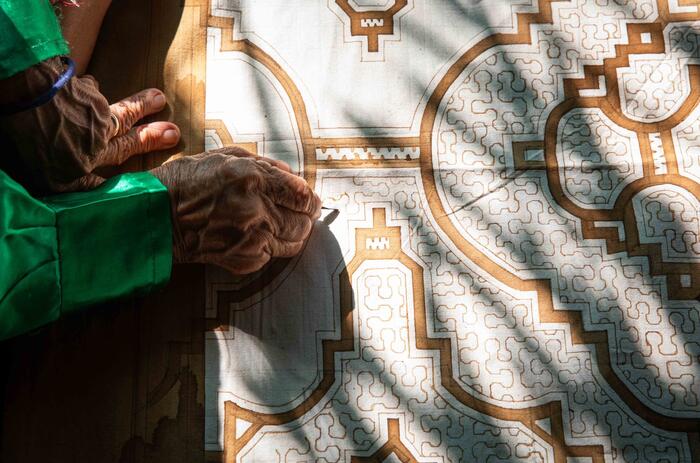
The Museo de Arte de Lima (MALI), in collaboration with the Shipibo Conibo Center in New York and with the support of proyectoamil in Lima and White Cube gallery in London, presented the exhibition Sara Flores. Non Nete, the first solo show of the renowned Shipibo-Konibo artist in a Peruvian museum.
WICHÍ TEXTILE ART IN NEW YORK
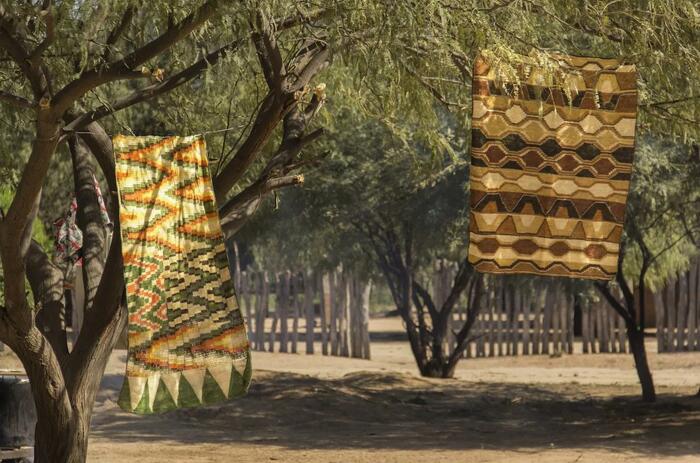
James Cohan presents the first New York solo exhibition of Claudia Alarcón & Silät, a collective of artists from the Wichí communities of northern Salta, Argentina; the show features new textile works exploring celestial themes.

REMEMORY 2026: SYDNEY BIENNALE UNVEILS ARTISTS AND WORKS ILLUMINATING SUPPRESSED HISTORIES
The 25th edition, curated by Hoor Al Qasimi, announced new projects which will explore memory and history through works from around the world.