
By
Verlichak, Victoria
FOUNDATION: Arte x Arte, the Long Spear
“I think art chooses you and art leaves you,” Luz Castillo confided to Arte al Día. Since 1995, Castillo has been the director of Arte x Arte, the Buenos Aires gallery specializing in photography, video and digital art. The venue, which she inaugurated with an exhibition of revolutionary portraits by Anatole Saderman (1904-1922), gained notoriety on account of the fact that it was the first commercial space devoted exclusively to photography and video. Simultaneously, Arte x Arte was also a radio program dedicated to the visual arts that was broadcasted between 1995 and 2000; it was mentioned in the book titled Interviews, which includes the opinions of around 70 leading participants in the art circuit.
December 03, 2009
“The famous Sephardic poet León Felipe declared that it is possible to choose between the Quixote’s long spear and a long fishing rod. As fishing bores me, I embarked, together with Alfonso, on this quixotic adventure,” Luz Castillo commented on the occasion of the opening of Arte x Arte in 2002. Indeed, the gallery betted exclusively on photography and other disciplines such as video and digital art, in a market which was then almost non-existent for these disciplines, and during a problematic national conjuncture (scarcely nine months after the country’s currency had lost its value, with half of the population below poverty line, and an institutional breakdown that swept away four presidents in less than a month).
Arte x Arte’s current venue was inaugurated with the splendid material contributed by Luis González Palma, Marcos López, Carlos Trilnick and Alfonso Castillo; a renowned photographer, the Guatemalan artist works with abstraction and he is a member of the Alfonso and Luz Castillo Foundation, which supports the gallery’s activities.
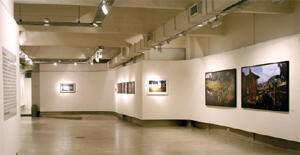
The fantastic space covering 1800 square meters, which used to be a dessert manufacturing plant, was recycled in such a way that it was transformed into five exhibition halls with no sharp edges, taking into account the rules of Feng Shui – earth, fire, air, metal, wood – and creating energetic spaces. State-of-the-art technology and noble materials were used to fit out the reading and video-consultation room, the bar and the kitchen, the two labs and the archive, the lecture room and the digital art studio, the photographic studio and the different amenities. Clearly influenced by Eastern philosophy, the director included a small Japanese garden.
The gallery was a pioneer not only in terms of the discipline it chose to represent (its example was later followed by Ernesto Catena, VVV Gallery), but also of the neighborhood where it was located. The pioneering presence in Palermo of the much admired Borges contributed to the expansion of an area in the north of the city, closely linked to art and design. Lavalleja Street, where the gallery is situated, is one of the various sectors into which Palermo is informally divided: Old Palermo, Palermo Soho, Palermo Hollywood, and Palermo Chico.
Current Codes
Arte x Arte also implies an opening-up to the art of the continent, as illustrated by “No sabe / No contesta. Prácticas fotográficas latinoamericanas” (”Does not know/ Does not answer. Latin American Photographic Practices), 2008, an exhibition/book featuring multiple and enigmatic points of view, not alluding to creative photography or photographic report, but to photography that may be found across the visual arts, is used by artists, and partakes of the generalized evolution of the different practices. It included the participation of Narda Alvarado (Bolivia), Martín Sastre (Uruguay), José Luis Bravo (Mexico), Gilda Mantilla and Diego Lama (Peru – winner of the Petrobras-BA Photo 2007 Contest), Francisca García and Carlos Montes de Oca (Chile), Gabriela Zuccolillo (Paraguay), José Alejandro Restrepo (Colombia), and María Teresa Ponce (Ecuador), among others.
Eduardo Médici’s curatorial practices contribute to fulfill Luz Castillo’s goal to make this space “a place where photographers may gather together and show their work with no other requisite than its quality.” Thus, Arte x Arte gathers together local and international critics and curators who deliver art history and photography courses, carry out examination and analysis of artworks, and organize seminars. The gallery participates in national and international art fairs and promotes a biennial competition open to Argentine photographers.
Between July and September, the gallery featured works by Paula Toto Blake and Daniel Kiblisky, and videos by Matilde Marín and Marisa Rueda, among other artists. Then, from October through December, art, science and new technologies were present at “Intersections”, displayed in the three levels of the gallery space, curated by Jorge Zuzulich and structured around three thematic axes: nature, technology and subjectivity. “Interactivity, real time, robotics, digital art, bio-art, are some of the terms that represent this confluence, characterizing some of the discursive possibilities of the new media,” the guest curator pointed out.
The show “will explore the relationship that is established between technology and nature (…) producing a particular shift in the way in which the latter is habitually understood… Likewise, the second nucleus will foster reflection on the way in which technologies operate on the construction of subjectivity. (…) The last axis will be focused on the constitution of a purely technological space as a logic to question the subject,” Zuzulich, art critic and professor at Tres de Febrero National University explains.
Video, video installations, interactive installations, digital photography will be featured by Marina Zerbarini, Silvia Rivas, Andrea Juan, María Antolini, Luis Campos, Martín Calcagno, Joaquín Fargas, Lisa Giménez, and Mookie Tenembaum, among others. The exhibition is accompanied by a book published by Arte x Arte, and presented at Buenos Aires Photo 2009 (October 28 through November 1, Palais de Glace).
Médici, who has been the artistic director of the gallery for four years, is enthusiastic about the digital project. He hopes that the viewer will be able to discern in Arte x Arte’s exhibitions “a decoy attracting the gaze…, a small difference amidst the repetition of images into which the current art system has been transformed.”
-
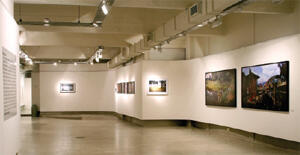 General view / Vista general. Exhibition / Exposición: No sabe, no contesta.
 -
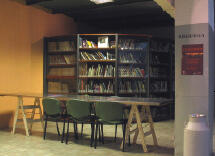 View of the Library / Vista de la Biblioteca
 -
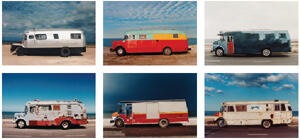 Raul La Cava. Colectivos(1998-2006). Analogic color photography 11. 11 x 17 in. Fotografía analógica a color. 28.5 x 43 cm.
 -
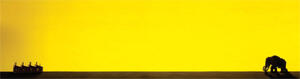 Juan Pablo Cheret. From the series / De la serie: Intruders. Untitled / Sin Titulo,2008. Photo shot with digital intervention 12.48 x 47 in. Toma directa con intervención digital. 32 x 120 cm.
 -
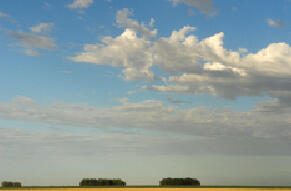 Daniel Kiblisky. Campo bicolor,2009. Photo on paper 19.5 x 29.25 in. Foto sobre papel. 50 x 75 cm
 -
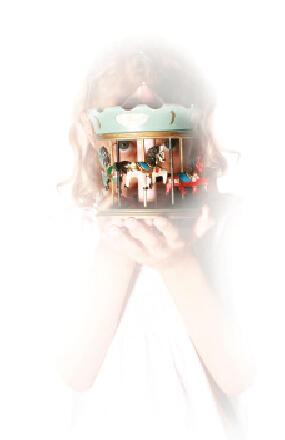 Cristina Fresca. From the series / De la serie: Ellas.Digital Photography 39 x 26 in. Fotografía digital. 100 x 66 cm.