
ESTEBAN VICENTE IN NEW YORK: THE PAINTER OF REALITY
Eighteen works from 1940 to 1996 arrive at the Instituto Cervantes following their run in Rome, Warsaw, and Paris.
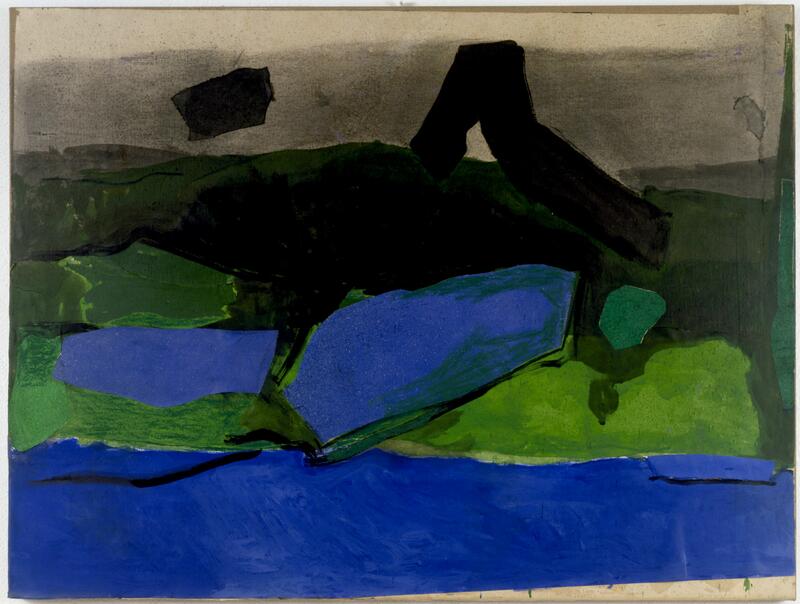
The Instituto Cervantes in New York presents, this October 2, the exhibition Esteban Vicente. The Painter of Reality, dedicated to the Spanish artist Esteban Vicente (Turégano, Segovia, 1903 – Long Island, New York, 2001). Curated by Eren Johnson and Ana Doldán, the exhibition comes to New York following its run in Rome, Warsaw, and Paris, and brings together eighteen works made between 1940 and 1996, on loan from The Harriet and Esteban Vicente Foundation, co-organizer of the exhibition alongside the Instituto Cervantes and the Museo de Arte Contemporáneo Esteban Vicente in Segovia.
In 1936, at the outset of the Spanish Civil War, Vicente relocated to the United States, where he would live for the rest of his life. Over more than six decades, he was part of the American Abstract Expressionist movement, in contact with its leading figures, critics, and gallerists, building on his earlier training in European capitals such as Paris and London.
The title of the exhibition draws on statements by the artist recorded by critic Irving Sandler in 1968, in which Vicente linked Spanish culture, and his own work, to a deep sense of reality, in the tradition of Cervantes and Zurbarán, as opposed to fancifulness.
-
Esteban Vicente. Untitled, 1963. De la colección de la Harriet and Esteban Vicente Foundation.
The selection is organized around the core ideas of Vicente's artistic thinking: the rejection of artifice in favor of painting as a sensorial experience; the need for order; austerity of materials, linked to Spanish artists such as Zurbarán and Juan Gris; intimacy and isolation; and the primacy of pictorial emotion.
The exhibition opens with works from the 1940s, such as Untitled (1940–1949), which present interiors and still lifes broken down into geometric planes, with a clear influence from Juan Gris. The works made during his stay in Puerto Rico (1944–1947) solidified his shift toward abstraction.
The show highlights the presence of collage, a technique the artist used in his search for the essence of painting, layering paper to generate transparency and depth. His early works associated with Abstract Expressionism draw on a gestural style close to de Kooning, with a more lyrical tone.
From the late 1960s, Vicente began an exploration of color fields, with near-architectural compositions and diffuse edges, such as Alison Series: Landscape Yellow (1976), in which he replaced the brush with the airbrush to heighten color saturation.
-
Esteban Vicente. Alison Series: LandscapeYellow, 1976. De la colección de la Harriet and Esteban Vicente Foundation
The exhibition links Vicente's use of color to his sensorial surroundings, from the landscapes of his native Segovia to his garden in Bridgehampton, present in series such as Harriet, dedicated to his wife.
The 1980s marked a return to nature as a source of inspiration, with organic forms and a broader palette, as in Untitled (1984). In the 1990s, the artist combined airbrush, stencils, and brushstrokes, in works such as Composición (1994).
The show also includes drawings and a series of everyday containers (jars and cans) transformed with paper, paint, ink, and charcoal between 1968 and 1997, conceived by Vicente as three-dimensional collages and exhibited alongside his "toys" at the Glenn Horowitz Bookseller Gallery in East Hampton.
Esteban Vicente. The Painter of Reality is on view from October 2, 2026, to January 9, 2027, at Instituto Cervantes New York, 211 E 49 St, New York, United States.
Related Topics
May interest you
TERESA MARGOLLES PRESENTS HER FIRST MAJOR SOLO EXHIBITION IN THE UNITED STATES
The exhibition spans three decades of works addressing disappearances, femicides, and forced displacement, with a focus on the border between Mexico and the United States.